














































































































































































































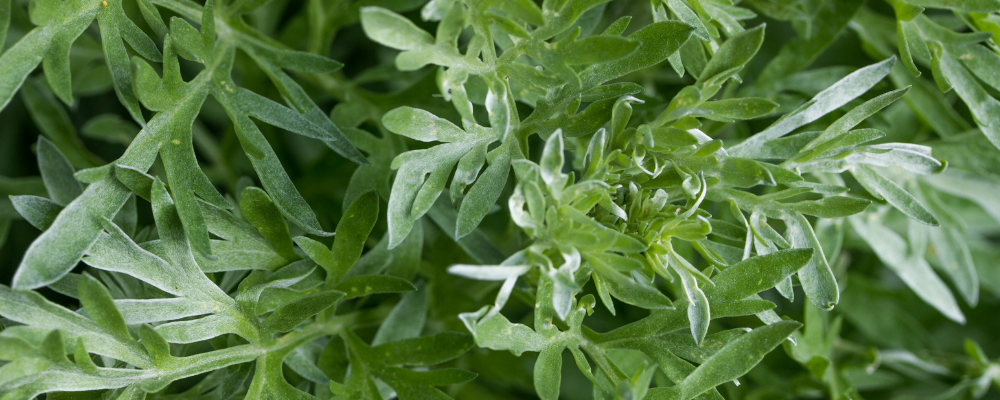
Beneath its silvery-gray foliage, Wormwood carries a magical history far more singular than modern lists of psychic virtues suggest. Artemisia absinthium appears in a Jewish treatise on magic composed during Late Antiquity, is assigned to Mars in English astrological botany, and enters a South Slavic practice intended to defend crops against storm witches.
These accounts portray a harsh plant placed in contact with hostile forces that the practitioner seeks to pass through, contain, or repel. In the Key of Moses, it helps one pass unseen and supports the fulfillment of a petition. For Nicholas Culpeper, it belongs to Mars because of its affinity with forges and places where iron is worked. In the account collected by James George Frazer, its smoke rises toward the hail clouds to reach the witches said to move within them.
Its historical magical identity is shaped by four forces: concealment, petition, defense, and Martian power. Together, they give Wormwood a firm, combative, and secretive character.
A bitter herb with silver foliage
Wormwood, Artemisia absinthium L., is a perennial plant in the Asteraceae family. Its stems and leaves are covered with fine hairs that give them an almost white-gray color. Its small yellow flower heads appear in summer, while its aromatic scent and pronounced bitterness define its sensory profile.
Its native range extends from Europe to Siberia, the western Himalayas, and North Africa. Kew’s botanical database recognizes Artemisia absinthium as an accepted species and records its native presence in France. The plant has also spread to many temperate regions beyond this original range. Kew, Plants of the World Online.
In herbals and magical texts, it appears under the names absinthium and wormwood. These words passed from one language and manuscript to another, with a botanical meaning that may have evolved. Common mugwort, Artemisia vulgaris, belongs to the same genus but has a distinct ritual history. This proximity explains how the two plants may have been confused in some translations.

Wormwood in the Sword of Moses
The most remarkable magical testimony is found in the Sword of Moses, or Harba de-Moshe. The scholar Yuval Harari probably places the composition of this extensive treatise on Jewish magic in Palestine, during the third quarter of the first millennium. The text is known from later manuscripts; in 1896, Moses Gaster published an edition and an English translation based on a manuscript he dated to the 13th or 14th centuries. Yuval Harari, Harba de-Moshe (Sword of Moses).
The “Sword” in the title refers to a long sequence of divine and angelic names, transmitted to Moses and placed at the center of the book’s operative power. Before using it, the operator must undergo a ritual preparation, recite prayers, and call upon the celestial powers associated with these names. The operations that follow invoke the Sword as a sovereign formula capable of acting upon illness, protection, favor, revelation, constraint, or victory.
Wormwood appears twice in a short recension included in an appendix to Gaster’s edition. The first passage concerns the art of walking in the street without being recognized. The text calls for wormwood, perfumes, and soot to be gathered in order to produce smoke, then adds a fox’s heart and the recitation of the Sword. The stated objective concerns recognition: the operator must be able to move about without the people he encounters identifying him. The passage therefore belongs to a magic of concealment and withdrawal from view.
The pungent odor of wormwood, the blackness of soot, the smoke that blurs contours, and the cunning associated with the fox compose a striking scene of concealment. Each material contributes to the operator’s withdrawal: the smoke clouds the view, the soot obscures, and the fox embodies the art of escaping notice.
The second passage gives wormwood a different role. The operator must take wormwood in his right hand, turn toward the Sun, and recite the Sword in order to obtain what he desires. The act is accompanied by a seven-day purification and moral requirements: performing good deeds toward his loved ones, refraining from swearing, and walking modestly.
The plant here becomes the material support for a request formulated under the authority of the sacred names. It is held in the acting hand while the operator faces the sunlight. The Sun fixes the orientation of the rite; Mars gives the plant its astrological rulership in Culpeper.
The two faces of Wormwood. In The Sword of Moses, the plant allows one to disappear from the attention of others and to carry a will before the powers invoked by the operator. It acts at the boundary between sight and desire: withdrawing from view, then directing one’s request. The Sword of Moses, translated by Moses Gaster, operations 13 and 16.
Why does Culpeper place Wormwood under Mars?
In the mid-17th century, the English physician and astrologer Nicholas Culpeper attributed Wormwood to Mars in his English Physician, later incorporated into his Complete Herbal. His choice was based on the places where the herb liked to grow.
Culpeper states that Wormwood thrives in martial places. He indicates that entire loads could be gathered around forges and workshops where iron was worked. Since iron belonged to Mars in astrological thought, the herb that flourished near forges received the same rulership. He also describes it as hot and dry in the first degree, in accordance with the qualities attributed to the planet.
The plant is thus linked to Mars through territory, metal, and the heat of human labor. For Culpeper, plants act through sympathy or antipathy with the planets responsible for bodily afflictions. Wormwood therefore receives the martial vigor of iron, forges, and places devoted to fire. Nicholas Culpeper, The Complete Herbal, “Wormwood”.
Mars therefore governs Wormwood through a very concrete chain of associations: iron, heat, struggle, and the ability to stand firm against obstacles. This kinship sheds light on its magical use in workings of defense, steadfastness, and will.
A smoke directed against the witches of the storm
Another use appears in The Golden Bough by James George Frazer. The author reports a practice from southern Slavonia associated with hailstorms. Witches were imagined riding the dark clouds threatening the crops. To reach them, the peasant brought a vessel filled with glowing coals and threw holy oil, bay leaves, and Wormwood into it.
The smoke was supposed to rise to the clouds, daze the witches, and cause them to fall. The act combined a substance consecrated in Christianity with two aromatic plants, as part of an action aimed at safeguarding the fields. Frazer also describes weapons and tools placed on the ground to injure the witches during their imagined fall. James George Frazer, The Golden Bough.
In this custom from southern Slavonia, Wormwood becomes a herb of rural defense. It takes its place between the fire of the bonfire, the Christian protection carried by holy oil, and the struggle against an invisible adversary. Its smoke acts as a plant-based weapon directed at the threat hanging over the crops.
Concealment, requests, and defense: how can you work with Wormwood?
Three magical faces answer one another. In the Key of Moses, Wormwood accompanies concealment and the fulfillment of a request. In southern Slavonia, it defends crops against weather witchcraft. In Culpeper, it is governed by Mars, the planet of iron, struggle, and action exerted against an obstacle.
Wormwood thus appears as a plant of resistance and will. Its character suits workings of firmness, active protection, discretion, and resolve. It accompanies those who wish to hold their position, preserve their intention, or act without attracting attention.
Wormwood’s visionary reputation belongs chiefly to the 19th century, when the green drink conquered cafés, artists’ studios, and the bohemian imagination. The magical plant of grimoires carries a different history, centered on will, secrecy, and defense.
The workings of the Key of Moses belong to a complete religious and magical system. Their power rests on the operator’s preparation, prayers, and a long series of sacred names. Wormwood acts within a framework in which word, gesture, and plant matter respond to one another.
In current practice, the dried plant may be placed without burning in a dish reserved for ritual work. Its correspondence with Mars allows it to be incorporated into an approach centered on firmness, defense, or resistance in the face of an obstacle. Tuesday or a Mars hour reinforces this planetary orientation.
For work involving discretion, Wormwood can remain present in the ritual space as a sign of withdrawal and control over what is seen. For a request, it can accompany a written petition placed on the altar. In defensive work, it marks the will to resist a hostile influence and preserve what must be protected.
The gesture remains restrained: a small amount of plant, a clearly stated intention, and a defined place on the altar. Wormwood then becomes the plant witness of a martial will capable of acting firmly, preserving its discretion, and resisting whatever threatens the intended goal.
Historical correspondences
| Reference | Correspondence |
|---|---|
| Botanical name | Artemisia absinthium L. |
| Planet | Mars, according to Nicholas Culpeper |
| Day | Tuesday, by extension of the martial correspondence |
| Magical text | Moses’ Sword |
| Historical contexts | Late antique Jewish magic; 17th-century English medical astrology; South Slavic rural practice |
| Magical domains | Concealment, fulfillment of a request, protection of crops |
| Current practice | Symbolic presence without burning in work involving discretion, firmness, or active protection |










