















































































































































































































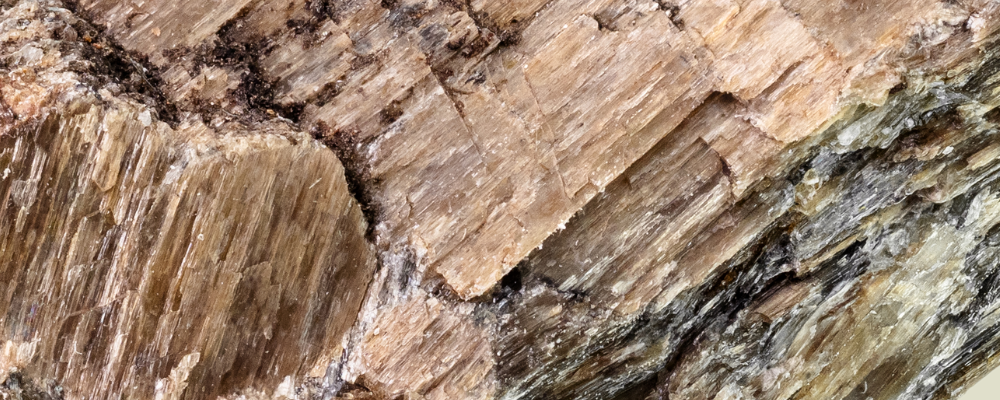
Enstatite is a stone of steadfastness. Brown, green, or bronze, it does not shine like an easy promise: its contained luster evokes the strength that remains standing, resists pressure, and chooses its exertion.
Its name, given in the 19th century, refers to the idea of resistance. No ancient tradition attributes a specific magic to it under this designation. Its modern correspondences can therefore be presented clearly: Saturn for endurance, Mars for courage, Earth for grounding, and Fire for controlled action.
To place this stone among related minerals, compare it with Diopside, Fassaïte, and Babingtonite.
A magnesium pyroxene
Enstatite is a magnesium silicate, MgSiO3, belonging to the orthopyroxenes. It forms a series with the iron-rich endmember called Ferrosilite. It occurs in igneous and metamorphic rocks, as well as in some meteorites.
The Handbook of Mineralogy indicates a hardness of 5 to 6, a vitreous to pearly luster, and characteristic cleavage. These properties make it a solid material that nevertheless remains sensitive to directed impacts.
From brown to bronze green
Pure Enstatite can be clear; iron gives it brown, greenish, or bronze tones. Some cut stones display an iridescent reflection or a soft metallic luster, particularly expressive under moving light.
The Mindat entry presents its forms and localities. Its variety of appearance does not alter the symbolic thread chosen here: a light held within a dense material.
The name of resistance
Gustav Rose named Enstatite in 1855 from the Greek enstates, “adversary” or “one who resists,” referring to its resistance to melting in a blowpipe flame. The Encyclopaedia Britannica places it in the orthorhombic pyroxene family.
This historical origin provides a strong but precise image: resistance is not invulnerability. It refers to the ability not to yield immediately under the action of fire.
Enstatite receives a modern symbolism based on its name and material. It guarantees no automatic supernatural protection; it serves as a witness to a decision to stand firm, refuse, or continue with restraint.
Saturn, Mars, Earth, and Fire
Saturn provides duration, discipline, and structure. Mars brings momentum, defense, and the courage to say no. Earth supports the body and continuity; Fire puts the will to the test.
Saturday suits long-term commitments, and Tuesday suits acts of courage. An iron nail, a dark red candle, and a flat stone can surround the Enstatite.
Endurance, courage, and refusal
Enstatite accompanies periods when a rule must be preserved, an effort completed, or pressure escaped. It suits boundary work, not as general closure, but as a conscious choice of what will no longer be sacrificed.
It can remain near a training schedule, a contract, or a long-term task. Its bronze sheen recalls that enduring strength does not need to show itself at every moment.
The Rite of the Non-Negotiable Point
Write down a situation in which you lose your position. Beneath the text, formulate a single boundary you can genuinely uphold. Place the Enstatite on the last word of this sentence.
Say: “I do not confuse hardness with strength. I hold this point and act with restraint.” Then note the first action, the deadline, and the exact phrase you will use.
Correspondences and references
| Reference | Correspondence |
|---|---|
| Nature | Magnesian orthopyroxene |
| Celestial bodies | Saturn and Mars |
| Elements | Earth and Fire |
| Days | Saturday and Tuesday |
| Ritual colors | Brown, bronze, dark red |
| Areas | Endurance, boundaries, courage, continuity |
| Associated objects | Nail, calendar, flat stone |
| Gesture | Formulating an applicable boundary |










