























































































































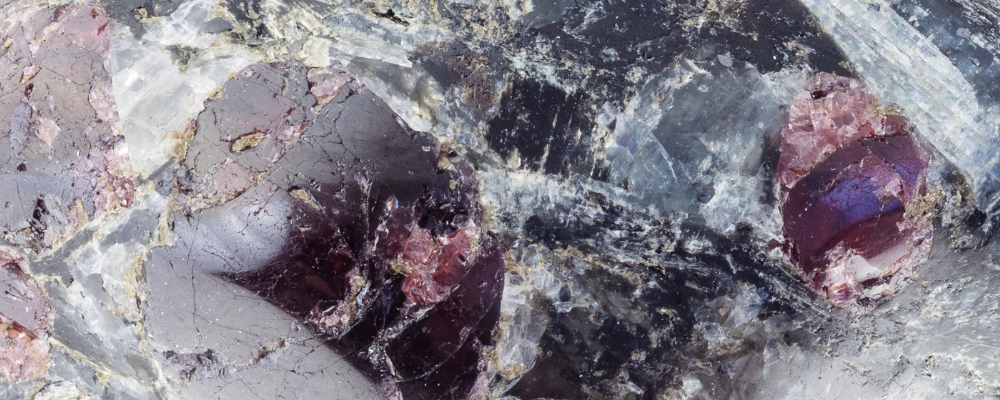
Almandine holds in its deep red an ember that does not disperse. In backlighting, some stones reveal a wine hue beneath an almost black surface; others display a clear, dense, and stable red.
This variety of Garnet carries an ancient history of seals, intaglios, and ornaments. It unites the strength of Fire with the steadfastness of Earth: not an explosion, but the will capable of remaining present until the end.
To place this stone among related minerals, compare it with Garnet, Green Garnet, and Rhodolite.
The Iron Garnet
Almandine is an iron- and aluminum-rich Garnet, with the formula Fe3Al2(SiO4)3. Its color ranges from brownish red to purplish red. It may be transparent, translucent, or nearly opaque, depending on its composition and inclusions.
The Mindat entry presents its mineralogical characteristics. The Gemological Institute of America places it among the principal species of the Garnet group.
From Alabanda to the name Almandine
Georgius Agricola used the name in 1546, referring to Alabanda, a city in Asia Minor renowned in antiquity for gem cutting. Pliny had already mentioned red stones from Alabanda among the “carbuncles,” an ancient category broader than modern Almandine.
The text by Pliny the Elder connects these stones with a fire visible within the material. However, one should avoid converting every ancient “carbunculus” into Almandine: rubies, spinels, and Garnets could be grouped under similar names.
Seals, intaglios, and guarded fire
Red Garnets have been used since antiquity for adornment and engraving. The Metropolitan Museum of Art houses a Roman Almandine intaglio dated between the 1st century BCE and the 3rd century.
The seal offers the finest ritual key. It asserts an identity, closes a message, and makes a decision recognizable. Paired with Almandine’s deep red, it transforms the stone into a witness to one's word, lasting courage, and the protection of a commitment.
Mars, Saturn, Fire, and Earth
Mars brings courage, the desire to act, and defense. Saturn gives duration, structure, and fidelity to the commitment. Fire animates the red; Earth contains this ardor and gives it direction.
Tuesday suits courageous decisions, while Saturday suits long-term pacts. Red wax, a seal, a clean iron nail, or a burgundy candle may surround the stone.
Keeping your word and protecting the commitment
Almandine supports promises, defending a position, endurance work, and restoring weakened resolve. It is less supportive of an enthusiastic start than of the ability to continue when the effort becomes steady.
Placed on a contract or near a calendar, it recalls the accepted conditions. In a protection practice, it can represent the right to say no, keep your territory, and respond without losing your composure.
The red seal ritual
On a Tuesday, write a commitment in one measurable sentence. Place the Almandine beneath it, then mark the sheet with a dot of red wax or draw your personal seal.
Say: “My word bears my mark, and my action gives it strength.” Date the commitment and set its first deadline. Keep the stone near the document until the deadline.
Correspondences and references
| Reference | Correspondence |
|---|---|
| Nature | Iron and aluminum garnet |
| Name | Linked to Alabanda, an ancient cutting center |
| Celestial bodies | Mars and Saturn |
| Elements | Fire and Earth |
| Days | Tuesday and Saturday |
| Ritual colors | Dark red, burgundy, black |
| Areas | Courage, commitment, protection, endurance |
| Ritual act | Sealing and dating a measurable promise |