















































































































































































































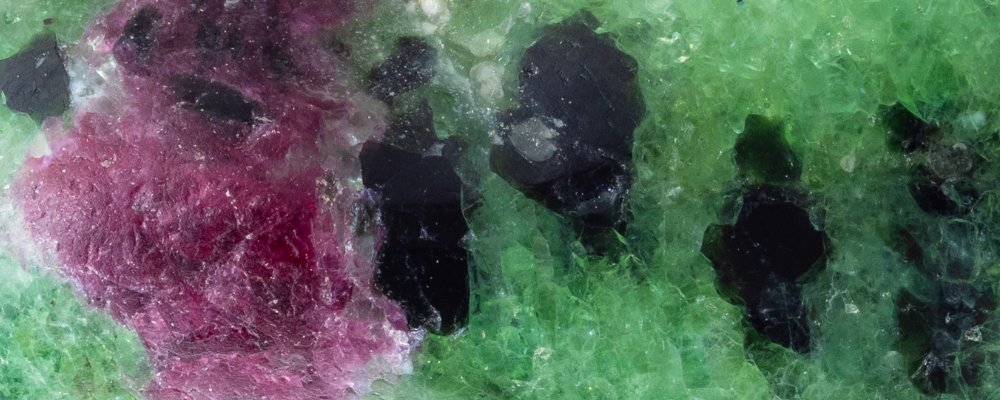
Anyolite brings together the green of Zoisite, the red of Ruby, and very dark touches of amphibole in a single rock. The colors do not blend: they remain distinct while forming a single material.
This combination gives it an immediately recognizable signature. Green promotes growth, red sets things in motion, and black defines boundaries. In contemporary magical work, Anyolite supports the coordination of forces that seemed to contradict one another.
To place this stone among related minerals, compare it with Garnet, Green Garnet, and Rhodolite.
Red Ruby in Green Zoisite
Anyolite is not an isolated mineral species. It is a metamorphic rock composed of chrome-rich green Zoisite, Ruby crystals, and very dark green to black amphiboles, including Pargasite.
The Mindat entry describes this assemblage. The contrast between red Corundum and the green matrix makes each piece recognizable, even when the Ruby remains opaque or irregular.
The Longido Rock
Anyolite is associated with the Longido district, in Tanzania’s Arusha region. The Gemological Institute of America presents Longido Ruby Zoisite as a remarkable material for cutting and carving.
Another study by Gems & Gemology describes Anyolite as a rock made of green Zoisite and dark amphibole, in which Rubies from this region occur.
A Recent Lapidary Identity
The spread of Anyolite belongs to the 20th-century mineral trade. Nothing links the rock to an ancient magical system bearing this name, nor supports attributing the modern correspondences circulating today to the people of Longido.
The visible composition is enough to build a ritual language. Ruby represents impulse, green Zoisite growth, and dark amphibole limitation. Their coexistence does not eliminate any force: it teaches them to work together on the same project.
Mars, Venus, Fire, and Earth
Mars corresponds to Ruby, courage, and taking action. Venus resonates with green, harmony, and fertility. Fire sets things in motion; Earth gives desire a form capable of growth.
Tuesday is suited to decisions, and Friday to relationship or creative projects. A red ribbon, a green ribbon, and a black line can accompany the stone.
Aligning desire, growth, and boundaries
Anyolite supports projects that desire alone is not enough to build. It invites you to align three questions: what do I want, what can grow, and what boundary protects that growth?
It is suited to partnerships, restarting activities, and transformations that require both boldness and structure. Placed on a work surface, it reminds you that energy must join with structure to become fruitful.
The Three-Color Rite
On a Tuesday or Friday, draw three overlapping circles: red for desire, green for resources, and black for the boundary. Write a sentence in each area, then place the Anyolite where they meet.
Say: “My desire finds its ground, and my boundary protects its growth.” Choose an action that respects all three statements. If it contradicts one of them, rephrase it before acting.
Correspondences and references
| Reference | Correspondence |
|---|---|
| Nature | Rock of green Zoisite, Ruby, and dark amphibole |
| Famous origin | Longido, Arusha Region, Tanzania |
| Celestial bodies | Mars and Venus |
| Elements | Fire and Earth |
| Days | Tuesday and Friday |
| Ritual colors | Red, green, black |
| Areas | Desire, growth, partnership, boundary |
| Ritual act | Aligning three colored circles |










