














































































































































































































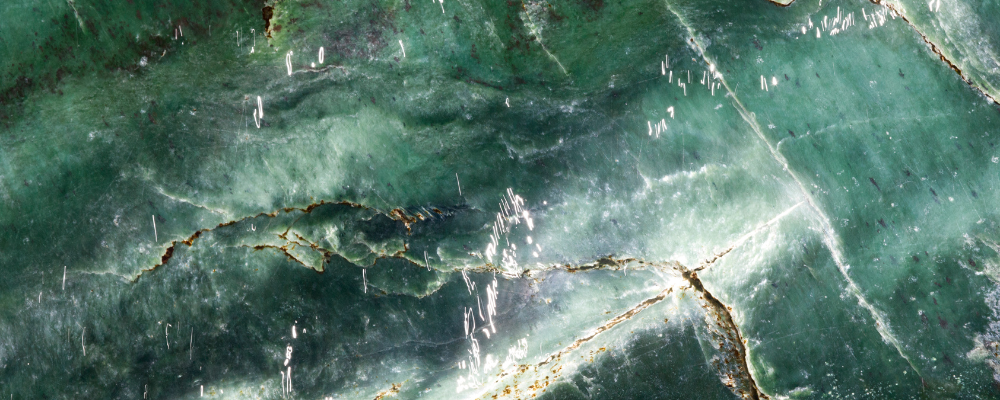
The name Jade primarily refers to two stones, Nephrite and Jadeite, but also to a shared imagery of endurance, dignity, and protection. In China, this material has accompanied rites, status, offerings, and the dead since the Neolithic period. In modern magic, it becomes a stone of wisdom, friendship, prosperity, and measured decision-making.
Jade does not speak of wealth acquired in haste. Its toughness, the time required to shape it, and the virtues that Chinese scholars projected onto it together form an ethic: endure, discern, and use resources wisely.
To place this stone among related minerals, compare it with Nephrite, Serpentine, and Anyolite.
Nephrite and Jadeite
The word Jade traditionally encompasses two mineral species. Nephrite belongs to the amphibole group, while Jadeite belongs to the pyroxene group. Their compositions differ, but their texture, formed from closely interlocked grains or fibers, gives them great toughness. They therefore withstand impacts better than a harder but brittle stone.
The Gemological Institute of America presents these two families and also recognizes green omphacite under certain gemological conditions. Green remains the most widely recognized hue, but it is not the only one: white, lavender, yellow, brown, gray, and black also belong to the language of Jade.
Ritual Jade in Ancient China
In China, Nephrite was worked long before the large-scale arrival of Jadeite from Burma. As early as the Neolithic period, cultures such as Hongshan and Liangzhu produced bi disks, cong tubes, blades, and ornaments associated with status and ceremonies.
The Metropolitan Museum of Art’s chronology of China between 8000 and 2000 BCE places these objects within the cultures that produced them. Their exact function varies from site to site; nevertheless, they attest to a ceremonial role that goes beyond adornment.
In burials, Jade could accompany the deceased and express their status. Later, texts associated it with moral qualities. This association does not mean that every piece of Jade was an amulet: its form, context, and recipient determined its use.
Virtue, harmony, and protection
In The Magic and Science of Jewels and Stones, Isidore Kozminsky revisits sources from the early 20th century that connect Chinese Jade with charity, kindness, knowledge, integrity, and harmony. He also makes it an emblem of love, beauty, and protection.
This interpretation belongs to a Western occult author and should be understood as such. However, it aligns with a broader cultural fact: in China, Jade has been used to conceptualize virtue through material qualities—luster, smoothness to the touch, resilience, and sonority.
Tenacity as a virtue. Jade is not the hardest stone, but its structure makes it difficult to break. In ritual, this property becomes an image of constancy: a flexible strength, capable of enduring without becoming rigid.
Venus, Water, and the color green
In his 1988 encyclopedia, Scott Cunningham places Jade under Venus and Water. He connects it with love, wisdom, protection, and prosperity. Green adds an association with growth, the garden, and resources.
These modern correspondences do not replace Chinese practices. They form another layer of interpretation. Friday is suitable for friendship and agreement; a Venus hour may be chosen for an offering or an exchange.
Wisdom, friendship, and prosperity
Jade supports decisions in which money and ethics must remain connected. Hold it while examining a proposal, then ask what each person receives, what each person risks, and whether the agreement can last. Prosperity is not merely accumulation: it is the ability to circulate resources without breaking trust.
Given between friends, Jade can become a witness to loyalty. Together, name what you wish to protect in the relationship, then leave each person free to accept or decline the gesture. The stone binds no one; it preserves the memory of a freely chosen commitment.
For wisdom, place it near a book or file. After reading, summarize what you have learned and how you will apply it. Knowledge becomes wisdom when it guides a just action.
The Rite of Prosperous Decision-Making
On a Friday, place the Jade on a square of green fabric with a coin and the proposal to be considered. Light a green candle. Write three columns: benefit, cost, consequence. Fill them in without omitting time, the health of relationships, and future obligations.
Take the stone and say: “May what grows remain just, and may what endures harm no one.” Decide only when every cost has been addressed. Then keep the Jade with the contract or the project's first revenue.
Correspondences and references
| Reference | Correspondence |
|---|---|
| Nature | Nephrite or Jadeite; some green Omphacites according to gemological criteria |
| Material quality | Great durability |
| Planet | Venus according to Scott Cunningham |
| Element | Water; Earth is also possible for green Jade |
| Day | Friday for harmony and friendship |
| Areas | Wisdom, protection, friendship, justice, and prosperity |
| Ritual image | The enduring strength of flexibility |
| Ritual action | Weigh the benefit, cost, and consequence before acting |










