






















































































































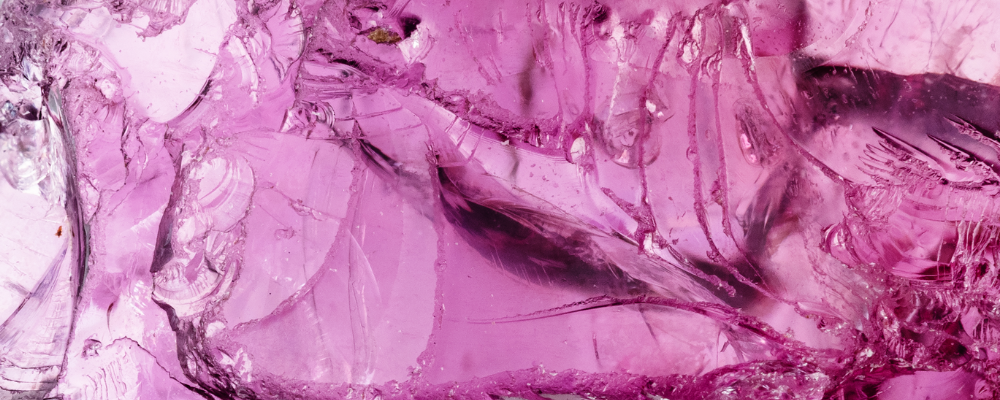
Rhodolite is a Garnet with the color of dark rose, raspberry, or red wine. Born from the meeting of Pyrope and Almandine, it unites the ardor of red with a more restrained violet nuance. Its magic accompanies faithful love, renewed trust, emotional courage, and commitments that must remain alive without becoming suffocating.
Its name appeared at the end of the 19th century, but it belongs to a family of stones surrounded by an ancient talismanic language. Garnet has carried images of constancy, friendship, protection, and guarded fire. Rhodolite receives this heritage in a gentler form, oriented toward reconciling desire and stability.
To place this stone among related minerals, compare it with Garnet, Green Garnet, and Almandine.
The rose-colored Garnet
Rhodolite belongs to the Garnet group and lies between Pyrope and Almandine. The Gemological Institute of America describes this family, whose members share the same structure while exchanging several elements in their composition.
Its pink to purplish-red color distinguishes it from dark brown Garnets. The stone thus brings together two images: the fire that sustains desire and the rose that regulates its expression.
From Cowee Valley to Rhodolite
The name Rhodolite was published in 1898 based on Garnets discovered in Cowee Valley, North Carolina. It derives from the Greek rhodon, meaning rose. The North Carolina Geological Survey preserves the history of this naming, linked to the work of William Earl Hidden and Joseph Hyde Pratt.
This relatively recent origin does not sever Rhodolite from the history of Garnet. It gives it a precise character: a stone of continuity whose color softens its power without diminishing it.
The magical heritage of Garnet
In The Magic and Science of Jewels and Stones, Isidore Kozminsky distinguishes Almandine from Pyrope. He places the former under Sagittarius and the latter under Aquarius. He also attributes to Pyrope the virtues of fidelity, stability, hope, and true friendship.
Rhodolite lies materially between these two Garnets. It can therefore represent a bond that preserves its fire while allowing each person their freedom. This symbolism suits unions, tested friendships, and reconciliations that require a new rule.
Fidelity remains a living act. Rhodolite does not speak of immovable attachment. It unites constancy and desire, promise and freedom, feeling and conduct.
Venus, Mars, Fire, and Earth
Venus governs love, harmony, beauty, and reciprocity. Mars brings red, desire, courage, and action. Their meeting suits a stone whose color oscillates between rose and ember.
Fire sustains momentum; Earth gives it lasting power. Friday is suitable for workings of love, friendship, and reconciliation. Tuesday supports trust, recovery after disappointment, and the words needed to defend a bond without submitting.
Fidelity, trust, and emotional courage
Rhodolite supports romantic commitments, the return of trust, and relationships seeking a balance between closeness and autonomy. Place it near a letter, a promise, or a shared object when the work concerns an already chosen bond.
After a breakup or disappointment, it helps reclaim the part of one’s desire abandoned in the past relationship. Write down what should remain as a lesson and what should no longer govern what follows. Place the stone on the second sentence.
In personal work, it supports the courage to love without concealing one’s boundaries. Its color reminds us that gentleness does not require self-effacement and that strength does not demand hardness.
The Rite of the Chosen Bond
On a Friday, place the Rhodolite between two candles, one pink and the other red. On a sheet of paper, write the name of the bond you wish to strengthen, then three actions that nurture its lasting power: a word, a boundary, and a commitment.
Tie a pink or burgundy ribbon around the stone without tightening it. Say: “May the bond keep its fire, may the promise keep its freedom, may my actions give substance to my words.” Keep the stone with the sheet for one lunar cycle and carry out the three actions.
Correspondences and references
| Reference | Correspondence |
|---|---|
| Nature | Pink-red to purplish garnet in the Pyrope-Almandine range |
| Planets | Venus and Mars in current correspondences |
| Inherited signs | Sagittarius for Almandine and Aquarius for Pyrope according to Kozminsky |
| Elements | Fire and Earth |
| Days | Friday for the bond; Tuesday for courage |
| Areas | Faithful love, friendship, trust, desire, reconciliation, and commitment |
| Associated objects | Pink or burgundy ribbon, letter, two candles, and a shared object |
| Gesture | Give the bond words, a boundary, and a commitment |