


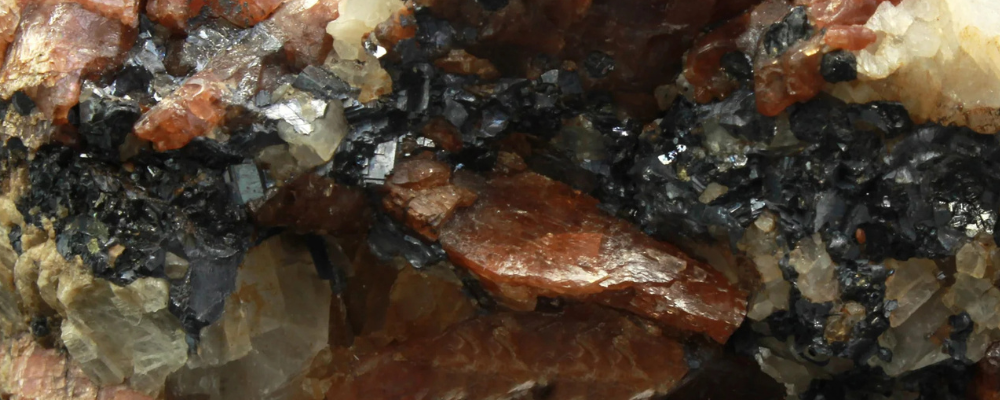
Bustamite unites the pink of attachment with the brownish red of will. Born in rocks transformed by heat, pressure and the circulation of fluids, it carries a language of regulated intensity: showing one’s desire, defending one’s place and preserving what would lose its strength under continuous exposure.
Its contemporary symbolism associates Venus with harmony and attraction, Mars with the courage to act, Earth with structure and Fire with metamorphic change. It suits workings in which desire must be given direction, a limit and duration.
To place this stone among related minerals, compare it with Rhodolite, Cobaltocalcite, and Rhodonite.
The pink born of transformation
Bustamite is a manganese and calcium silicate. Its crystals, fibers and compact masses range from pale pink to brownish red, with a vitreous luster. The Handbook of Mineralogy presents its composition, colors and characteristics.
Its pink color may fade after prolonged exposure to light. This property provides a clear rule for talismanic work: all visibility has a measure. What deserves to be declared should not remain endlessly exposed to the gaze of others.
Manganese, metamorphism and skarns
Bustamite forms in manganese-rich sediments transformed by metamorphism and in skarns, where it comes into contact with rocks altered by hot fluids. It may occur alongside Rhodonite, Calcite, Tephroite, Wollastonite, Diopside and Grossular Garnet.
This setting speaks of a transformation that does not destroy the elements involved: it forces them to form a new balance. In the grimoire, Bustamite represents desire that passes through a trial, changes form, and returns with clearer resolve.
Anastasio Bustamante and the mineral name
The stone was named in the 19th century in honor of Anastasio Bustamante, a Mexican military officer and statesman born in 1780. The mineral’s spelling retains “Bustamite,” while the surname is spelled Bustamante.
This name conveys an image of authority and public presence, but the material immediately imposes a limit: prolonged exposure can fade its color. Bustamite’s authority therefore does not rest on constant demonstration. It appears when useful, then returns to reserve.
Venus, Mars, Earth and Fire
Venus corresponds to pink, connection, desire, and the ability to attract without coercion. Mars corresponds to red, affirmation, and the gesture that transforms an intention into action. Their association is a modern reading of the stone's color and formation.
Earth provides the framework, duration, and protection. Fire recalls metamorphism and the force that changes a situation. Friday suits workings of harmony and attraction; Tuesday supports affirmation, decision-making, and defending a boundary.
Desire, courage, and appropriate exposure
Bustamite accompanies a declaration, a public presentation, or an emotional choice that requires courage. It helps determine what should be shown, to whom, for how long, and for what purpose. Its color turns desire into a visible force, while its sensitivity calls for protecting the intimacy that sustains it.
It is also suitable for reputation-related work. Placed near a letter, a dossier, or a creation, it represents the part one agrees to expose. A second sheet keeps private what remains so: sources, limits, conditions, and strategy.
The rite of visible proportion
On a Friday, draw three concentric circles. In the center, write what belongs to your private life; in the middle circle, what you share with chosen people; then in the outer circle, what you make public. Place the Bustamite between the first two circles.
Then write a duration next to each visible element: one day, one week, or until a set date. On the following Tuesday, carry out the public action, then remove whatever has reached its end. The rite combines Venus's attraction with Mars's active sense of proportion.
Correspondences and reference points
| Domain | Correspondence | Reading |
|---|---|---|
| Planets | Venus and Mars | Attraction, harmony, courage, and affirmation. |
| Elements | Earth and Fire | Framework, protection, metamorphism, and action. |
| Days | Friday and Tuesday | Present the desire; take the action and set the limit. |
| Colors | Pale pink and brownish red | Attachment, will, and measured intensity. |
| Figures | Circles, veil, luminous threshold | Degrees of intimacy and duration of exposure. |
| Verbs | Attract, affirm, preserve | The talismanic method of Bustamite. |
Bustamite teaches that desire grows stronger when it knows its limits. It unites the impulse that reveals itself, the courage that acts, and the reserve that protects inner color.