














































































































































































































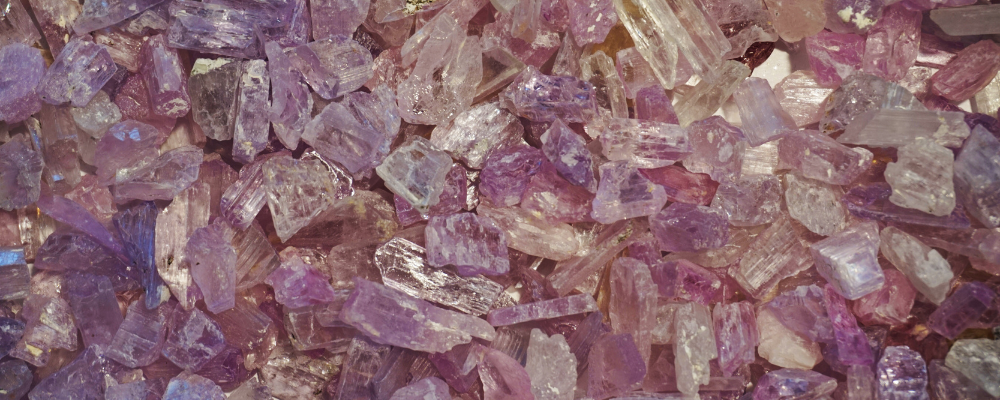
Kunzite has a soft pink color that changes with the angle of view. Discovered at the beginning of the 20th century, it does not need an invented ancient past to speak to the heart: its color, light, and sensitivity already form a language of clear-eyed affection.
In a contemporary esoteric interpretation, Venus governs love and value, the Moon receives emotion, Water allows tenderness to flow, and Air gives it words. Kunzite supports the expression of feelings, gentleness with boundaries, and relationships in which giving does not mean losing oneself.
To place this stone among related minerals, compare it with Rose Quartz, Rose Tourmaline, and Rhodochrosite.
The Pink of Spodumene
Kunzite is the pink to pinkish-violet variety of Spodumene, a lithium aluminum silicate. The Gemological Institute of America links its color to small amounts of manganese.
It may appear paler or more intense depending on the viewing direction. This variation, called pleochroism, offers a beautiful relational image: the same emotional truth can have several facets without becoming a lie.
Manganese and Changing Light
The Mindat database presents it as a pink gem variety of Spodumene. Its crystals can be substantial, with distinct cleavage that requires careful cutting and protection from impacts.
Prolonged and repeated exposure to intense light can diminish certain colors. This sensitivity does not prevent the stone from being worn or displayed; it simply suggests avoiding a display case in constant direct sunlight.
The 1902 Discovery
Pink crystals found in San Diego County, California, were entrusted in 1902 to mineralogist George Frederick Kunz. The GIA historical account explains that he recognized them as a previously unidentified color of Spodumene; the variety was subsequently named after him.
Kunzite therefore does not belong to the lapidaries of antiquity. The themes of the heart, comfort, and unconditional love associated with it are modern. They may be used as symbols, provided they are not turned into medical promises or presented as an ancient heritage.
Tenderness needs a form. Without words, it remains guessed at; without boundaries, it becomes exhausted. Kunzite brings together the gentleness of Venus and the clarity of Air so that affection can be offered, received, or refused without confusion.
Venus, Moon, Water, and Air
Venus carries attachment, the desire for harmony, and self-esteem. The Moon represents receptivity, sensitive memory, and the need for security. Water governs feeling; Air allows it to be expressed.
Friday suits relationships, while Monday suits emotional needs. Pale pink, lilac, and silver make up its palette. A letter, a bowl of clear water, or two loosely knotted ribbons can accompany its rites.
Tenderness, Speech, and Reciprocity
Kunzite accompanies a declaration, a reconciliation, or a conversation in which emotion needs to find simple words. It invites you to speak from your own feelings: “I wish,” “I fear,” “I can,” rather than deciding on the other person’s behalf.
It is also suited to work on reciprocity. Giving, receiving, and asking are three different gestures; distinguishing them protects generosity from resentment.
The Pink Letter
On a Friday evening, write a short letter that you are not required to send. Divide it into three paragraphs: what you feel, what you can offer, and what you need.
Place the Kunzite on the letter and say: “May my gentleness remain genuine, may my gift remain freely given, may my request remain clear.” The next day, reread the text. Keep only the sentences that respect both your heart and the other person’s freedom.
Correspondences and References
| Reference | Correspondence |
|---|---|
| Nature | Pink variety of Spodumene |
| Color | Pale pink to rosy violet |
| Celestial Bodies | Venus and Moon, contemporary setting |
| Elements | Water and Air |
| Days | Friday and Monday |
| Areas | Tenderness, expression, reciprocity, esteem |
| Associated Objects | Letter, bowl of water, ribbons |
| Gesture | Distinguishing feeling, offering, and need |










