














































































































































































































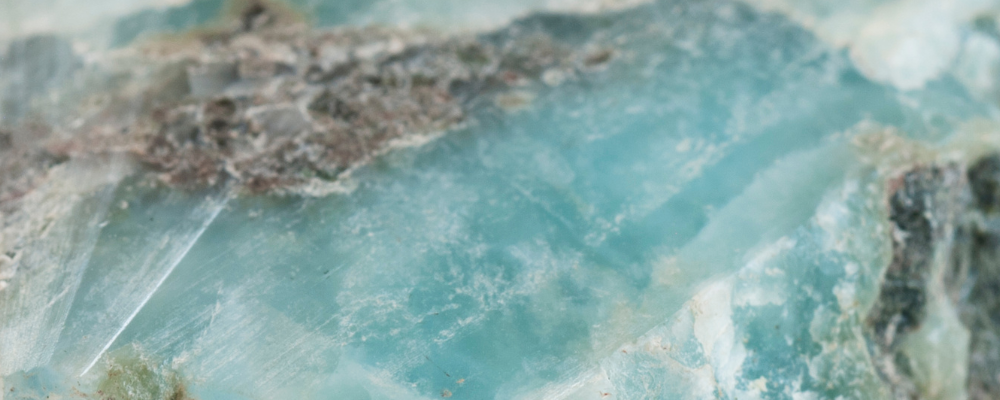
Larimar seems to hold a clear sea within rock born of the volcano. Its blues, whites, and flowing lines have made this Dominican Pectolite a stone of the shores: where Water meets Fire, where departure calls for return, where emotion seeks a peaceful form.
Its name and ornamental use belong to the 20th century. There is therefore no ancient Larimar cult to unearth. Its contemporary symbolism can nevertheless be rich and honest: the Moon governs the inner tides, Venus harmony, Water relationship, and volcanic Fire transformation.
To place this stone among related minerals, compare it with Kunzite, Ocean Jasper, and Lava.
Caribbean Pectolite
Larimar is the commercial name for massive blue Pectolite from the Dominican Republic. Mindat clearly connects this name to the Pectolite species.
The material may combine sky blue, turquoise, white, subtle green, and red or brown areas associated with its matrix. Its patterns evoke sea foam, but this visual resemblance should not obscure its terrestrial geological origin.
Blue in Basalt
Larimar occurs in cavities and veins of altered volcanic rocks. The gemological study published by the GIA describes a blue Pectolite associated with Basalt from the Barahona region and links its color to small amounts of copper.
More recent research on the Dominican Larimar mine examines its mineralogical and petrological context. The meeting of watery blue and volcanic rock thus provides a material foundation for its symbolic Water-Fire pairing.
A Name Born in 1975
The material was actively mined starting in 1974. Miguel Méndez formed the name Larimar from “Lari,” the nickname of his daughter Larissa, and mar, the Spanish word for sea. The GIA article places the regular use of this name from 1975 onward.
Claims that make Larimar an Atlantean stone or a sacred Taíno heir do not have an equivalent historical basis. Its real, recent, volcanic Dominican history offers a stronger narrative than these added lineages.
The sea drawn by the volcano. Larimar brings together two movements that are too quickly set against each other: emotion that flows and will that transforms. Its rite seeks their alliance, not the victory of one over the other.
Moon, Venus, Water, and Fire
The Moon governs the tides, welcoming, and returns. Venus carries connection, beauty, and reconciliation. Water represents feeling; Fire recalls the volcanic matrix and the courage to change.
Monday suits emotions, and Friday suits relationships. Light blue, white, and copper make up its palette. An empty shell, a bowl of water, and an unlit candle can accompany its rites without imitating any particular Caribbean ceremony.
Bond, passage, and calming
Larimar accompanies departures, returns, moves, and conversations where affection meets a necessary change. It helps express what must continue, what must evolve, and what must come to an end.
Its symbolic calming effect is not a promise of healing. It lies in a method: slow the gesture, name the emotion, then choose an action clear enough not to let the turmoil decide on its own.
The tide and the ember
Place a bowl of water on the left and an unlit candle on the right. Place the Larimar between them. Write down what the emotion wants to preserve, then what the change requires.
Touch the bowl, then the base of the candle, and say: “Water recognizes my bond; fire transforms its form.” Then pour the water onto a plant and light the candle only for as long as it takes to carry out one concrete action related to the passage.
Correspondences and references
| Reference | Correspondence |
|---|---|
| Nature | Massive blue pectolite |
| Origin | Barahona region, Dominican Republic |
| Celestial bodies | Moon and Venus, contemporary setting |
| Elements | Water and Fire |
| Days | Monday and Friday |
| Areas | Bond, passage, return, calming |
| Associated objects | Bowl of water, shell, candle |
| Gesture | Preserving the bond by transforming its form |










