















































































































































































































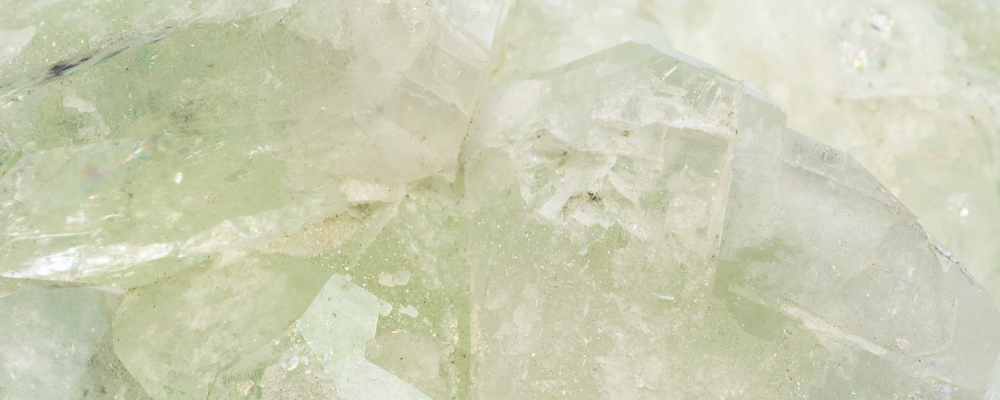
Datolite owes its name to the idea of division. Its vitreous crystals and granular masses led Jens Esmark to choose a Greek word associated with sharing. This origin offers a solid ritual focus: divide a burden into readable portions, distribute the means, and make each step manageable.
Described in 1806, Datolite has no distinct ancient magical tradition of its own. Its contemporary symbolism remains tied to its name and material. Mercury distinguishes categories, Jupiter distributes, Saturn sets boundaries; Earth receives the portions, and Water flows between them.
To place this stone among related minerals, compare it with Cancrinite, Bakerite, and Canasite.
The stone that is divided
Jens Esmark named Datolite in 1806 from the Greek dateisthai, “to divide,” and lithos, “stone.” The Mindat entry links this choice to the granular texture of massive forms.
The name does not mean that all specimens split into regular portions. It describes an appearance that provided the mineralogist with his first clue.
A calcium borosilicate
Datolite is a calcium hydroxyl borosilicate, CaBSiO4(OH). The Handbook of Mineralogy indicates a hardness of 5 to 5.5, a monoclinic system, and prismatic, globular, granular, or compact forms.
It may be colorless, white, greenish, yellow, pink, or red. Its vitreous luster gives well-formed crystals an appearance very different from that of nodular masses.
From basalts to copper-bearing nodules
Datolite forms in cavities in volcanic rocks, skarns, and certain mineral veins. It occurs with Calcite, Prehnite, Zeolites, or Axinite.
In the Lake Superior region, it forms compact nodules colored by inclusions and minerals associated with copper. The geological presentation of Datolite recalls this variety of habits and hues.
Dividing a burden does not diminish its value. It makes it possible to know who carries what, in what order, and with what means. The fair share makes the whole achievable.
Mercury, Jupiter, and Saturn
Mercury separates categories and names tasks. Jupiter distributes resources and responsibilities. Saturn sets the size of the portions and their deadlines. Earth receives the distribution; Water maintains the flow between the stages.
Wednesday is suitable for dividing, Thursday for sharing, and Saturday for checking. A divided circle, four tokens, and a white string accompany the stone.
Sharing, Sequence, and Distribution
Datolite supports an overly broad project, a succession of tasks, or a distribution among several people. It encourages defining complete portions, small enough to be taken on.
It is also suitable for exchanges where fairness remains unclear. A fair distribution does not necessarily give everyone the same amount; it makes the criterion visible.
The Rite of the Four Shares
Divide a circle into four sectors: matter, time, assistance, and reserve. Place one token in each sector, then write down the share assigned to each. Place the Datolite at the center and move the tokens until you achieve a sustainable distribution.
Say: “I divide without dispersing. Each share receives its weight, its order, and its guardian.” Begin with the portion whose boundary is clearest.
Correspondences and References
| Reference | Correspondence |
|---|---|
| Nature | Mineral species, calcium borosilicate |
| Celestial Bodies | Mercury, Jupiter, and Saturn |
| Elements | Earth and Water |
| Days | Wednesday, Thursday, and Saturday |
| Ritual Colors | White, pale green, copper |
| Domains | Sharing, sequence, distribution, fairness |
| Associated Objects | Divided circle, four tokens, string |
| Gesture | Distributing a burden according to a visible criterion |










