















































































































































































































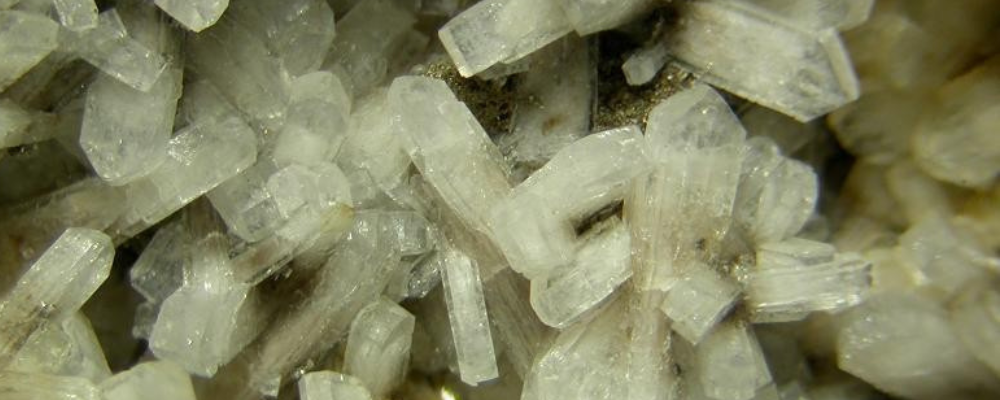
Edingtonite is a rare zeolite whose aluminosilicate framework houses barium and water. Its small white, gray, pinkish, or colorless crystals hide in volcanic cavities and veins. It offers a precise image of welcome: not a void open to every passage, but a structured place with openings and proportions.
Named in Scotland in the 19th century, edingtonite has no ancient magical heritage. Its ritual interpretation is contemporary: Saturn for architecture, Jupiter for the space granted, Air for the channels, and Water for the mobile molecules they contain. It accompanies work involving space, hospitality, and allocation.
To place this stone among related minerals, compare it with Heulandite, Zeolite, and Cancrinite.
A zeolite named in Scotland
Wilhelm Karl von Haidinger described edingtonite in 1825 from specimens from the Kilpatrick Hills, near Glasgow. The name honors Scottish collector James Edington. The Mindat entry preserves this date, the type locality, and the history of the name.
A tiny stone can thus carry a network of people, careers, and collections. The label is part of that memory.
A framework, water, and barium
Its ideal formula, BaAl2Si3O10·4H2O, combines an aluminum and silicon framework, barium ions, and water. The International Zeolite Association describes the EDI structure and the species’ natural occurrences.
The crystals have a hardness of 4 to 4.5 and perfect cleavage. Their pseudo-tetragonal appearance may conceal orthorhombic symmetry. The true structure requires more than a quick glance.
Cavities, veins, and small spaces
At Old Kilpatrick, edingtonite occurs in veins and cavities of Carboniferous andesite. Other localities yield it in alkaline rocks, dolerites, or near hydrothermal veins. A study of zeolite compositions includes material from the type locality among its analytical references.
The cavity is not a lack. It becomes the place where fluids circulate and where a crystal can form. A fertile space is prepared by boundaries.
Welcoming requires capacity. A suitable space has a size, duration, and function. Without boundaries, hospitality becomes overload; without openness, it becomes closure.
Saturn, Jupiter, Air, and Water
Saturn provides structure and measure. Jupiter grants space and presides over hospitality. Air corresponds to the channels of the framework; Water to what resides there and can withdraw from it under the effect of heat.
Saturday is suitable for preparing the container, Thursday for the invitation. White, gray, pale pink, and midnight blue form the palette. A compartmentalized box, a bowl, and a blue ribbon accompany the stone.
Welcoming, capacity, and allocation
Edingtonite supports the organization of a place, schedule, or budget. It invites you to reserve space before welcoming a new task, person, or object.
It is suitable for moments when generosity is confused with unlimited availability. Its structure reminds us that a space can be open while still retaining its rules.
The Rite of the Prepared Space
Choose a box, a calendar slot, or an empty surface. Define what may enter it, for how long, and within what limit. Place the Edingtonite beside it, then deliberately leave a small part unoccupied.
Say: “I prepare the space before opening the door. I welcome what I can truly contain.” Tie the blue ribbon around the container without closing it.
Correspondences and references
| Reference | Correspondence |
|---|---|
| Nature | Hydrated barium zeolite |
| Celestial bodies | Saturn and Jupiter |
| Elements | Air and Water |
| Days | Saturday and Thursday |
| Ritual colors | White, gray, pale pink, midnight blue |
| Areas | Welcoming, capacity, allocation, measurement |
| Associated objects | Compartmentalized box, bowl, blue ribbon |
| Gesture | Preparing the space before welcoming |










