















































































































































































































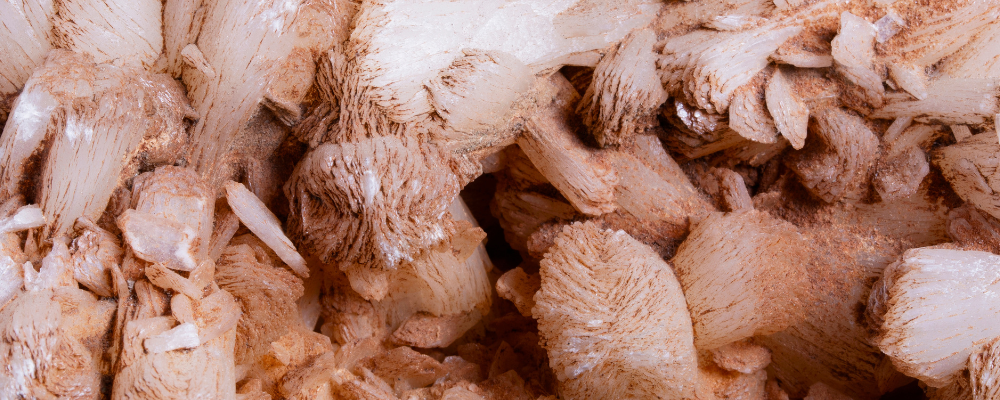
Stilbite brings together two opposing movements: its blades knot at the center, then open into a spray. This natural architecture makes it a stone of coordination, circulation, and untangling. It helps bring together what is moving in several directions without stifling each path.
Described at the end of the 18th century, Stilbite is given here a ritual reading based on its name, its pearly luster, the water enclosed in its structure, and its radiating sprays. It accompanies branching projects, exchanges to be brought back into order, and decisions that require a clear center.
To place this stone among related minerals, compare it with Zeolite, Heulandite, and Scolecite.
The stone of brilliance and the spray
Jean-Claude Delamétherie named Stilbite in 1797 from the Greek stilbein, “to shine.” The word refers to the vitreous or pearly luster visible on its cleavage faces. Another old name, Desmine, evokes the bundle or spray and describes the way its crystals gather together.
These two names already reveal its operative character: make visible, then connect. The light does not remain enclosed at the center; it follows each blade. The Mindat mineralogical entry traces this etymology and the characteristic forms of Stilbite-Ca.
Water held in the structure
Stilbite belongs to the zeolites, whose mineral framework contains channels occupied by water molecules and cations. Stilbite-Ca, dominated by Calcium, is the most common form; Stilbite-Na, dominated by Sodium, is much rarer. Distinguishing between them requires analysis.
This structural water does not circulate like water in a container. It inhabits an ordered network. The image suits emotions and information that need a framework to move without invading the whole space. The stone therefore supports regulated circulation rather than limitless flow.
From cavity to radiance
Stilbite develops in cavities of volcanic rocks penetrated by low-temperature fluids. Each blade grows in the available space, while the spray maintains a common point. Apophyllite, Heulandite, Calcite and Quartz may accompany it.
The International Zeolite Association data sheet describes its crystal framework. For ritual work, the cavity becomes a chamber of formation: create space, let the pathways emerge, then bring them together around a central intention.
Moon, Mercury, Water and Air
The Moon corresponds to the white or pearly sheen, contained water, and the cluster’s gentle rhythm. Mercury governs channels, connections, messages, and coordination among several tasks. Water receives and transmits; Air distributes, connects, and makes the structure legible.
These correspondences extend the material characteristics of a species described in the modern era. Monday suits calming, inner organization, and returning to the center. Wednesday serves messages, meetings, routes, and projects divided into several branches.
Circulation, Coordination, and Untying
Stilbite accompanies periods when too many paths remain open at once. It helps restore the central task, distribute roles, and get a conversation moving again. Its cluster shows that a project can retain several directions as long as they share an origin and a rule.
It is also suited to untying tangled commitments. The aim is not to sever every connection, but to distinguish those that nourish the whole from those that hold it back unnecessarily. Placed near a calendar, a work plan, or correspondence, it reminds us that clarity comes from a living order.
The Rite of the Knot and Rays
Write your goal in the center of a sheet, then draw four rays. On each one, note a concrete condition: time, person, means, and expected result. Place the Stilbite beside the center without rubbing it on the paper.
Review the four branches and choose the action that puts the others back into circulation. Circle it, then say: “I gather without confining. Each path finds its order again.” Keep the sheet for a seven-day cycle and remove one ray as soon as its condition is fulfilled.
Correspondences and reference points
| Reference point | Correspondence |
|---|---|
| Nature | Hydrated zeolite; Stilbite-Ca predominates in collections |
| Operative images | Cluster, bundle, central knot, and channels |
| Planets | Moon and Mercury |
| Elements | Water and Air |
| Days | Monday and Wednesday |
| Number | Four, for paths gathered around a center |
| Areas | Coordination, circulation, organization, exchange, and untying |
| Ritual gesture | Unfold a project’s branches, then choose the central action |
| Correspondence Status | Contemporary analogical reading based on form and structure |










