
























































































































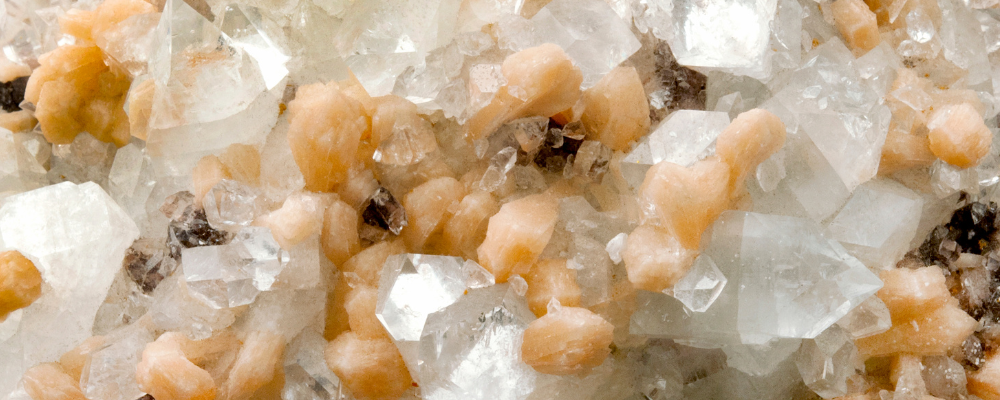
Apophyllite catches the light like cut glass and displays faces that already seem polished. Its name means that it “flakes apart”: when heated, its structure loses water and separates into thin layers. This image gave rise to a modern magic of clarity, revelation, and the removal of unnecessary layers.
The term no longer refers to a single species, but to a group of closely related minerals. Their luster, transparency, and cleavage offer a precise ritual language: see a question, isolate what obstructs it, then allow a workable answer to emerge.
To place this stone among related minerals, compare it with Zeolite, Heulandite, and Stilbite.
A group of water-rich crystals
“Apophyllite” is a group name encompassing several hydrated phyllosilicates, including Fluorapophyllite-(K). Mindat describes this group, while the Handbook of Mineralogy gives Fluorapophyllite-(K) a hardness of 4.5 to 5, perfect cleavage, and a vitreous or pearly luster.
White, colorless, green, or pinkish crystals occur in cavities in volcanic rocks, alongside Calcite and minerals of the Zeolite group. Their pseudocubic and pyramidal forms explain their architectural appearance.
The mineral that flakes apart
René Just Haüy gave Apophyllite its name in 1806. The Greek etymology combines the idea of separation with that of a leaf. The 1911 Encyclopædia Britannica explains that the mineral exfoliates when heated because it loses part of its water.
The classification evolved in the 20th century: the common name now encompasses several species. This history invites us to view a specimen’s label as an entry point, not as a complete chemical identity.
A modern magic of revelation
Apophyllite does not appear in ancient or medieval lapidaries under this name. Its esoteric uses developed after its mineralogical description. They are based on three visible characteristics: transparency, reflection, and separation into layers.
It is suitable for divination when a question remains precise enough to receive a useful answer. It also serves to remove an interpretation that has become too burdensome, clarify an exchange, and open mental space before writing or a reading.
Unveiling does not mean revealing everything. Sometimes removing one sheet is enough to make the text legible. Apophyllite invites you to remove the exact obstacle without dismantling the whole.
Mercury, Moon, Air, and Water
Mercury governs reading, questions, signs, and analysis. The Moon corresponds to reflection, the water contained in the structure, and received images. Air clarifies; Water allows forms to appear without fixing them too quickly.
Wednesday is suitable for study, writing, and formulating a question. Monday is for dreams, the mirror, and memory. A blank sheet of paper, a glass of water placed at a distance, a feather, and indirect light extend these correspondences.
Clarity, Divination, and Clearing
Before a reading, place the Apophyllite near the deck and rephrase the question until you have removed vague terms. The stone marks the boundary between a genuine request and shapeless anxiety.
For a decision, write the facts separately from the interpretations. Place the stone on the line supported by direct evidence. This method prevents intuition from being confused with fear.
In a room dedicated to study, it can remain near a notebook or a covered mirror. Its symbolic role remains that of a window: it helps you see, but it does not decide in your place.
The Removed Sheet
On a Wednesday, stack three sheets. On the first, write the fact; on the second, your interpretation; on the third, your fear. Place the Apophyllite on top of them.
Remove the third sheet, then reread the other two. Say: “I separate what I know from what I project.” Formulate an action based on the fact and keep only the sheet that supports it.
Correspondences and References
| Reference | Correspondence |
|---|---|
| Nature | Group of Hydrated Phyllosilicates |
| Name | Haüy, 1806; “which flakes off” |
| Modern Planets | Mercury and Moon |
| Elements | Air and Water |
| Days | Wednesday and Monday |
| Areas | Clarity, Divination, Study, Dream, and Clearing |
| Symbols | Window, Sheet of Paper, Mirror, and Written Question |
| Ritual Act | Separating Fact, Interpretation, and Fear |