















































































































































































































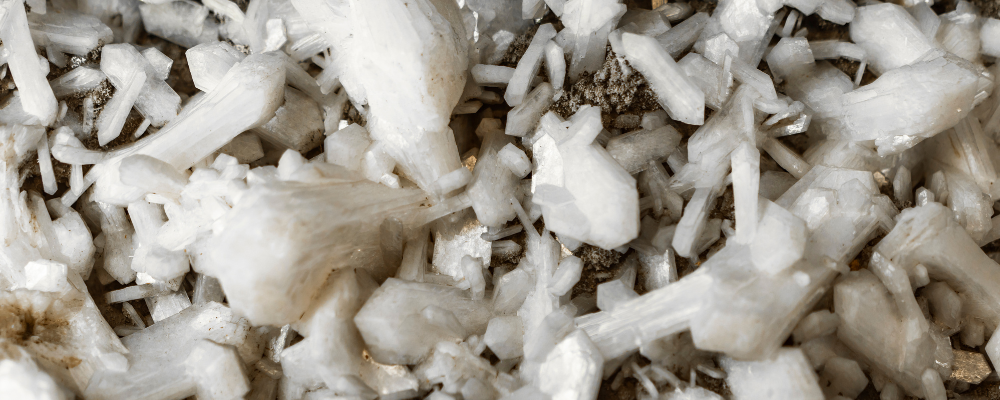
The word zeolite means “boiling stone.” In the 18th century, Axel Fredrik Cronstedt heated a mineral that released steam: the water was not sitting on its surface; it occupied cavities within its structure.
Zeolites form an entire family of minerals capable of receiving, exchanging, and releasing certain molecules and ions. This channelled architecture gives them a strong symbolism of thresholds, sorting, and circulation. The exact species name remains essential, because not all zeolites have the same form or require the same precautions.
To place this stone among related minerals, compare it with Heulandite, Stilbite, and Scolecite.
A family of channelled stones
Zeolites are hydrated aluminosilicates whose structure forms cages and microscopic passages. These spaces contain water and cations that can be exchanged without destroying the entire mineral framework.
The recommended nomenclature for zeolites distinguishes many species, including Stilbite, Heulandite, Natrolite, Scolecite, Chabazite, and Clinoptilolite. The word zeolite alone therefore refers to a family, not a precisely defined stone.
Cronstedt and the boiling stone
In 1756, Swedish mineralogist Axel Fredrik Cronstedt heated a mineral now classified among the zeolites. He observed steam being released by water contained in the structure and formed the name from the Greek zein, “to boil,” and lithos, “stone.”
The stone did not burn or create water: heat revealed what it held in its cavities. This scene gives zeolites a precise ritual image—that of invisible contents appearing when the right threshold is reached.
Receiving, exchanging, and releasing
The regular size of the channels allows zeolites to retain certain molecules and exchange ions. This property explains their uses in filtration, water treatment, agriculture, and catalysis. The US Geological Survey presents these natural and industrial applications.
Filtering does not mean absorbing everything. Zeolite works through size, affinity, and exchange capacity. It supports boundaries that let through what nourishes and retain what clutters.
Mercury, Saturn, Water, and Air
Mercury governs exchanges, passages, and circulation. Saturn sets the framework and the size of the threshold. Water occupies the cavities; Air appears in the vapor released by heat.
Wednesday suits negotiations, sorting, and networks. Saturday is used to set the filter and the rule. White, gray, beige, and pale blue make up a palette suited to the family.
Filter, threshold, and circulation
Zeolite accompanies the sorting of a space, the management of exchanges, the protection of a threshold, and the reorganization of a group. It helps define what enters, what remains, what comes out, and what must be replaced.
It also suits work with speech. Before a conversation, it invites you to distinguish what deserves a response, what calls for a question, and what can pass through the mind without taking up residence there.
The Rite of the Four Passages
Divide a sheet into four boxes: let in, keep, exchange, and let out. Place a Zeolite of known species in the center and write an element of the situation in each box.
Say: “My threshold knows its measure. What nourishes circulates; what clutters departs.” Then move one word to the box it actually belongs in, and carry out the concrete action associated with that move.
Correspondences and references
| Reference | Correspondence |
|---|---|
| Nature | Family of hydrated aluminosilicates with a porous structure |
| Name | From the Greek “boiling stone,” given by Cronstedt in 1756 |
| Celestial bodies | Mercury and Saturn |
| Elements | Water and Air |
| Days | Wednesday and Saturday |
| Ritual colors | White, gray, beige, and pale blue |
| Areas | Filter, threshold, exchange, circulation, and organization |
| Ritual action | Sort among letting in, keeping, exchanging, and letting out |










