















































































































































































































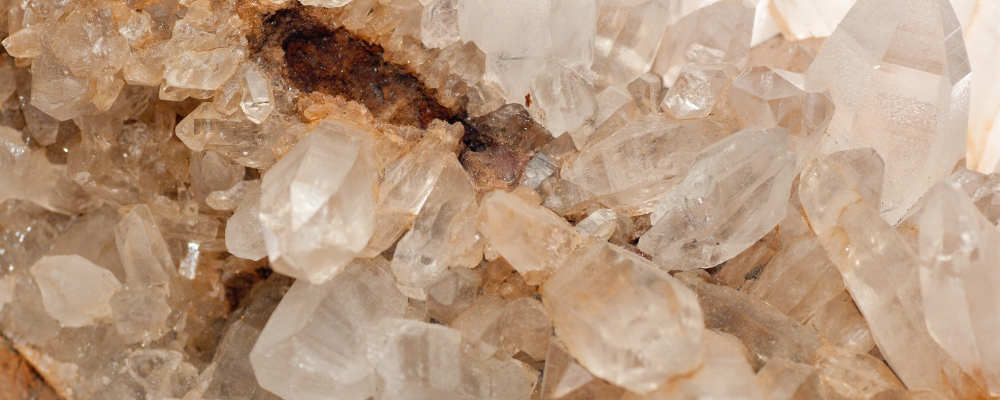
Heulandite belongs to the zeolites, minerals whose structure forms channels capable of holding water and ions. Its white, pink, or orange crystals resemble small assembled blades. They offer a fertile image of exchange: receive, let circulate, then preserve one’s architecture.
No distinct ancient magical heritage associated with Heulandite is known. The themes of hospitality, reciprocity, and adaptation proposed here are a contemporary construction based on its structure. Mercury governs exchange, Jupiter welcome, Air circulation, and Water what enters and leaves.
To place this stone among related minerals, compare it with Zeolite, Stilbite, and Scolecite.
The name of Henry Heuland
The mineralogist Henry James Brooke gave the name Heulandite in 1822, in tribute to the collector Henry Heuland. This name replaced Stilbite when a finer distinction was established between the two minerals. Mindat preserves the history of Heulandite-Ca.
The name therefore bears the mark of a network of collection, observation, and comparison. Here, science advances by distinguishing between two similar appearances.
The channels of a zeolite
Heulandite is no longer considered a single species, but a series whose suffix indicates the dominant element: calcium, sodium, potassium, strontium, or barium. The Commission on the Structures of the International Zeolite Association describes its channel network and exchange sites.
Water and certain ions can enter this architecture without destroying it. This scientific property does not mean that the stone absorbs emotions or removes toxins from the body.
Collect, separate, classify
Zeolites left the confines of mineralogy to find agricultural and industrial applications related to adsorption and ion exchange. The USGS presents these uses and the resources of natural zeolites.
Collection-grade Heulandite remains a specimen to contemplate. Its internal network inspires a symbol of exchange, not a cure.
Welcoming does not mean holding on to everything. Heulandite offers the image of a structure traversed by exchanges. It receives, transmits, and remains itself: a lesson in hospitality with boundaries.
Mercury, Jupiter, Air, and Water
Mercury corresponds to passages, messages, and circulation. Jupiter represents hospitality and the expansion of a shared space. Air carries exchange; Water represents what passes through and renews itself.
Wednesday suits agreements, and Thursday suits welcoming. Pale pink, white, and soft orange form its palette. Two empty bowls, a key, and a thread can accompany the stone.
Hospitality and Reciprocity
Heulandite accompanies the opening of a place, the arrival of a person, or the creation of a partnership. It invites you to state what can circulate: time, knowledge, attention, or resources.
It also reminds us that a fair exchange includes a way back. Giving without receiving is exhausting; receiving without passing anything on creates a burden.
The House of Exchanges
Place two empty bowls on either side of the Heulandite. Name what you are willing to offer in the first, then what you need to receive in the second. Stretch a thread between them without tying it.
Say: “I open a passage that respects every dwelling. What circulates finds return, measure, and place.” Put away the thread once the agreement has been stated to the person concerned.
Correspondences and References
| Reference | Correspondence |
|---|---|
| Nature | Zeolite with a channel structure |
| Celestial Bodies | Mercury and Jupiter |
| Elements | Air and Water |
| Days | Wednesday and Thursday |
| Ritual Colors | Pale pink, white, soft orange |
| Domains | Hospitality, exchange, adaptation, reciprocity |
| Associated Objects | Two bowls, key, thread |
| Gesture | Naming What Is Given and Received |










