Staurolite bears a cross that the human hand did not carve. Two crystals meet according to a twinning law and bring forth the sign of passage, alliance, and the four directions. This natural form has nourished dated amuletic practices from Basel to Brittany, followed by an American story that became famous at the beginning of the 20th century.
Its symbolic power comes from the meeting of terrestrial geometry and an immediately recognizable religious sign. It is suited to thresholds, journeys, and promises that require maintaining a direction.
To place this stone among related minerals, compare it with Kyanite, Kyanite, and Andalusite.
The Cross Born in Rock
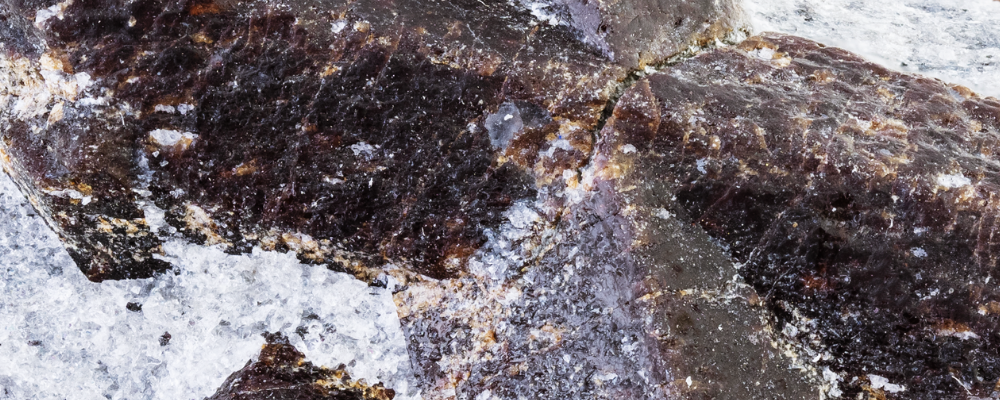
Staurolite is an iron- and aluminium-rich silicate that forms in metamorphic schists and gneisses. Its brown crystals twin at angles of approximately 60 or 90 degrees. The cross is therefore neither engraved nor added: it reveals the internal order of crystal growth.
The name combines the Greek words stauros, “cross,” and lithos, “stone.” The Handbook of Mineralogy describes its characteristic twins and hardness of 7 to 7.5. This hardness does not prevent the arms of a natural cross from breaking under impact.
The Baptismal Stone of Basel
In The Curious Lore of Precious Stones, George Frederick Kunz cites the mineralogical treatise published by Axel Fredrik Cronstedt in 1758. Staurolite is mentioned there under the name Baseler Taufstein, “baptismal stone of Basel,” and as an amulet associated with baptism.
Here, the symbol protects a beginning: entry into a community, a spiritual commitment, or a new stage of life. The stone does not replace the religious rite; it preserves its material memory and recalls the words spoken at the threshold.
Brittany and Virginia: Two Lines of Transmission
The Pitt Rivers Museum in Oxford preserves crystals collected near Auray and presented in 1879 as “True Cross stones.” In Brittany, these twinned crystals were worn as protective charms and linked, in local traditions, to stones that had fallen from the sky.
In Virginia, the names “fairy crosses” and “fairy tears” gained new momentum through John Fox Jr.’s 1908 novel The Trail of the Lonesome Pine. Kunz noted in 1915 that the American vogue for these amulets was largely driven by this story. The two lines of transmission should therefore not be conflated: one is Breton and Christian, the other literary and American.
Saturn, Sun, and Earth
Saturn corresponds to rock tested by pressure, duration, rules, and a kept vow. The Sun occupies the central point of the cross: it unites the directions and gives coherence to the path. Earth maintains the whole in stability, dwelling, and continuity.
The number four is imposed by the form: four directions, four angles, four supports. Saturday favors guarding thresholds and lasting commitments. Sunday is suitable for a blessing, a departure, or an act placed under the sign of light.
Threshold, road, faith, and commitment
Staurolite may be placed near a door to remind you of the household rules, in a travel bag to help you stay on course, or on a prayer altar when the cross belongs to the path being followed. It supports pilgrimages, moves, alliances, and decisions that close one road in order to open another.
It acts as a reminder of a given word. Its center prevents dispersal; its arms show that a decision radiates in several directions. Wearing or keeping this stone means accepting that all protection also rests on faithful conduct.
The Rite of the Four Directions
Place the Staurolite at the center of a sheet of paper. In the north, write what guides you. In the east, what you are beginning. In the south, what you must nurture. In the west, what you agree to complete. Reread the four sentences clockwise.
Draw the two axes that connect them and say: “Four paths, one center. I keep my direction and my word.” Fold the sheet toward the center, keep it near the entrance for seven days, then carry out the action associated with the direction that calls for your presence.
Correspondences and references
| Reference | Correspondence |
|---|---|
| Nature | Brown metamorphic silicate; twins close to 60 or 90 degrees |
| Documented uses | Baptismal amulet in Basel; Christian charm in Brittany |
| Planets | Saturn for the vow; Sun for the center |
| Element | Earth |
| Days | Saturday and Sunday |
| Number | Four |
| Areas | Protection, threshold, road, faith, alliance, and commitment |
| Associated symbols | Cross, key, door, walking stick, and solar circle |
| Ritual gesture | Connecting four directions to a central decision |