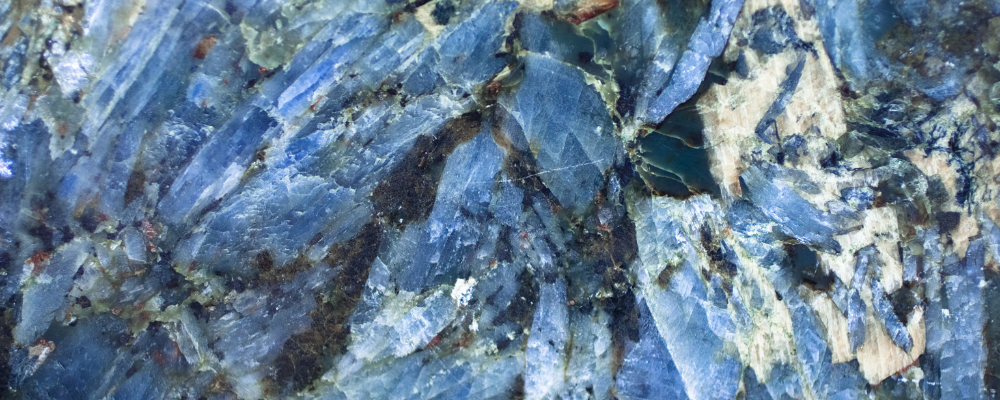
Cyanite stretches its blue into long blades, like a line drawn between thought and speech. Its substance has a remarkable peculiarity: its resistance changes depending on the direction in which it is measured. It thus reminds us that the same reality may require two readings without losing its coherence.
Also known as Kyanite and Disthene, it does not appear in ancient lapidaries under its current designation. Its esoteric correspondences are modern and based on its shape, color, and double hardness: Mercury for language, Saturn for the axis, Air for the voice, and Earth for stability.
To place this stone among related minerals, compare it with Kyanite, Andalusite, and Staurolite.
A blade of aluminum silicate
Cyanite is an aluminum silicate with the formula Al2SiO5. It forms in metamorphic rocks subjected to high pressure and appears as elongated crystals, blue in its best-known form, but also white, gray, green, or black.
The Handbook of Mineralogy details its triclinic structure, cleavage, and colors. In rock, its presence informs geologists about metamorphic conditions.
The Stone of Two Forces
Measured along the length of the crystal, its hardness is around 4.5 to 5; across it, it reaches approximately 6.5 to 7. This anisotropy explains the French name Disthene, formed from the idea of “two forces.”
The Mindat entry brings together these references and its localities. For the lapidary, this difference demands attention to orientation; for ritual language, it becomes an image of two complementary measures.
Cyanite, Kyanite and Disthene
Kyanite comes from the Greek kyanos, meaning dark blue. Cyanite is its French form, while Disthene emphasizes its double hardness. Three names therefore highlight three aspects: color, linguistic usage, and physical property.
The Encyclopaedia Britannica places it alongside Andalusite and Sillimanite, which share the same formula but have a different structure. Kyanite thus shows that a similar composition can take a different form depending on the circumstances.
Its symbolism does not come from an ancient blue talisman. This is an explicitly contemporary reading: the blade becomes an axis, blue becomes speech, and the dual hardness becomes the art of adjusting one’s measure to the meaning of the action.
Mercury, Saturn, Air, and Earth
Mercury governs expression, translation, and negotiation. Saturn provides the line, discipline, and responsibility of keeping one’s word. Air carries the voice; Earth gives it a concrete effect.
Wednesday suits interviews, studies, and messages; Saturday suits commitments and boundaries. A feather, a straight, taut blue thread, and a white candle make suitable supports.
Axis, speech, and conciliation
Kyanite supports the preparation of a delicate conversation, the rephrasing of a disagreement, and the search for a sentence that betrays neither yourself nor the other person. Its dual measure invites you to check both the substance and the manner, the intention and the effect.
It can be placed above a text, in the direction of reading, to remind you that fair speech is not merely sincere: it must also be understandable and oriented toward an outcome.
The Rite of the Straight Statement
Draw a vertical line on a sheet of paper. On the left, write what you need to say; on the right, what your interlocutor needs to be able to hear. In the center, compose a sentence that respects both columns.
Align the Kyanite with the line and say the statement once. Then say: “May my words keep their axis and find their passage.” Send the message or prepare the exchange without adding unnecessary justification.
Correspondences and references
| Reference | Correspondence |
|---|---|
| Nature | Aluminum silicate |
| Celestial bodies | Mercury and Saturn |
| Elements | Air and Earth |
| Days | Wednesday and Saturday |
| Ritual colors | Blue, white, gray |
| Areas | Speech, axis, commitment, conciliation |
| Associated objects | Feather, thread, sheet |
| Gesture | Writing a statement between intention and reception |