















































































































































































































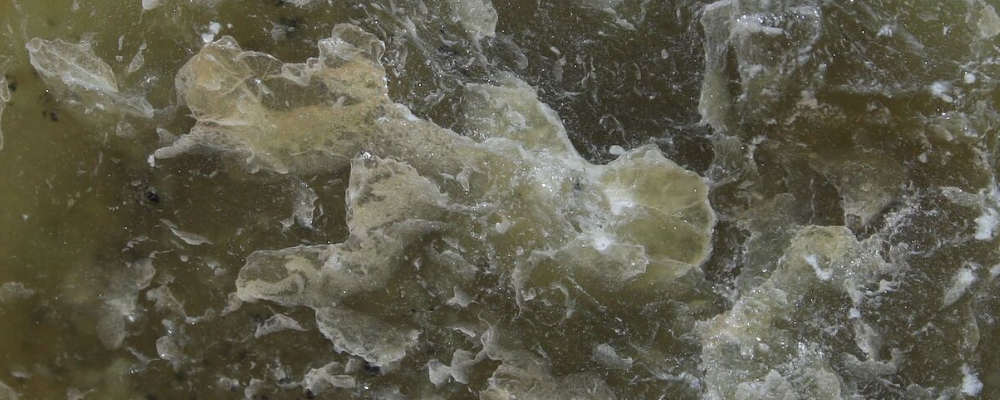
Damourite is not a separate species, but a very fine, compact muscovite formed from sheets so small that they lose the mica’s usual appearance. It can replace another mineral while preserving its outline. Its material thus speaks of transition, layering, and transmitted form.
The name was created in the 19th century in honor of the mineralogist Alexis Damour. No ancient magical corpus attributes a specific function to it. A contemporary reading can nevertheless follow the mica: the Moon governs the sheets, Mercury the substitution, Air the fineness, and Earth the preserved form.
To place this stone among related minerals, compare it with Mica, Muscovite, and Biotite.
The Name of Alexis Damour
Achille Delesse described damourite in 1845 and named it in honor of Augustin Alexis Damour. The Mindat entry introduces this French mineralogist and the fine nature of the material.
Damour worked on the composition of many minerals and on archaeological stone objects. The name thus preserves the memory of an analytical perspective on the transformations of matter.
A very fine-grained muscovite
Damourite is a compact, microcrystalline variety of muscovite. The University of Minnesota’s presentation of muscovite recalls this mica’s sheet structure and the former use of its large plates as window glass.
In damourite, the sheets are too fine to produce the broad, familiar blades. The feel may become soft or slightly greasy, with a massive or fibrous appearance.
Replacing without erasing the form
Damourite frequently appears as an alteration product of feldspars or as a replacement for other minerals. It can form a pseudomorphosis: the material changes, but the outline of the former crystal remains.
The National Museum of Wales describes fine muscovite as a secondary alteration product. This geological history gives damourite a language of continuity without stagnation.
Preserving the form does not require preserving the material. A function, framework, or name can accommodate a new way of doing things. The transition becomes clear when it respects what remains useful.
Moon, Mercury, Air, and Earth
The Moon receives layers, the memory of form, and passages. Mercury governs substitution and revision. Air corresponds to the thinness of the sheets; Earth preserves the outline.
Monday is suitable for transition, and Wednesday for rewriting. A sheet of tracing paper, a graphite pencil, and a white envelope accompany the stone.
Transition, Revision, and Continuity
Damourite accompanies a change in organization, a text revision, or the resumption of an existing role. It invites you to identify the form that remains valid before replacing what no longer meets the need.
It is also suitable for inheritances one wishes to transform without denying them: a family method, archive, inherited object, or professional habit.
The Tracing-Paper Rite
Place a sheet of tracing paper over an old plan, text, or diagram. Copy only the outlines that still serve a purpose. On the tracing paper, add the new material, new words, or new arrangement. Place the Damourite beside it.
Say: “I acknowledge the form handed down and choose what will fill it from now on.” Slip the tracing paper into an envelope with the date it was put into practice.
Correspondences and references
| Reference | Correspondence |
|---|---|
| Nature | Compact, fine variety of Muscovite |
| Celestial bodies | Moon and Mercury |
| Elements | Air and Earth |
| Days | Monday and Wednesday |
| Ritual colors | White, gray, pale green |
| Areas | Transition, revision, continuity, inheritance |
| Associated objects | Tracing paper, graphite pencil, white envelope |
| Gesture | Preserve the outline and renew the contents |










