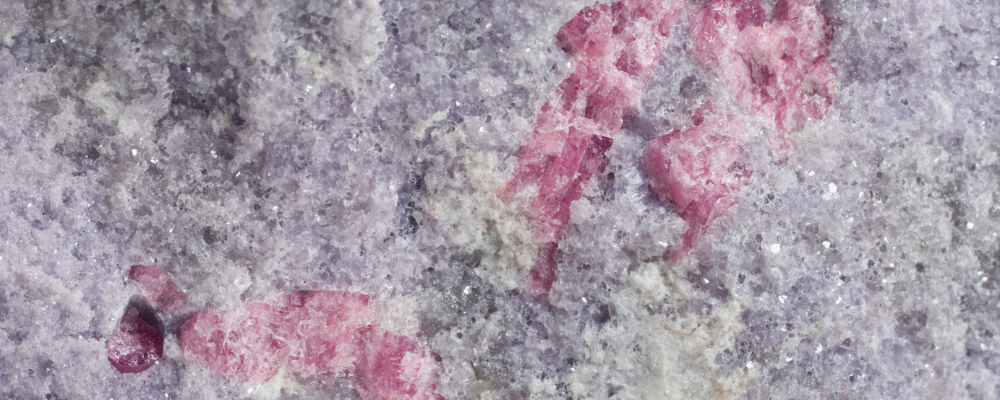
Lepidolite opens into fine pink, lilac, or silvery layers. It does not tell of an abrupt change, but of a transformation through layers: detaching from a habit, reorganizing a rhythm, turning a page without tearing out the whole book.
This lithium-rich mica has no identified ancient magical lineage. Its contemporary symbolism associates the Moon with cycles, Mercury with moving from one stage to another, Water with adaptation, and Air with a new perspective. It accompanies transitions, simplification, and calm built through concrete actions.
To place this stone among related minerals, compare it with Mica, Muscovite, and Biotite.
The Mica with Lilac Hues
The name Lepidolite refers to a group of lithium-rich micas related to the Trilithionite–Polylithionite series. Mindat specifies that it is a field name covering several closely related compositions, rather than a single mineral species.
Its color may be pink, lilac, violet, gray, or almost white. Its pearly surfaces separate into fine layers, a characteristic shared by micas and the direct source of its association with gradual transition.
A Layered Family
Lepidolite forms in pegmatites rich in rare elements, alongside Quartz, feldspars, Tourmalines, and other lithium minerals. The Handbook of Mineralogy page provides mineralogical information about this family.
Its perfect cleavage makes its layers easy to separate and sensitive to friction. A compact mass is easier to handle than a crystallized rosette, but every piece should be protected from water and impacts.
Lithium and Rubidium
The name comes from the Greek lepis, meaning scale, referring to its layered appearance. In the 19th century, the chemical study of this material also played a role in the history of the elements: the Royal Society of Chemistry recounts how Bunsen and Kirchhoff identified Rubidium in 1861 from a Lepidolite ore.
The presence of lithium in the rock does not turn the stone into a treatment. Contemporary associations with calm should remain symbolic and do not replace any medical support.
A transition becomes manageable when it is divided into sheets. Lepidolite does not ask you to resolve an entire life in one gesture; it invites you to recognize the page that can be turned today.
Moon, Mercury, Water, and Air
The Moon governs cycles, habits, and the need for rest. Mercury connects stages, organizes, and reformulates. Water facilitates adaptation; Air lightens what burdens the mind.
Monday suits adjusting a rhythm, and Wednesday suits sorting. Lilac, pearl gray, and white make up its palette. A journal, three loose sheets, and a silver ribbon can accompany its rituals.
Transition, sorting, and rhythm
Lepidolite accompanies a change of job, home, relationship, or daily organization. It invites you to separate what is ending, what remains, and what is beginning, so these movements do not become confused.
It is also suitable for periods of overload. Its role then is to reduce the number of simultaneous decisions, create a simple order, and make the next action visible.
Turn three pages
Prepare three sheets. On the first, write what you are ceasing to fuel. On the second, what you are keeping. On the third, the smallest action that opens the way forward.
Place the Lepidolite on the second sheet and say: “I keep my center while the pages turn.” Put away the first sheet, carry out the action on the third, then return to the ritual after seven days.
Correspondences and references
| Reference | Correspondence |
|---|---|
| Nature | Group name for lithium-rich micas |
| Structure | Sheets with perfect cleavage |
| Celestial bodies | Moon and Mercury, contemporary framework |
| Elements | Water and Air |
| Days | Monday and Wednesday |
| Areas | Transition, sorting, rhythm, simplification |
| Associated items | Journal, loose sheets, silver ribbon |
| Gesture | Separate what ends, remains, and begins |