















































































































































































































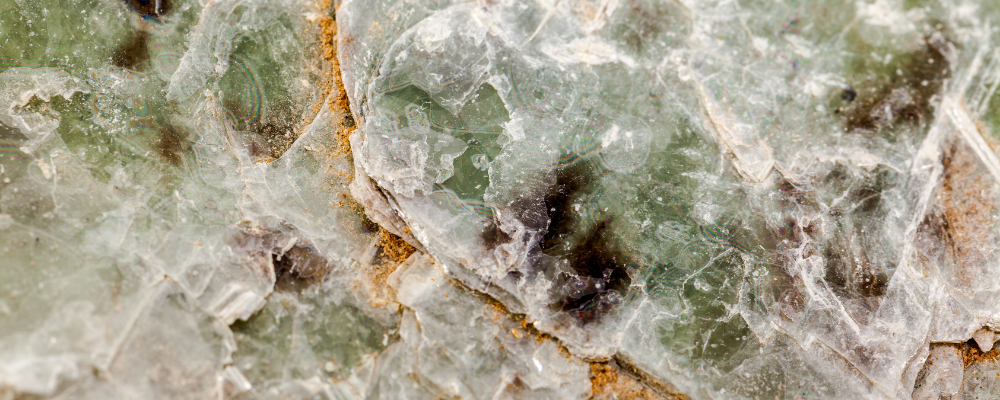
Mica appears as a book of stone: sheet after sheet, it separates without losing its luster. Some flakes let light pass through; others reflect it in silver, golden, or black flashes. Its symbolic language is that of planes, filters, and truths that can be distinguished without being torn apart.
“Mica” does not refer to a single stone, but to a family that notably includes Muscovite, Phlogopite, Biotite, and Lepidolite. There is therefore no single ancient occult tradition common to all micas. In a contemporary framework, Mercury governs distinction and writing, the Moon reflection, Air thought, and Earth the stacking of layers.
To place this stone among related minerals, compare it with Muscovite, Biotite, and Lepidolite.
A family of sheets
Mica is the name of a large group of layered silicates. The U.S. Geological Survey lists thirty-seven minerals in this family and distinguishes Muscovite and Phlogopite among the species important to industry.
A clear specimen is therefore not automatically Muscovite, just as a black specimen is not always Biotite. The Mindat mica group entry highlights this variety. When known, the species name refines the meaning and correspondences.
Separating without breaking
The bonds are strong within a sheet and weaker between the sheets. The crystal therefore separates into parallel, thin, shiny flakes. Some bend and then regain their shape; others are more brittle.
This structure makes a useful distinction visible: separating does not necessarily mean destroying. A fact can be isolated from an interpretation, responsibility from guilt, or an emotion from a decision so that they can later be brought back into relation more effectively.
From window to insulator
Large transparent sheets of Muscovite were used as panes for windows, lanterns, and stove doors. The Svalbard Museum displays Mica glazing and recalls its use in cold countries.
Heat resistance and low electrical conductivity subsequently led to industrial uses as an insulator. Mica’s material history thus brings together two actions: letting light pass through and maintaining a protective separation.
Seeing through is not the same as revealing everything. A clear sheet still filters the light, and a book of Mica layers several sheets over one another. Clarity requires knowing the layer from which one is looking.
Mercury, Moon, Air, and Earth
Mercury governs reading, organization, speech, and passage from one level to another. The Moon corresponds to reflection and changes in appearance according to the angle. Air carries thought; Earth maintains structure.
Wednesday suits writing and analysis, while Monday suits introspection. White, silver, gold, and black form a palette to adapt to the species. Tracing paper, a mirror, and a book are its working objects.
Clarity, boundaries, and reading
Mica accompanies the reading of a complex situation, the revision of a text, and the separation of confused responsibilities. It suits moments when several versions of a story overlap and their source must be identified.
It can also mark a light protection: letting useful information through while refusing intrusion. Placed near a desk, it supports orderly thinking without demanding complete certainty.
The Rite of the Four Layers
Write a question in the center of a sheet, then draw four spaces around it: “fact,” “interpretation,” “emotion,” and “decision.” Place the Mica near the category you most easily mix up with another.
Move each sentence to its proper layer. Say: “I separate to see, then I join to act.” Finish with a decision based on facts, informed by emotion, and clearly distinguished from both.
Correspondences and references
| Reference | Correspondence |
|---|---|
| Nature | Group of sheet silicates |
| Examples | Muscovite, Phlogopite, Biotite, Lepidolite |
| Suggested celestial bodies | Mercury and Moon |
| Suggested elements | Air and Earth |
| Days | Wednesday and Monday |
| Domains | Clarity, organization, boundaries, reading, reflection |
| Associated objects | Tracing paper, mirror, book |
| Gesture | Separate the layers before joining them |










