
























































































































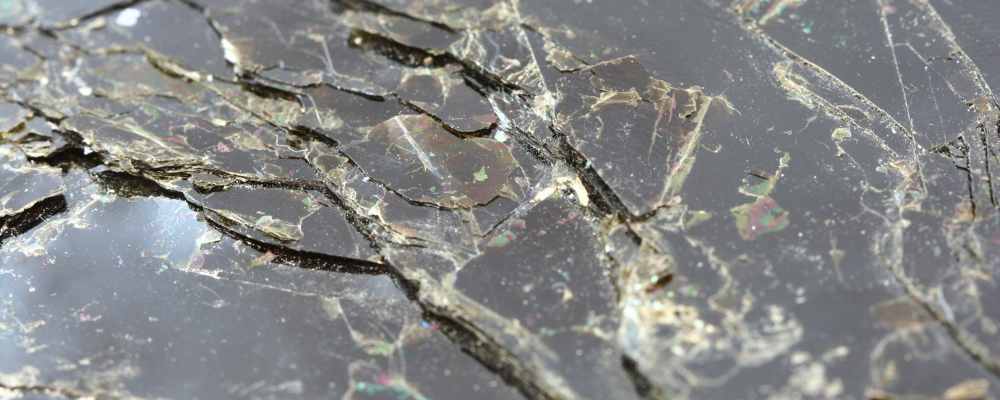
Biotite appears as dark layers that catch the light like the mineral pages of a closed book. In granite, gneiss, or schist, its black and brown sheets give rhythm to the rock and invite us to look at what lies between the layers.
It has no ancient magical lineage under this name, which was created in the 19th century. Nevertheless, its esoteric language can be constructed without fiction: Saturn governs structure and limitation, Mercury reading and classification, while Air moves between the layers of a material born from the Earth.
To place this stone among related minerals, compare it with Mica, Muscovite, and Lepidolite.
The Mica with Dark Pages
Biotite belongs to the micas: silicates whose layered structure allows perfect cleavage. It separates into thin, flexible, elastic sheets that are black, brown, or greenish. Its low hardness, around 2.5 to 3, explains the delicacy of its edges.
It is found in granites, gneisses, schists, and pegmatites. The Handbook of Mineralogy brings together its physical characteristics, while the rock surrounding it tells the story of the conditions under which it formed.
A Group Rather Than a Species
The term Biotite remains convenient for designating dark trioctahedral micas. Modern nomenclature, however, no longer treats it as a species with a fixed formula, but as a group situated notably between Annite and Phlogopite.
The mica classification associated with the International Mineralogical Association helps explain this nuance. It does not detract from the beauty of a specimen; it simply reminds us that a name visible to the eye may encompass several compositions.
The Perspective of Jean-Baptiste Biot
Johann Friedrich Ludwig Hausmann gave it this name in 1847 as a tribute to the French scientist Jean-Baptiste Biot, who studied the optical properties of micas. The Mindat entry on Biotite preserves this history.
The stone therefore does not appear under this name in ancient or medieval grimoires. Its magical use belongs to a contemporary construction by analogy, based on its layers, its color, and its role in rocks.
Biotite teaches that a reality can have several layers without becoming confusing. The first glance names the whole; examination distinguishes the parts. This tension between synthesis and precision forms the heart of its current symbolism.
Saturn, Mercury, Earth, and Air
Saturn is associated with black, time, memory, and boundaries. Mercury governs names, archives, and the passage from one layer of information to another. Earth provides the matrix; Air evokes the interval and reading.
Saturday is suitable for sorting and closure, while Wednesday is suited to study and organization. Pair Biotite with paper, black or brown ink, and a key, without tearing off its blades for the rite.
Reading, Boundaries, and Memory
Biotite accompanies the examination of a complex situation, the organization of archives, the writing of a chronology, and the separation of fact, interpretation, and emotion. Symbolically, it helps prevent confusing what belongs to the present with what comes from an older layer.
Placed near a file, it also reminds us that a healthy boundary does not deny history: it only indicates how far an obligation, promise, or responsibility extends.
The Three-Sheet Rite
Take three sheets of paper. On the first, write the facts; on the second, what you concluded from them; and on the third, the decision you can make now. Place the Biotite beside them, never under pressure that could cause it to delaminate.
Read the sheets in this order and say: “I distinguish the layers, I preserve the memory, I choose the right boundary.” Keep the third within reach and archive the other two.
Correspondences and References
| Reference | Correspondence |
|---|---|
| Nature | Group name for dark micas |
| Celestial Bodies | Saturn and Mercury |
| Elements | Earth and Air |
| Days | Saturday and Wednesday |
| Ritual Colors | Black, Brown, Gray |
| Areas | Memory, Organization, Boundaries, Reading |
| Associated Objects | Pages, Key, Black Ink |
| Action | Separate Fact, Interpretation, and Decision |