















































































































































































































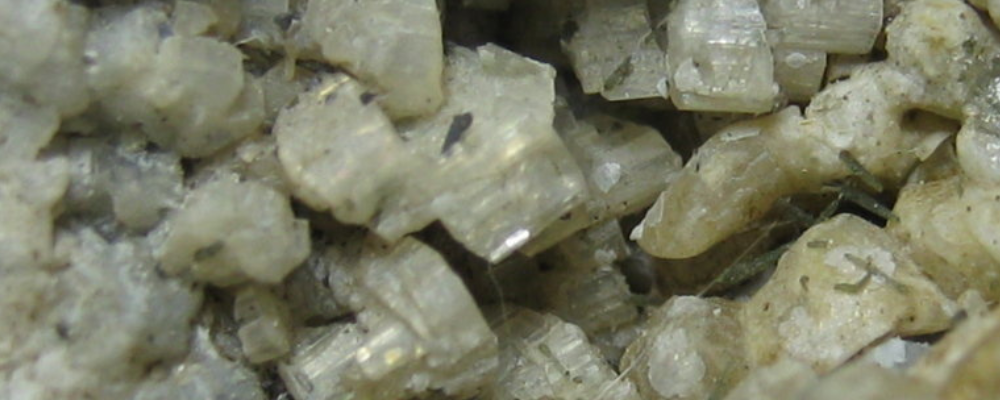
Davyne is a clear mineral from Leucite-rich lavas and blocks ejected by Italian volcanoes. Its structure belongs to the Cancrinite group, and its name honors the chemist Humphry Davy. It connects volcanic fire with laboratory experimentation: observe, separate, test, then name.
Identified in the 19th century, it has no ancient magical tradition. Its contemporary symbolism can follow this real history. Mercury governs experimentation and formulation, the Sun illuminates discovery, Saturn upholds the protocol; Fire transforms while Air makes observation intelligible.
To place this stone among related minerals, compare it with Cancrinite, Covelline, and Cafetite.
The Name of Humphry Davy
Davyne was named in honor of the English chemist Humphry Davy. The Mindat entry recalls this dedication and the species' variable formula.
The name suits a mineral containing sodium, potassium, and calcium: Davy isolated several metals by electrolysis in the early 19th century, including sodium and potassium.
The Cancrinite Framework
Davyne belongs to the Cancrinite group. Its aluminosilicate framework accommodates sodium, potassium, calcium, chloride, sulfate, and carbonate in varying proportions.
The Handbook of Mineralogy describes colorless to white hexagonal crystals with a hardness of 5.5 to 6. The structure provides a stable framework for several constituents.
Vesuvius, Chemistry, and Experiment
Davyne occurs at Monte Somma and Vesuvius, in Leucite-rich lavas and volcanic ejecta. It was described by Teodoro Monticelli and Niccolò Covelli, authors of a mineralogy of Vesuvius.
A mineralogical source published in 1816 already mentions the dedication to Davy and its association with the volcanic rocks. The name therefore connects field observation with experimental chemistry.
A hypothesis is not yet a result. It becomes useful when an observation supports it, a test can disprove it, and a date makes it possible to repeat the experiment.
Mercury, Sun, Saturn, and Fire
Mercury governs the question, the protocol, and the wording. The Sun reveals the result; Saturn sets the test conditions. Fire transforms matter, and Air makes it possible to describe what happened.
Wednesday is suitable for the hypothesis, Sunday for reading the result, and Saturday for checking. A notebook, three boxes, and a black pin accompany the stone.
Observation, Hypothesis, and Evidence
Davyne accompanies research, a commercial trial, a change in method, or a decision based on too many impressions. It invites you to separate what you observe from what you assume.
It is also suitable for small-scale trials. Testing one variable before transforming the entire system reduces risk and makes learning visible.
The Rite of Experimentation
Draw three boxes in a notebook: observation, hypothesis, test. First describe the fact without explaining it, then formulate a single interpretation, and finally choose an action capable of confirming or correcting it. Place the Davyne above the page.
Say: “I distinguish what I see from what I imagine. I test my idea and welcome the result.” Date the test before beginning.
Correspondences and Reference Points
| Reference Point | Correspondence |
|---|---|
| Nature | Mineral Species of the Cancrinite Group |
| Celestial Bodies | Mercury, Sun, and Saturn |
| Elements | Fire and Air |
| Days | Wednesday, Sunday, and Saturday |
| Ritual Colors | White, Yellow, Black |
| Domains | Observation, Hypothesis, Trial, Evidence |
| Associated Objects | Notebook, Three Boxes, Black Pin |
| Gesture | Separate Fact, Interpretation, and Test |










