


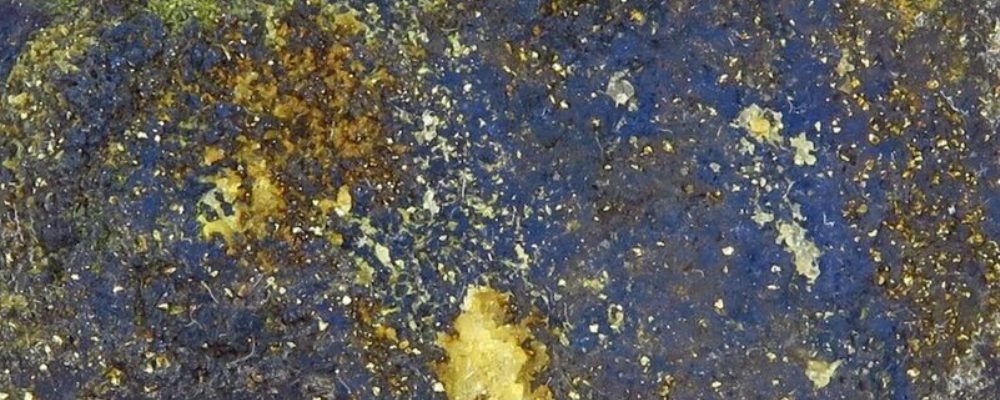
Covelline covers copper with an almost nocturnal indigo blue, crossed by red, violet, or metallic flashes. Its sheets are soft and fragile. This changing surface gives the stone a language of thresholds: what appears on the outside tells of a transformation already underway within the material.
Discovered at Vesuvius and named in the 19th century, it has no documented magical tradition of its own. Its composition nevertheless allows for a coherent modern correspondence. Venus receives copper, the Moon indigo, Saturn the layers and the boundary; Water transforms the surface while Earth preserves the body of the ore.
To place this stone among related minerals, compare it with Copper, Bronze, and Malachite.
The name of Niccolò Covelli
Covelline, called Covellite in English, honors Niccolò Covelli, who discovered the mineral at Vesuvius. The Mineralogical Society of America dates its naming to 1832.
The name thus associates a person and a volcano, but the stone is found mainly in areas where copper deposits are transformed.
An indigo copper sulfide
Covelline is a copper sulfide, CuS. The Handbook of Mineralogy describes its hexagonal plates, perfect cleavage, very low hardness of 1.5 to 2, and frequently iridescent indigo color.
Its thin leaves can be flexible, but the specimen remains delicate. Its metallic luster should therefore not make us forget the fragility of the material that bears it.
From Vesuvius to copper deposits
At Vesuvius, Covelline can appear in a volcanic setting. In many deposits, it instead forms as a secondary mineral when copper sulfides are transformed near the surface.
The CAMEO database of Boston’s Museum of Fine Arts recalls its connection with Covelli and describes its dark blue appearance. The stone thus becomes a visible witness to a chemical change in the ore.
The surface is not always a mask. It may be the first trace of a real transformation. Before removing it, you must understand what it announces and what it protects.
Venus, Moon, Saturn, and Water
Venus corresponds to copper and relational value. The Moon receives indigo and changing states; Saturn holds the strata and boundaries. Water works on the surface, while Earth preserves the support.
Friday is suited to relationships, Monday to observing a change, and Saturday to protection. A copper disk, a blue card, and a black square accompany the stone.
Surface, Transition, and Revelation
Covelline accompanies a period when the first signs appear before the transformation is complete. It invites you to observe a transition without artificially accelerating it.
It is also suited to working with public image: distinguishing what appearance reveals, what it protects, and what it ultimately conceals.
The Rite of Surface and Depth
Place a blue card on a black square. On the card, write what becomes visible; beneath it, what is truly changing. Place a copper disk beside the Covelline, without direct contact.
Say: “I read the sign without confusing it with the entire work. I let the transformation reach its form.” Choose a concrete indicator to observe for seven days.
Correspondences and References
| Reference | Correspondence |
|---|---|
| Nature | Mineral species, copper sulfide |
| Celestial Bodies | Venus, Moon, and Saturn |
| Elements | Water and Earth |
| Days | Friday, Monday, and Saturday |
| Ritual Colors | Indigo, violet, black, copper |
| Areas | Surface, transition, revelation, image |
| Associated Objects | Copper disk, blue card, black square |
| Gesture | Distinguishing the Visible Sign from Real Change |