


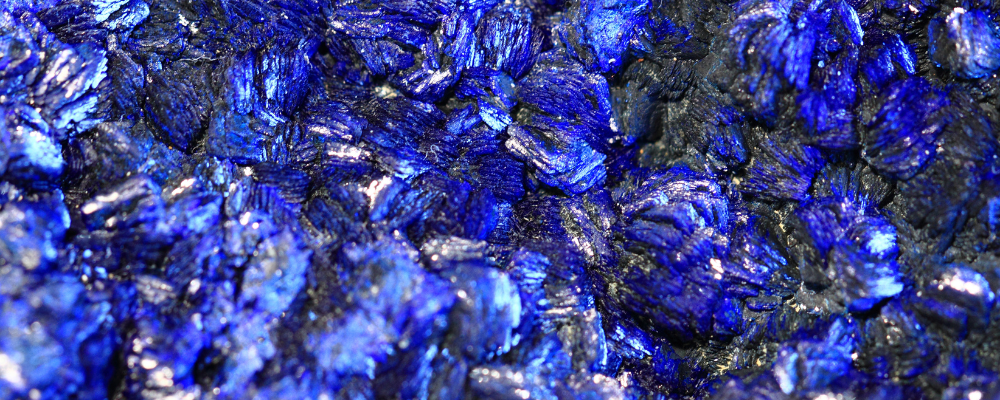
Deep blue born in copper deposits, Azurite was first a color before becoming a vision stone. Ground up, it gave painters a sought-after pigment; kept whole, it joined 20th-century practices of dreaming, divination, and contemplation.
Its domain is not one of ostentatious revelation. Azurite asks us to look for a long time, to let an image emerge, and to distinguish what comes from observation, memory, or desire. Its magic is a discipline of the gaze.
To place this stone among related minerals, compare it with Malachite, Azurite-Malachite, and Chrysocolla.
The Blue of Copper
Azurite is a deep-blue copper carbonate. It forms in areas where copper ores undergo alteration through contact with water and air. It occurs alongside green Malachite, and the two minerals may meet within the same specimen.
Its hardness of 3.5 to 4 calls for gentleness. The Azurite entry in the Handbook of Mineralogy brings together its properties and main discovery sites. For the ritual gaze, its most striking feature remains this blue that seems to concentrate the sky within an earthly material.
From Stone to Pigment
Azurite was ground to produce a blue pigment used in antiquity, the Middle Ages, and the Renaissance. The powder was prepared and bound before being applied. The fineness of the grinding altered the shade: if ground too finely, it lost some of its intensity.
The Metropolitan Museum of Art’s pigment glossary recalls this material history. The transition from rock to image gives its symbolism a very concrete foundation: Azurite makes visible what initially existed only in the painter’s eye and hand.
The Birth of a Vision Stone
Ancient occult compendiums do not devote a body of work to it comparable to that devoted to Amethyst. In 1922, Isidore Kozminsky describes it and places it under Libra. Late-20th-century stone magic develops its links with perception more clearly.
In his 1988 encyclopedia, Scott Cunningham associates Azurite with Venus and Water. He recommends it for dreams, divination, and the development of perception. This association is modern and identifiable; it does not need to be disguised as pharaonic secrecy to support a practice.
From pigment to vision. Azurite was genuinely used to create images. Contemporary magic extends this fact by analogy when it makes the stone a focus for contemplation: the continuity is symbolic, not proof of an unchanged rite since antiquity.
Venus, Water, and Libra
Venus governs accord, proportion, and the ability to connect. Libra adds the weighing of viewpoints. Water receives images, distorts them, or reflects them. Together, these correspondences give Azurite the role of mediator between vision and judgment.
Friday is suitable for a question about a relationship or agreement. Evening and the lunar hour are better suited to dreams. These frameworks are ritual choices, not physical properties of the stone.
Dreams, divination, and right seeing
For dreams, place the Azurite on a table near the bed, never under the pillow, where its softness would expose it to impact. Write a short question before going to sleep. Upon waking, note the images before trying to interpret them.
For a decision, place the stone between two papers presenting the options. Read each text aloud, then add the concrete consequences, costs, and people concerned. Libra does not decide by enchantment: it obliges you to weigh things carefully.
In an artistic practice, Azurite can accompany the transition from idea to image. Place it near your notebook, look at its color, then make a first sketch without waiting for it to be perfect.
The Rite of the Two Lights
Place the Azurite between two white candles, leaving enough distance so that it does not heat up. Write a question that does not call only for “yes” or “no.” Light the candles and look at the stone for a few minutes, without forcing the appearance of a scene.
Close your eyes, note three words or images, then open them again and write down what belongs to fact, fear, and desire. The rite ends when these three categories have been separated. Give thanks, extinguish the candles, and return to your notes the following day.
Correspondences and references
| Reference | Correspondence |
|---|---|
| Nature | Blue copper carbonate |
| Hardness | 3.5 to 4 on the Mohs scale |
| Planet | Venus according to Scott Cunningham |
| Sign | Libra according to Isidore Kozminsky |
| Element | Water |
| Areas | Dreams, divination, art, discernment, and accord |
| Ritual image | The pigment that makes a vision visible |
| Ritual act | Contemplate between two lights, then distinguish fact, fear, and desire |