















































































































































































































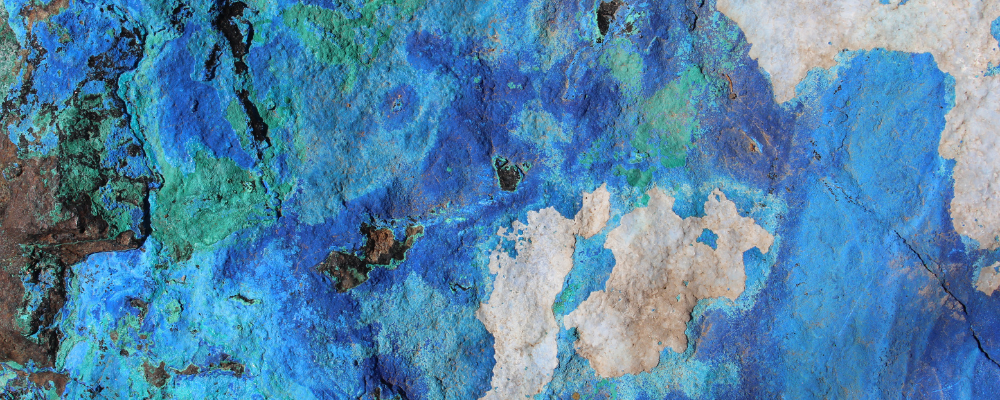
Azurite-Malachite brings together the blue and green of two copper carbonates that form in the same oxidation zones. Azurite opens a space for vision and speech; Malachite gives this perception protection, a boundary, and tangible growth.
The two minerals were used as pigments long before entering modern collections. Their esoteric lineage passes through Copper, the metal of Venus, and through Libra, which Kozminsky attributes to both Azurite and Malachite. Their union serves harmony between what is understood and what must be transformed.
To place this stone among related minerals, compare it with Copper, Azurite, and Bronze.
Two Carbonates Born of Copper
Azurite and Malachite are hydroxylated copper carbonates. Azurite is blue; Malachite, green. The Smithsonian National Museum of Natural History explains that they occur together in copper deposits and were exploited as ores, pigments, and ornamental stones.
Water rich in carbon dioxide acts on copper ores near the surface. Depending on the conditions, Azurite can also transform into Malachite. The two-color specimen therefore shows two minerals linked by the same metal and by a shared geological history.
The Blue and Green of Ancient Pigments
Ground into powder, Azurite and Malachite provided colors for painting and ritual decoration. The Metropolitan Museum of Art notes that Azurite was mined in antiquity in Egypt, Cyprus, and Spain. Malachite served as a mineral green and could be used in the manufacture of Egyptian blue.
These uses do not make it possible to automatically assign a magical function to each pigment. They nevertheless establish a real presence of copper-bearing blue and green in funerary, votive, and ceremonial objects.
Venus, Libra, and Renewal
In The Magic and Science of Jewels and Stones, published in 1922, Kozminsky places Copper compounds under Venus. He links Azurite and Malachite to Libra. He also presents Malachite as a Rosicrucian symbol of spring and reports its uses for protection against falls, accidents, hostile magic, and the evil eye.
In the mixed stone, Azurite can represent the vision that identifies an imbalance; Malachite, the act that restores harmony. The Scales do not erase conflict: they seek a measure that can be upheld.
See in blue, act in green. Perception transforms nothing until it receives either a gesture or a limit. Azurite-Malachite connects understanding with the conduct that makes it real.
Venus, Mercury, Water, and Earth
Venus governs Copper, harmony, beauty, attraction, and Libra. Mercury supports speech, analysis, and the transition from an idea to an action. Water dissolves and transports; Earth fixes the color and gives it form.
Friday is suitable for relationships, household protections, and reconciliations. Wednesday serves conversations, diagnoses, and contracts. A Copper wire, two blue and green papers, a scale, or a covered mirror extend these correspondences.
Vision, protection, and reconciliation
For a relationship, write on the blue paper what you understand about the situation, then on the green paper what you agree to do. Set aside any action that contradicts the observation.
For protection, place the stone near an entrance and define the rule it represents: access, schedule, speech, or behavior. A stated boundary protects better than diffuse hostility.
For a creative project, use blue for the concept and green for the means. The stone reminds us that inspiration requires materials, a budget, and a deadline.
From blue to green
On a Friday, place a blue paper on the left and a green paper on the right. On the first, write the truth you must acknowledge. On the second, write the act capable of responding to it.
Place the Azurite-Malachite between the two and say: “I see without fleeing; I act without betraying what I see.” Carry out the act before the following Friday, then bring the papers together.
Correspondences and references
| Reference | Correspondence |
|---|---|
| Nature | Natural association of two Copper carbonates |
| Colors | Azurite blue and Malachite green |
| Planets | Venus and Mercury |
| Sign | Libra according to Isidore Kozminsky |
| Elements | Water and Earth |
| Days | Friday and Wednesday |
| Areas | Vision, harmony, protection, speech, and reconciliation |
| Ritual gesture | Linking an acknowledged truth to a concrete action |










