
























































































































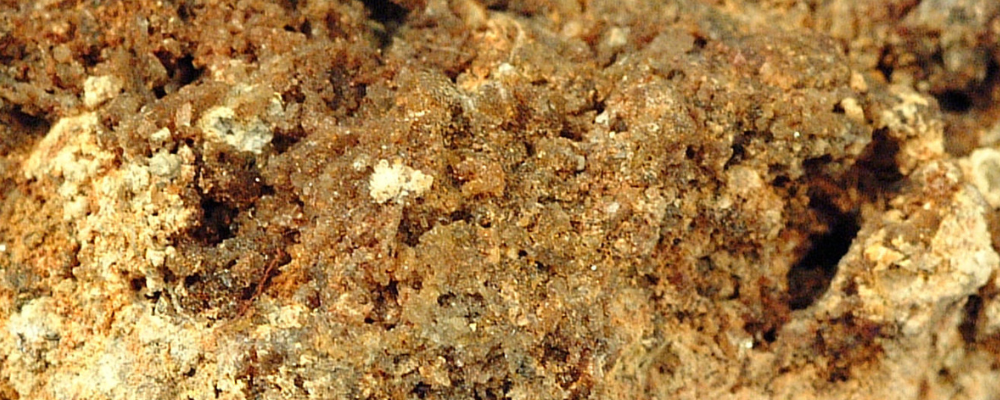
Bismite appears where Bismuth meets oxygen. Its yellow to greenish powder covers the metal like a new skin and makes visible a transformation that would otherwise remain silent. It invites us to observe what time deposits on the surface without confusing trace, alteration, and loss.
Mineralogy defines it as a natural oxide of bismuth. Its name and classification are modern; the symbolism proposed here connects the Sun with its color, Saturn with aging, Air with oxidation, and Earth with the material that preserves the mark of change.
To place this stone among related minerals, compare it with Bismuth, Covelline, and Adamite.
The natural oxide of Bismuth
Bismite is the bismuth oxide Bi2O3. The Handbook of Mineralogy describes it in the monoclinic system, occurring as earthy masses, coatings, or very rare crystals. Its colors range from yellow to greenish yellow, with a luster varying from dull to adamantine depending on the condition of the material.
A simple yellow hue is not enough to identify it. Other alteration products of Bismuth may resemble it, and identifying a powdery deposit requires analysis.
A surface born of oxidation
Bismite forms in the oxidized zones of deposits containing Bismuth. The Mindat entry presents it as an oxidation product of native Bismuth and bismuth-bearing minerals.
It therefore tells of a transition: the metal is not erased, but its encounter with the environment produces a distinct substance. This mineral skin becomes the visible archive of air, moisture, and time.
From Bismuth to Bismite
Bismuth was long associated with lead, tin, or antimony before being recognized as a distinct element. Bismite received a name formed directly from that of the metal whose oxide it is.
The RRUFF project compiles spectroscopic data that make it possible to distinguish Bismite from related phases. Its history reminds us that the eye detects a transformation, but measurement establishes its nature.
The surface is not a worthless mask. It receives marks from its surroundings and reveals what has acted upon it. Reading a trace nevertheless requires separating observation from interpretation.
Sun, Saturn, Air, and Earth
The Sun receives yellow and illumination. Saturn governs age, patina, and lasting consequence. Air represents oxidation; Earth, the matter that bears the trace. Sunday is suitable for revealing a fact, and Saturday for examining its effects over time.
A yellow disk placed on a black square accompanies the work. Bismite remains in its box if its surface is powdery or friable.
Trace, aging, and visible truth
Bismite accompanies the examination of signs left by a situation: the wearing away of a relationship, the drift of a habit, the effect of a decision, or a change in a place. It helps you look at the actual mark before telling the story of its cause.
It also supports passages in which one accepts that a transformation can produce a new identity without erasing the history of the original material.
The rite of the revealing surface
Place the Bismite, enclosed in its box, or use a photograph. On a sheet of paper, draw a yellow disk. Inside it, describe only what you observe. Around the circle, write down the possible causes, then mark those that can be verified.
Say: “I see the trace, I verify its cause, and I respond to what it reveals.” Then choose an action based on a verifiable fact.
Correspondences and references
| Reference | Correspondence |
|---|---|
| Nature | Natural bismuth oxide |
| Celestial bodies | Sun and Saturn |
| Elements | Air and Earth |
| Days | Sunday and Saturday |
| Ritual colors | Yellow, pale green, black |
| Domains | Trace, revelation, aging, verification |
| Supports | Yellow disk, black square, photograph |
| Gesture | Distinguishing fact from interpretation |