


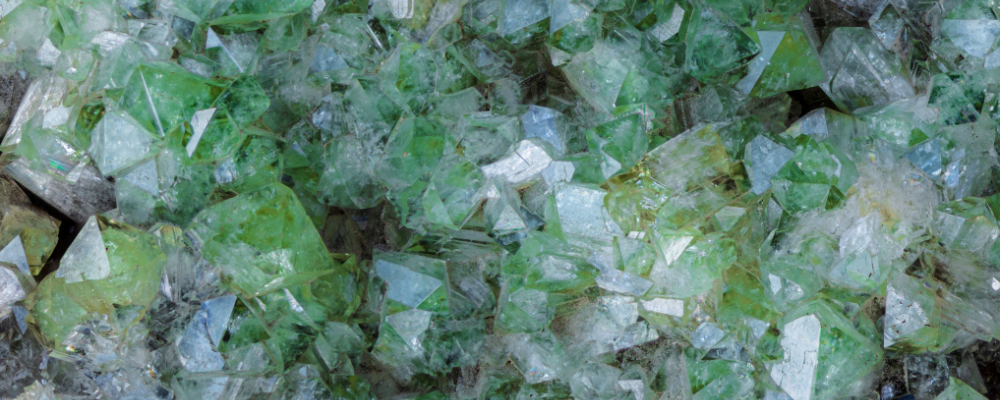
Adamite may seem made of honey, lemon, or young grass. Under ultraviolet light, some specimens respond with vivid fluorescence. This ability to change appearance according to the light has encouraged a recent language of revelation and clarity; however, it proves neither therapeutic power nor a sacred heritage from antiquity.
Described in the 19th century, Adamite belongs to the history of mining sciences. It forms in the oxidized zone of zinc deposits containing arsenic. Its beauty therefore imposes a clear rule: admire it without ingesting it, create no dust, and keep the stone out of children's reach.
Its most coherent ritual use begins with what it actually shows: a secondary material born when ore meets oxygen, a color that changes according to the elements present, and fluorescence that reveals another face of the crystal.
To place this stone among related minerals, compare it with Apatite, Turquoise, and Variscite.
A fragile zinc arsenate
Adamite is a hydroxylated zinc arsenate, with the formula Zn2(AsO4)(OH). It crystallizes in the orthorhombic system. Its hardness, between 3.5 and 4 on the Mohs scale, makes it susceptible to scratches and impacts. Its high density, close to 4.3 to 4.5, contrasts with the luminous appearance of its crystals.
It forms prismatic crystals, rounded aggregates, crusts, and radiating groups. Colors range from colorless to yellow, greenish yellow, and green. Partial substitution of zinc by copper can intensify the green. The mineralogical entry for Adamite on Mindat brings together its formula, properties, and occurrences.
Forming in the oxidation zone
Adamite is a secondary mineral. It forms near the surface, where water and oxygen transform zinc ores associated with arsenic. The released elements recombine and coat fissures or cavities. Localities in Chile, Mexico, Greece, Namibia, and other mining regions have yielded specimens prized for their crystals and fluorescence.
The word “secondary” does not indicate lesser value. It describes a geological stage: Adamite is not the first mineral deposited, but the product of a new circulation and a new equilibrium. This formation after alteration offers an apt image for reformulation work: a situation exposed to the air becomes readable in another way.
The transformation does not erase the origin. Adamite retains the zinc and arsenic from the deposit in its formula. In a contemporary practice, it can represent the moment when one stops hiding a problem’s data and works with what is actually present.
Friedel, Adam, and the year 1866
The French mineralogist and chemist Charles Friedel named Adamite in 1866 in honor of Gilbert Joseph Adam, a collector and inspector of finances. The first specimens studied came from Chañarcillo, in the present-day Atacama Region of Chile.
This origin is unambiguous: the name evokes neither the biblical Adam, nor a “first man,” nor a primordial stone. Any interpretation that builds symbolism around the figure from Genesis is based on a similarity between words, not on the history of the mineral.
Adamite therefore does not appear under this identity in ancient or medieval lapidaries. Its history begins with mineral collecting, mines, and 19th-century chemistry. A contemporary ritual practice remains possible if it acknowledges this framework.
Color and fluorescence: two readings of the same stone
Many yellow specimens emit a yellowish-green light under ultraviolet light, while others react weakly or not at all. Fluorescence depends on the composition and defects in the crystal lattice. On its own, it cannot certify a specimen’s identity or provenance.
The phenomenon remains fruitful for ritual: the material does not change, but different illumination makes visible what ordinary lighting did not show. Rather than seeing it as a “high frequency,” one can recognize a discipline of reading: change the angle, test a hypothesis, and distinguish fact from interpretation.
Making a situation understandable
Keep the Adamite in a closed box and place it beside two sheets of paper. On the first, write what you know with certainty. On the second, note what you suppose, fear, or hope. Read them again under two different types of lighting, then move the statements that are in the wrong category. This gesture draws on the stone’s visual capacity without asking it to reveal a hidden truth.
For a decision-making exercise, list three options and, under each one, the real cost, the expected benefit, and the person who will have to answer for the consequences. Light a lamp and say: “May what is tangled be distinguished,” then choose the step that makes it possible to gather the missing information. Keep the Adamite closed throughout the entire operation.
In a transformation ritual, place an object representing the initial state and another representing the desired form in front of the box. Write the concrete process connecting them between the two. The stone reminds us that oxidation produces new material in stages; it promises neither a shortcut nor healing.
Handling and storage
The presence of arsenic in its composition means that Adamite must never be licked, ingested, immersed to prepare a drink, heated, ground, polished, or drilled. Wash your hands after handling and avoid any contact with food. A friable piece should remain confined.
The low hardness and fragility of the crystals prohibit vigorous brushing, steam, and ultrasound. Remove dust from the container, not the crystal, with a damp cloth. If cleaning the stone is essential, entrust it to a specialist in mineralogical collections.
To observe fluorescence, use a UV lamp designed for this purpose, protect your eyes and skin, and limit exposure. Never look directly at the source. UV light is used to observe a phenomenon; it is not a purification method.
Mineralogical and ritual references
| Reference point | Correspondence |
|---|---|
| Mineralogical nature | Hydroxylated zinc arsenate |
| Formula | Zn2(AsO4)(OH) |
| Crystal system | Orthorhombic |
| Hardness | 3.5 to 4 on the Mohs scale |
| Colors | Colorless, yellow, yellow-green, or green |
| Name | Named by Charles Friedel in 1866 in honor of Gilbert Joseph Adam |
| Formation | Oxidized zone of zinc deposits containing arsenic |
| Optical phenomenon | Yellow to yellow-green fluorescence in some specimens |
| Current practice | Clarification, distinction between facts and projections, reformulation after a crisis |
| Precaution | No ingestion, dust, or immersion; wash hands |