
























































































































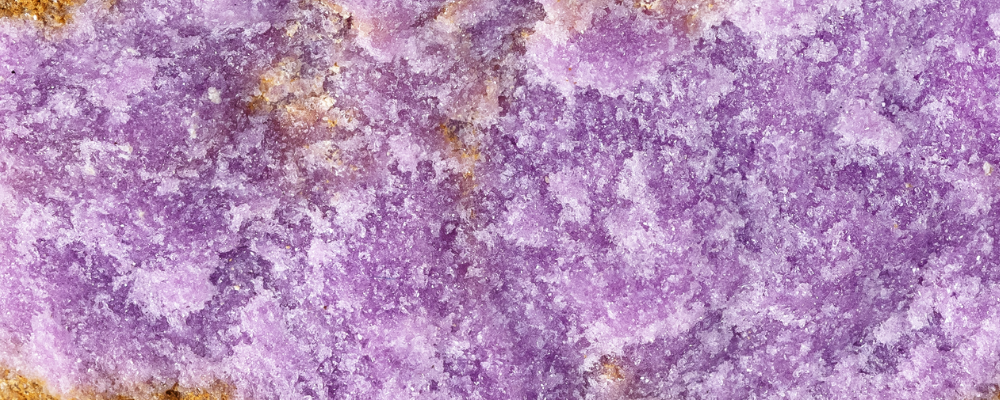
Violet, pink, or reddish brown, Phosphosiderite forms when iron-rich phosphates transform. Its name unites phosphate with the Greek sideros, iron. It becomes a stone of redirected strength: Mars’s drive receives Jupiter’s measure and finds a calmer form in Earth and Water.
Its magic is contemporary, but it can be constructed without vague formulas. Its composition provides the Martian iron; violet calls upon Jupiterian authority; mineral alteration supplies the central theme. Phosphosiderite accompanies the passage from a raw reaction toward a decision that preserves the strength without preserving the conflict.
To place this stone among related minerals, compare it with Iron, Hematite, and Magnetite.
The iron phosphate with violet hues
Phosphosiderite is a hydrated iron phosphate, FePO4·2H2O. The Handbook of Mineralogy describes violet, pink, red, brown, or nearly colorless specimens. Its moderate hardness calls for gentle handling.
Violet attracts the eye, but it does not sum up the entire stone. This variation reminds us that a single identity can carry several expressions. In ritual, it suits emotions that must be acknowledged before a direction is chosen for them.
The iron inscribed in the name
The name Phosphosiderite was given in 1890 from phosphate and the Greek sideros, “iron.” The Mindat entry preserves this etymology based on the composition.
Iron has long belonged to the vocabulary of Mars. Yet the stone does not contain a metal blade: the iron is bound in a hydrated phosphate. This change of form supports a ritual reading of restrained, transformed, and made governable strength.
Strength transformed by alteration
In some pegmatites, Phosphosiderite appears as an alteration product of primary phosphates. It shares its formula with Strengite but adopts a different structure. The Webmineral database details its monoclinic system and properties.
Matter does not disappear: it reorganizes when it comes into contact with a new environment. This story suits periods following an argument, a disruption in rhythm, or a rash decision. The work does not seek to erase the event, but to give it a less abrasive continuation.
Mars is not suppressed; it is directed. The martial association comes from iron and strength. Jupiter adds judgment, moderation, and violet. This combination belongs to a contemporary interpretation presented as such.
Mars, Jupiter, Earth, and Water
Mars gives the courage to act, make decisions, and defend a boundary. Jupiter requires the action to serve an order greater than immediate anger. Earth stabilizes; Water, present in the formula, receives the return to calm and adaptation.
Tuesday is suitable for decision-making and reclaiming authority. Thursday supports reconciliation with a fair rule, learning, and broadening one’s perspective. Violet, muted red, and a bowl of water placed at a distance make up its altar.
Calm, authority, and redirected strength
After a conflict, place the Phosphosiderite near the written account of the facts. Underline what still requires action and cross out what can no longer be changed. The stone preserves the strength intended for the first part without feeding the second.
For authority, consecrate it to a rule that you must enforce consistently. Write down the intended consequence and apply it without adding a threat. Jupiter gives legitimacy; Mars provides execution.
In a difficult learning process, it accompanies the moment when error becomes method. Note the correction and repeat the action until a new form replaces the old habit.
From iron to a kept word
On a Tuesday, write down a reaction that you refuse to let guide you. Below it, express the same force as a right action: reply later, set a boundary, seek redress, or leave a situation.
Place the Phosphosiderite between the two sentences. On Thursday, reread only the second and carry it out. Say: “I preserve the strength and choose its form.” Put the stone away when the act has replaced the reaction.
Correspondences and references
| Reference | Correspondence |
|---|---|
| Nature | Hydrated iron phosphate |
| Name | Phosphate and Greek sideros, “iron” |
| Suggested planets | Mars and Jupiter |
| Suggested elements | Earth and Water |
| Days | Tuesday and Thursday |
| Areas | Calm, authority, courage, correction, and transformation |
| Ritual image | Iron engaged in a new structure |
| Ritual act | Turning a reaction into a right and deliberate action |