















































































































































































































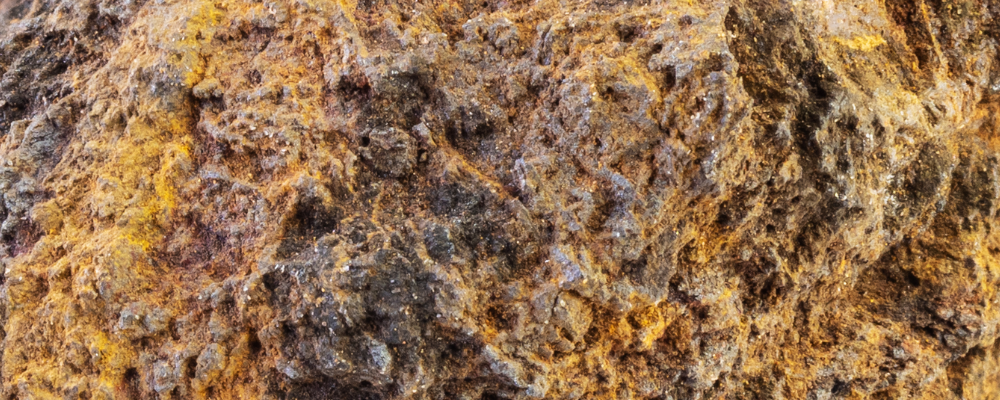
Limonite bears the yellows, browns, and rust-colored earths that accompanied humanity long before writing. It is not an isolated mineral species, but a field name for iron oxides and hydroxides. In the hand, it connects rock, color, and the first mark left on a surface.
Iron-rich ochres served as pigments, signs, and adornment materials for more than one hundred thousand years. This antiquity does not give every piece of Limonite a universal power, but it grounds a symbolism of trace, memory, and territory. Saturn fixes the mark, the Sun reveals the color, the Earth bears it, and Fire transforms yellow toward red.
To place this stone among related minerals, compare it with Iron, Hematite, and Magnetite.
The iron’s yellow earth
Limonite appears as earthy masses, crusts, nodules, or yellow to brown concretions. Its streak ranges from brownish yellow to rust brown. The name comes from the Greek leimôn, meaning wet meadow, in reference to iron deposits formed in water-rich environments.
Its material may be compact or friable. This difference matters for care: an earthy piece should be preserved like an archaeological pigment, without washing, whereas a dense mass can withstand more direct dusting.
One name for several materials
Mindat explains that “Limonite” most frequently refers to Goethite, associated in varying proportions with Lepidocrocite, Hematite, Maghemite, and other components.
It is therefore best understood as a natural mixture or a descriptive term, not a fixed formula. Rain, oxygen, and time transform iron minerals and deposit these yellows and browns: Limonite is as much a transitional material as it is a material of traces.
Ochre, an ancient color
Ochres are rocks or earth rich in iron oxides, whose composition may include Goethite and Limonite. The Smithsonian Human Origins Program reminds us that our species has used these pigments for more than one hundred thousand years.
In ancient Egypt, yellow, red, and brown were obtained with ochres and iron oxides. The Metropolitan Museum of Art shows how these minerals were ground and then mixed with a binder to become paint.
These uses were material, aesthetic, and, depending on the context, ritual. They allow ochre to be linked to human marking; they do not authorize attributing the same meaning to every culture that used it.
The first magic may be the trace that remains. Marking a wall, an object, or a body transforms a place into memory. Limonite invites us to choose the mark we are willing to leave behind.
Saturn, Sun, Earth, and Fire
Saturn governs duration, the boundary marker, and inscription. The Sun reveals the color and makes the mark visible. Earth carries the pigment; Fire transforms the oxides and turns some ochres from yellow to red.
Saturday suits boundaries, and Sunday visibility. Ochre yellow, brown, and rust red make up its palette. A stick of ochre chalk, a drawn boundary marker, or an imprint on paper may accompany its rites.
Trace, Memory, and Territory
Limonite accompanies work involving family memory, the demarcation of a space, and the transmission of a rule. It asks: which trace do we receive, which do we extend, and which ends with us?
It is also suitable for protecting a workshop, office, or place of study. Here, protection takes the form of a defined threshold and a stated use, rather than a supposedly self-acting invisible barrier.
The Mark That Remains
Without grinding the stone, draw a rectangle in ochre pencil representing your work territory. Write inside what may enter it; outside, what must remain beyond this space.
Place the Limonite on the line and say: “My mark makes the boundary visible. My memory chooses what it transmits.” Then place the sheet near the relevant threshold and follow the written rule for seven days.
Correspondences and References
| Reference | Correspondence |
|---|---|
| Nature | Descriptive term for iron oxides and hydroxides |
| Colors | Brownish yellow, ochre, rust brown |
| Celestial Bodies | Saturn and Sun |
| Elements | Earth and Fire |
| Days | Saturday and Sunday |
| Domains | Trace, memory, territory, transmission |
| Associated Objects | Ochre chalk, boundary marker, imprint |
| Gesture | Making a boundary visible |










