















































































































































































































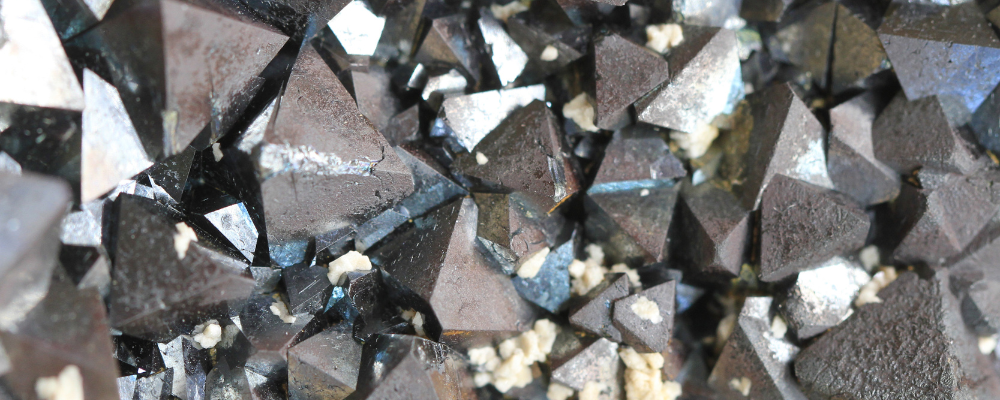
Magnetite has an action the eye can follow: it responds to a magnet and, in its naturally magnetized form, attracts iron. This property made it a stone of direction, attraction, and fidelity to one’s purpose. Its magic here extends the material’s actual behavior.
Its history links the compass, tales of lovers brought together by the magnet, and African American rootwork. Mars gives it iron and willpower; Venus, attraction and accord; Earth, stability. Few stones offer such clear esoteric associations without requiring vague powers to be attributed to them.
To place this stone among related minerals, compare it with Iron, Hematite, and Limonite.
The Black Ore That Attracts
Magnetite is a black iron oxide, Fe3O4, found in many rocks. The Handbook of Mineralogy describes its structure, forms, and properties. All specimens respond to a magnetic field, but not all independently attract an iron object with the same force.
“Lodestone” refers to magnetite that retains a perceptible natural magnetization. This distinction matters in practice: before any attraction ritual, gently bring a pin or a little magnetic sand close to it and observe the response.
The Stone That Shows the Way
A lodestone free to pivot aligns itself with Earth’s magnetic field. From this property arose one of the instruments that transformed travel: the compass.
The National High Magnetic Field Laboratory traces early observations of iron’s attraction. The Royal Museums Greenwich preserves a lodestone used to remagnetize compass needles until the 18th century. The stone thus became a symbol of maintaining one’s course as much as of an attracted object.
Venus Attracts Mars
In the 4th century, the poet Claudian described a statue of Venus made of lodestone attracting an iron statue of Mars. The scene gives desire a striking form: Venusian gentleness sets Martian strength in motion.
The theme was taken up in early 20th-century lapidary occultism, notably in The Magic and Science of Jewels and Stones by Isidore Kozminsky. A pair of stones can then represent two people drawing closer, provided the rite serves a consensual and reciprocal bond.
Attraction is not coercion. A magnet acts when iron enters its field. In love or business work, the stone represents a meeting made possible by a clear presence, a real offer, and a free exchange.
A living stone in Hoodoo
In African American Hoodoo and rootwork, the lodestone holds a major place in money, clientele, luck, and love workings. A stone can represent a business or a person; a pair represents two partners.
It receives a written request, coins, or other witnesses, and is then “fed” with filings or magnetic sand. The testimonies collected by Harry Middleton Hyatt in the 20th century, available in Hoodoo, Conjuration, Witchcraft, Rootwork, attest to this practice in mojo bags, bottles, and attraction workings.
Love, clientele, and willpower
For a business, Magnetite supports the arrival of genuinely interested people, regular sales, and the return of satisfied customers. For love, it supports coming closer, fidelity, and mutual attention. For a project, it recalls the direction when requests scatter your efforts.
Mars and Venus form its planetary pair: Mars provides iron and movement, Venus harmony and attraction. Earth stabilizes the whole. Tuesday is suited to action, Friday to relationships and business.
Feeding a worthy attraction
Place the stone in a dry dish, with a brief request. Place three witnesses to the goal around it: coins for business, two names for an agreement, or a small compass for direction. Bring them closer to the center while naming a concrete action that opens their path.
Every Tuesday or Friday, add a pinch of magnetic sand and perform the announced action: publish an offer, reply to a message, resume work on a file. When the work is complete, thank the stone, remove the filings, and keep everything dry.
Correspondences and references
| Reference | Correspondence |
|---|---|
| Nature | Magnetic iron oxide |
| Lodestone | Naturally magnetized Magnetite |
| Celestial bodies | Mars and Venus |
| Element | Earth |
| Days | Tuesday and Friday |
| Areas | Attraction, love, clientele, money, direction, willpower |
| Living tradition | African American Hoodoo and rootwork |
| Gesture | Feeding the stone and bringing witnesses closer |










