















































































































































































































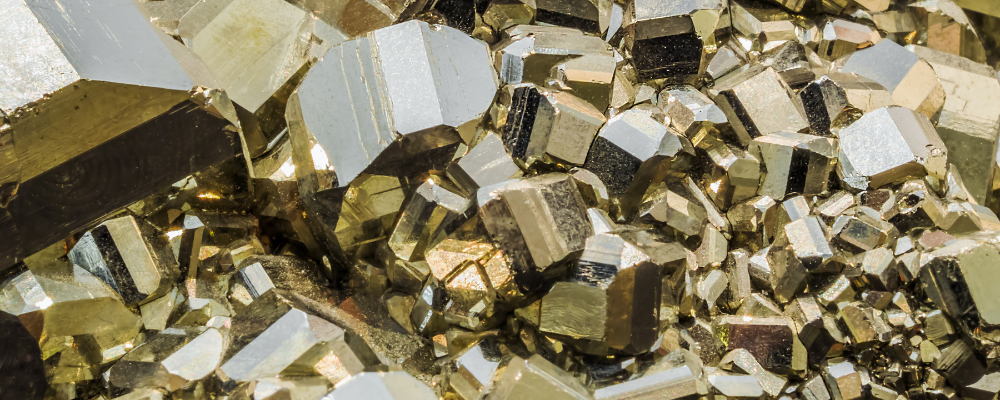
A fire stone, metallic mirror, and talisman of action, Pyrite bears a golden luster without being gold. It thus teaches a double lesson: recognize real value behind appearances, then produce the spark necessary to act. In modern magic, it is associated with courage, luck, and prosperity earned through disciplined will.
Its history does not begin with the offices where it is placed today. Pyrite was used to produce fire and make reflective surfaces. Occultists in the early 20th century connected it with Mars and Scorpio; more recent manuals developed its use for money and success.
To place this stone among related minerals, compare it with Marcasite, Chalcopyrite, and Arsenopyrite.
The Iron Sulfide with Golden Cubes
Pyrite is an iron sulfide, FeS₂. It forms cubes, pyritohedra, and aggregates whose yellow metallic luster gave rise to the nickname “fool’s gold.” It is harder than an ordinary knife but brittle.
The Handbook of Mineralogy describes its forms and properties. Its resemblance to gold is not merely a trap: it offers a symbol of discernment between price, value, promise, and reality.
The Stone That Gives the Spark
The name comes from the Greek pyr, fire. Struck against a hard material, Pyrite produces sparks capable of lighting prepared tinder. The British Museum houses fire-making kits associating Pyrite and flint.
In ritual, this history gives it a more precise function than the vague idea of energy: initiating, triggering, setting in motion. Pyrite is suited to the first step of a project, the courage to ask, and the decision that transforms an intention into action.
Mars and the Fighter’s Talisman
In his 1922 treatise, Kozminsky places Pyrite under Mars and Scorpio. He calls it a fire stone and reports a martial talisman engraved with an armed horseman. The text belongs to a late magical literature; it does not prove a universal use of Pyrite in warfare.
The Martian connection remains consistent with Iron, the spark, decisiveness, and defense. It is useful for workings that require firmness, courage, and endurance, provided strength is not confused with constant conflict.
From spark to prosperity. Fire and Mars are attested in early 20th-century occultism. The use of Pyrite as a money stone became especially established in late 20th-century crystal magic.
Mirrors for power and vision
Pre-Columbian cultures polished Pyrite to form mirrors made from small assembled plates. The Met preserves a Pyrite mosaic mirror that bears witness to the craftsmanship required to obtain a reflective surface.
The metallic mirror unites light, status, and ritual vision. Pyrite placed on the altar can therefore serve to direct attention back toward the available means: money, time, alliances, tools, and skills. It asks what one possesses before asking for more.
Prosperity that is built
Scott Cunningham associates Pyrite with Mars, Fire, luck, money, and divination. Its color explains part of this use, but its association with fire adds the notion of triggering effort.
Keep it near the place where financial decisions are made. It supports a request for a sale, work, or payment, especially if the request specifies the corresponding action. Avoid leaving it in contact with damp coins or light-colored textiles.
Kindle the prosperity working
On a Tuesday, place the Pyrite in front of a green candle. Write the amount, contract, or desired objective, followed by the action you will take within twenty-four hours. Place the stone along the upper edge of the paper, like a seal.
Light the candle, read the request, and carry out the announced action before repeating the rite. When the result arrives, set aside a small portion for maintaining work tools, saving, or a donation: prosperity is thus directed rather than dissipated.
Correspondences and references
| Reference | Correspondence |
|---|---|
| Nature | Iron Sulfide |
| Planet | Mars |
| Sign | Scorpio according to Isidore Kozminsky |
| Element | Fire |
| Day | Tuesday |
| Areas | Action, courage, prosperity, luck, discernment, and defense |
| Ritual image | Spark, golden cube, and metallic mirror |
| Ritual gesture | Place on an objective accompanied by a dated action |










