


A stone of iron, symbolic blood, and grounding, Hematite brings ritual back to the weight of the body, the earth, and the act that must be completed. Its metallic gray exterior conceals a red streak: a material that unites armor and life, dark mirror and blood mark, funerary protection and Saturnian discipline.
Hematite has an ancient history, but it was regularly confused with other bloodstones and with the Lodestone. Mesopotamian and Egyptian objects attest to its place in seals and amulets. Kozminsky reports inscribed funerary headrests; Cunningham develops its grounding and divination in the 20th century.
To place this stone among related minerals, compare it with Iron, Magnetite, and Limonite.
Gray Iron with a Red Streak
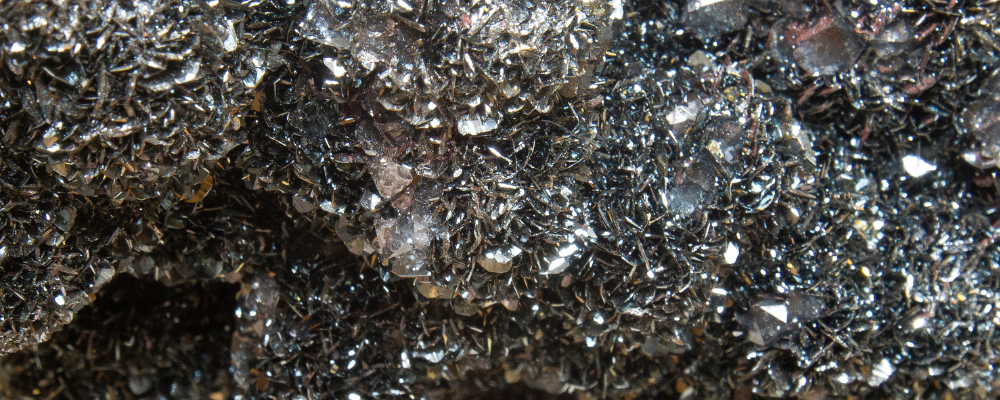
Hematite is an iron oxide, Fe₂O₃. It may appear earthy red, steel gray, or black, but its streak on a suitable surface remains reddish brown. This mark explains its name, derived from the Greek haima, blood.
The Handbook of Mineralogy describes its massive, specular, and earthy forms. Polished pieces sold commercially have a metallic luster; some highly magnetic imitations are made from reconstituted materials.
Seals, Mirrors, and Earthly Authority
Hematite was carved into cylinder seals in the Near East. Its density, color, and polish made it suitable for impressing a name or office. The Met preserves ancient objects made of Hematite that demonstrate its ability to become a sign of authority.
A polished face can also reflect a flame. This dual function—imprinting and reflecting—gives the stone a role in verification: what one asserts must be able to take shape and withstand being looked at.
The Rest of the Dead Beneath a Bloodstone
Kozminsky reports in his 1922 work that the Egyptians placed headrests or Hematite amulets beside the dead, along with passages from chapter 166 of the Book of the Dead. Funerary objects confirm the stone’s use, even though not all of the author’s interpretations can be applied to ancient Egypt.
The function concerns the resting of the head, the protection of the deceased, and passage out of the tomb. In current practice, this story invites the use of Hematite to close out a day, protect sleep, or establish a clear boundary between the living and the dead.
Hematite’s blood is a color, not a substance. Its red streak inspired its name and magical language. Its actual material remains an Iron Oxide: dense, earthy, and suitable for polishing.
Saturn, Fire, and grounding
Scott Cunningham, in 1988, associates Hematite with Saturn and Fire. He connects it with grounding, stability of attention, and divination. Saturn provides weight, limits, and discipline; Fire corresponds to Iron and the reddish streak.
Keep it near your work chair or hold it when your thoughts scatter. Its purpose is not to weigh you down, but to bring you back to what can be done now: a call, tidying up, a decision, or closure.
The flame in the Iron mirror
A well-polished Hematite can serve as a contemplation aid. Its surface does not return a clear image like a mirror: it concentrates a dark reflection and limited light, suited to a concrete question.
The rite should remain brief. Look at the flame reflected in it, ask a question, then write down the first verifiable action. Divination thus leads to practical action and does not become an endless series of interpretations.
The weight of commitment
On a Saturday, write down a task you have been postponing for a long time. Place the Hematite on the sentence and hold everything in your hands until you feel its weight. Light a dark red or white candle.
Announce the exact time when you will begin and the duration of the first effort. Keep the stone on the document until the task is completed. Once the action is done, draw a red line beneath the sentence and store the stone at the workplace.
Correspondences and references
| Reference | Correspondence |
|---|---|
| Nature | Iron Oxide with a reddish-brown streak |
| Planet | Saturn according to Scott Cunningham |
| Element | Fire according to Cunningham; Earth through its grounding use |
| Day | Saturday |
| Areas | Grounding, protection, discipline, closure, and divination |
| Ritual image | Gray armor, blood streak, and dark mirror |
| Historical objects | Seals, amulets, and funerary headrests |
| Ritual gesture | Place on a task, then announce the beginning of the action |