















































































































































































































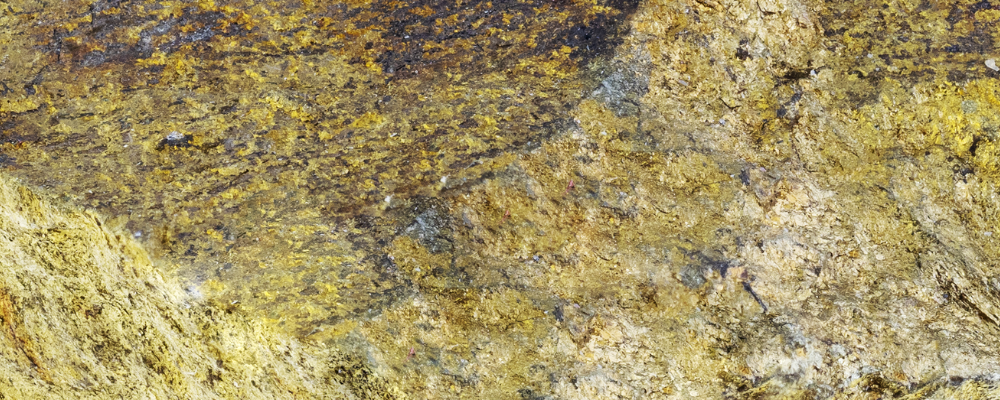
Chalcopyrite resembles gold shot through with copper. Its metallic yellow can become covered with blue, violet, and pink when an alteration layer forms on the surface. Beneath this luster are three symbolically charged substances: copper, iron, and sulfur.
It thus enables work richer than that of a simple “stone of abundance.” Venus attracts and connects, Mars acts and defends, and Sulfur animates transformation. Their harmony suits projects that require desire, effort, and exchange at once.
To place this stone among related minerals, compare it with Copper, Bronze, and Malachite.
Copper, iron, and sulfur united
Chalcopyrite is a copper-iron sulfide with the formula CuFeS2. It crystallizes in the tetragonal system, has a metallic luster, and a hardness of 3.5 to 4. It is one of the principal copper ores.
The Handbook of Mineralogy details its structure and associations. The Mindat database shows its presence in numerous veins and deposits where it occurs alongside Pyrite, Quartz, Galena, or Sphalerite.
Yellow gold and iridescent reflections
Its yellow color leads it to be confused with Pyrite or gold, but it is softer and its streak tends toward greenish black. The National Museum of Wales presents its characteristics and mining occurrences.
The blue and violet reflections come from surface alteration. They may appear naturally or be intensified through treatment. The piece remains Chalcopyrite; the iridescence describes the state of its surface, not its entire composition.
The language of the planetary metals
In European ceremonial magic, copper belongs to Venus and iron to Mars. Sulfur carries a combustible and active principle in alchemy. Chalcopyrite was not necessarily consecrated as a distinct stone, but its composition now makes it possible to bring these currents together without inventing them.
The stone does not represent hidden gold that would make one rich through contact. It teaches a more concrete economy: attracting an opportunity, putting in the effort, transforming matter, and organizing exchange.
Venus, Mars, the Sun, and Fire
Venus governs copper, agreements, and attraction. Mars corresponds to iron, ambition, and work. The Sun is reflected in its golden gleam; Fire, in sulfur and transformation. Friday is suited to business relationships, Tuesday to action, and Sunday to visibility.
A coin, a contract, a green or gold candle placed at a distance, and an object related to the profession make a suitable altar. The desired wealth must be given a measurable form.
Exchange, ambition, and prosperity
Chalcopyrite accompanies sales, negotiations, requests for raises, and projects where several interests must align. It supports ambition when ambition accepts the work and the reciprocal exchange.
On a desk, it can represent the value created before the expected profit. Near a cash register, it reminds us that prosperity depends on the offer, the price, trust, and follow-up. In a relationship, it helps you examine what attracts and what requires real effort.
The Rite of the Three Forces
On a sheet of paper, draw three circles labeled “attract,” “act,” and “exchange.” Write one concrete measure in each: a person to contact, a task to complete, and value to offer. Place the Chalcopyrite at their intersection.
On a Friday, say: “I attract without coercion, I act without exhaustion, I exchange at fair value.” Choose the action that connects the three circles and complete it before the following Tuesday. The rite closes when the proposal receives a real response.
Correspondences and references
| Reference | Correspondence |
|---|---|
| Nature | Copper and iron sulfide, metallic yellow |
| Surface | Natural or enhanced alteration with iridescent reflections |
| Metals | Venus’s copper and Mars’s iron |
| Celestial bodies | Venus, Mars, and the Sun |
| Element | Fire |
| Days | Friday, Tuesday, and Sunday |
| Areas | Commerce, ambition, agreement, prosperity, and visibility |
| Ritual act | Connecting attraction, action, and fair exchange |










