


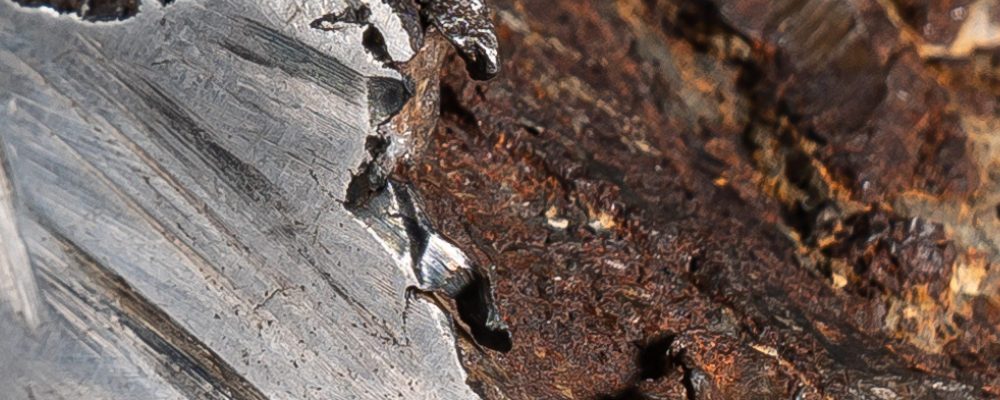
A meteorite is a fragment from another body in the solar system that has reached the ground. Its actual trajectory—space, atmospheric fire, arrival on Earth—gives it a powerful ritual language: passage, resistance, message, and change of scale.
Long before iron metallurgy became widespread, artisans shaped meteoritic iron into prestige objects. Contemporary magic sees in it the sky meeting the Earth. Fire corresponds to the luminous passage; Saturn to the material’s antiquity; Uranus to the eruption that changes a trajectory.
To place this stone among related minerals, compare it with Tektite, Moldavite, and Fulgurite.
When the fragment reaches Earth
In space, the fragment is called a meteoroid. The light produced as it enters the atmosphere is a meteor. The part that reaches the ground becomes a meteorite. This distinction separates the object, the luminous phenomenon, and the final stage of the journey.
NASA explains this journey as well as the origin of many fragments in asteroids, the Moon, or Mars. They may be nearly as old as the solar system, but each piece has its own history.
Stone, iron, and blended worlds
Stony meteorites are the most numerous. Iron meteorites contain mainly iron and nickel alloys. Mixed meteorites combine metal and silicates; among them, pallasites display olivine crystals in a metallic matrix.
The Natural History Museum in London presents these major families. The Meteoritical Bulletin Database compiles recognized names, discovery locations, and classifications. A black or magnetic stone is therefore not authenticated by its appearance alone.
Shaped iron from the sky
In ancient Egypt, artisans worked nickel-rich iron from meteorites before iron obtained from ore became widespread. The blade placed in Tutankhamun’s tomb in the 14th century BCE is a famous example.
An analysis published in Meteoritics & Planetary Science confirmed the blade’s meteoritic origin through its composition of iron, nickel, and cobalt. The object bears witness to the prestige accorded to this material and to the artisans’ skill, without proving that all falls received the same religious meaning.
The sky becomes matter through the human hand. The fall is not enough: the fragment must be recognized, preserved, and shaped. The rite can retrace this chain by transforming an endured event into a worked passage.
Fire, Saturn, and Uranus
Fire corresponds to the luminous entry into the atmosphere and the transformation brought by the journey. Saturn governs ancient time, dense matter, and boundaries crossed. Uranus, in a modern interpretation, expresses irruption, a break in trajectory, and a change of scale.
Saturday suits long passages and commitments; Tuesday suits momentum; a chosen moment under a clear sky suits perspective. Black, steel gray, and luminous white make up its palette. The key, card, and circle are its associated objects.
Passage, protection, and perspective
A Meteorite accompanies a change of country, career, home, or life. Place it near the document that opens the passage: ticket, contract, letter, or key. It represents a crossing that changes the form without erasing the origin.
For protection, it represents resilience in a difficult environment. For perspective, it reminds us that a problem immense on the scale of a day can change proportion on the scale of a year, a generation, or a world.
The Rite of the Celestial Threshold
Draw two circles on a sheet of paper. In the first, write the situation you are leaving; in the second, the desired state. Between the two, note the action that makes the transition possible.
Move the Meteorite slowly from one circle to the other and say: “I cross over without denying my origin; I change without losing my axis.” Keep it near the relevant key or document until the action is completed.
Correspondences and references
| Reference | Correspondence |
|---|---|
| Nature | Extraterrestrial fragment that reached the ground |
| Types | Stony, metallic, and mixed |
| Suggested celestial bodies | Saturn and Uranus |
| Elements | Fire and Earth |
| Days | Saturday and Tuesday |
| Areas | Passage, protection, travel, perspective, change of scale |
| Associated objects | Key, card, circle |
| Gesture | Moving the stone from one state to another |