


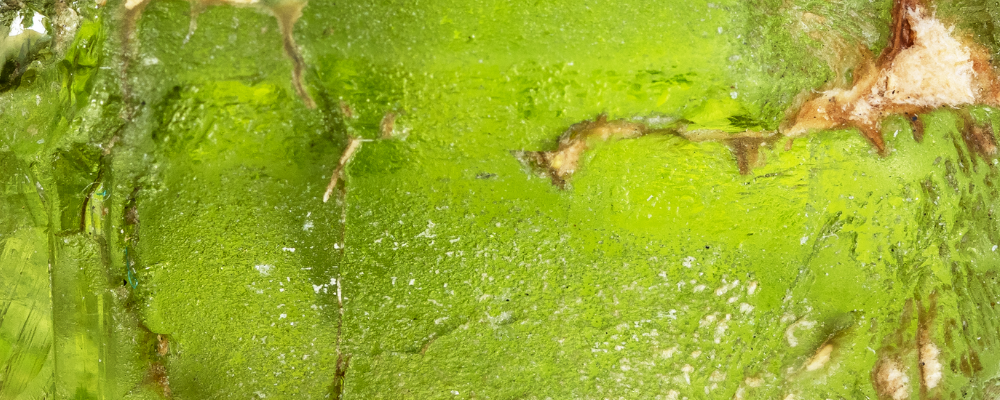
Peridot bears a light green crossed with gold, like a young leaf beneath the Sun. Extracted since antiquity on the Egyptian island of Zabargad, it long traveled under other names. Western magic has linked it to nighttime protection, eloquence, hope, and an unburdensome prosperity.
Its identity requires unraveling an ancient confusion: some of the “Topazes” in Greek and Roman texts probably refer to Peridot. Recognizing this shift takes nothing away from its history; on the contrary, it restores its own places, color, and uses to it.
To place this stone among related minerals, compare it with Olivine, Fayalite, and Topaz.
Olivine's Gem Green
Peridot is the gem variety of olivine, a magnesium-and-iron silicate. Its color ranges from yellow-green to olive green; iron is part of its composition and produces this hue. Unlike several other gems, Peridot exists only within this color family.
It forms in the Earth's mantle and rises in certain volcanic rocks. Olivine crystals also occur in stony-iron meteorites called pallasites. The GIA presents its composition, deposits, and gemological characteristics.
Zabargad, the Red Sea Island
Zabargad, or Saint John's Island, lies in the Red Sea off the coast of Egypt. Its Peridot deposits were exploited as early as antiquity. The island was known by names resembling Topazios, which contributed to the confusion between Peridot and Topaz.
A study published in Gems & Gemology traces the history of Zabargad and its gems. The accounts passed down describe guarded extraction carried out under difficult conditions. Artificial light is said to have helped locate the crystals' gleam at night, while the gathering was then done by day.
When Topaz Was Peridot
In book 37 of his Natural History, Pliny describes a greenish stone associated with Topazos Island. Researchers identify it as Peridot rather than modern Topaz. Reading ancient lapidaries therefore requires not automatically transferring their names into current mineralogy.
This ancient identity illuminates its magical imagery: a gem spotted in the darkness, extracted from a difficult-to-reach island and compared to a green light. It supports rites seeking a practicable path when the situation seems closed off.
See in the night. The tradition of Zabargad tells of a light recognized in the darkness. Peridot does not promise to eliminate fear; it becomes a witness to the clear point that makes it possible to move forward despite it.
Venus, Earth, and solar hour
Isidore Kozminsky places Peridot under Pisces and recommends a gold setting in The Magic and Science of Jewels and Stones, published in 1922. He attributes to it protection against enchantments and nighttime terrors, inspiration, prophecy, eloquence, and hope.
Scott Cunningham assigns it Venus and Earth in 1988, with uses for protection, wealth, and sleep. Friday is suitable for relationships and prosperity; a solar hour or Sunday places greater emphasis on light, confidence, and public speaking.
Protection, Speech, and Prosperity
For nighttime protection, place the Peridot near the bed on green fabric and name what belongs to the night: rest, dreams, silence. Leave the next day’s tasks outside the circle. This ritual framework helps mark the end of the day without replacing appropriate support in cases of persistent difficulties.
For speech, hold the stone before a conversation and summarize your intention in one true, brief, non-threatening sentence. Its green light serves just and honest eloquence here, not victory achieved through pressure.
For prosperity, place it beside a sum intended to be put into circulation: a budget, investment, or donation. Peridot represents living wealth, directed toward growth rather than anxious accumulation.
The green lamp of hope
At sunset, place the Peridot between a white candle and a small bowl of earth. Write a difficulty on a piece of paper, then below it, the next possible action, however modest. Read only that action aloud.
Say: “In the night, I keep the point by which to move forward.” Place the stone on the paper until morning. The next day, carry out the action written down, then return the earth to a garden or pot. Keep the Peridot as a witness to the movement begun.
Correspondences and references
| Reference | Correspondence |
|---|---|
| Nature | Gem variety of olivine |
| Hardness | 6.5 to 7 on the Mohs scale |
| Historical location | Zabargad, an island in the Red Sea |
| Sign | Pisces according to Isidore Kozminsky |
| Planet | Venus according to Scott Cunningham |
| Element | Earth according to Cunningham |
| Areas | Nighttime protection, hope, eloquence, sleep, and prosperity |
| Ritual gesture | Name the clear point, then carry out the possible action |