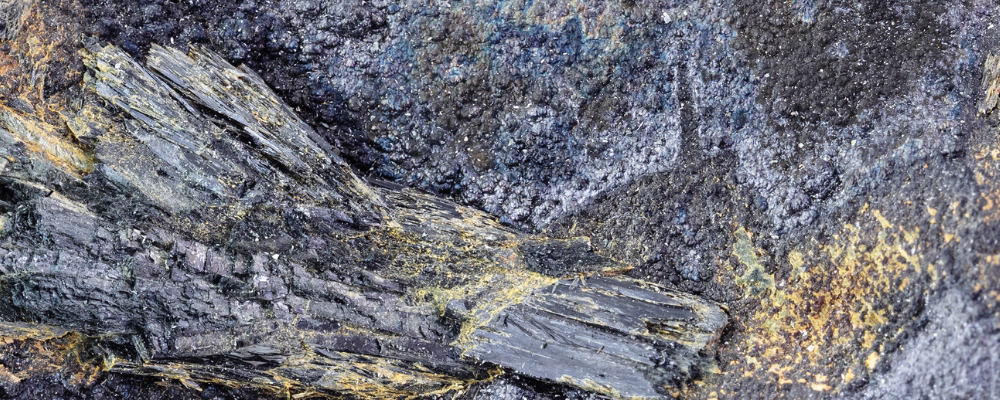
Vivianite can form almost colorless, then develop an increasingly dark blue-green when exposed to air and light. It thus reveals a color that transforms it as it exposes it.
This slow metamorphosis makes it a stone of memory, measured revelation, and guarded grief. Light reveals its blue, but excess ultimately alters it: its teaching rests on the right balance between showing and preserving.
To place this stone among related minerals, compare it with Iron, Hematite, and Magnetite.
The water-rich iron phosphate
Vivianite is a hydrated iron phosphate, with the formula Fe3(PO4)2·8H2O. It forms in oxygen-poor environments where iron meets a source of phosphate: peat bogs, clay, buried wood, shells, bones, or deposits rich in organic matter.
The Handbook of Mineralogy describes its flattened crystals and composition. Its possible presence near organic remains explains its natural connection with what was once alive, without reducing the stone to a funerary image.
From almost colorless to deep blue
Fresh vivianite, with few oxidation products, can be very pale. Oxygen transforms some of the iron and brings out blue, green, and then almost black tones. A study of its oxidation products shows that this color accompanies a real change in the material.
The National Museum of Wales reminds us that prolonged exposure can darken and weaken large crystals. Revealing, therefore, does not mean leaving them unprotected.
The hidden blue of ancient paintings
Earthy vivianite was used as a blue pigment. It has been identified in medieval decorations and certain European paintings. The Museum of Fine Arts, Boston describes it as a natural blue earth whose hue may change with oxidation.
Vivianite’s blue belongs to the images that move through time without remaining still. The stone carries a living memory: it preserves a name, while accepting that the way it is seen may change.
Saturn, Moon, Water, and Earth
Saturn governs time, remains, memory, and what endures beneath the earth. The Moon receives light with moderation and watches over memories. Water belongs to the hydrated structure; Earth corresponds to deposits, peatlands, and preservation.
Saturday is suitable for work involving memory, mourning, and closure. Monday supports family memories and dreams. Midnight blue, dark green, and black form a palette attuned to the stone.
Memory, mourning, and measured revelation
Vivianite helps give a memory a place without allowing it to invade the whole space. It suits ancestral altars, mourning work, preserving a letter, and family stories that need to be named with restraint.
It also accompanies a truth that one chooses to reveal in stages. Its change of color reminds us that an exposed word transforms as much the person who carries it as the person who receives it.
The Rite of the Kept Name
Write a name, date, or memory on blue paper. Fold it and place it in an opaque box with a photograph of Vivianite, or with the specimen if it already has a protective case.
Light a white candle beside the closed box and say: “I give this memory a place without abandoning it to every light.” After a few minutes, extinguish the candle and put the box away in a dark place.
Correspondences and references
| Reference | Correspondence |
|---|---|
| Nature | Hydrated iron phosphate sensitive to oxidation |
| Color | Pale to blue-green, then darkens with exposure |
| Celestial bodies | Saturn and Moon |
| Elements | Water and Earth |
| Days | Saturday and Monday |
| Ritual colors | Midnight blue, dark green, and black |
| Domains | Memory, mourning, truth, preservation, and measured revelation |
| Ritual act | Keep a name or a letter in an opaque box |