















































































































































































































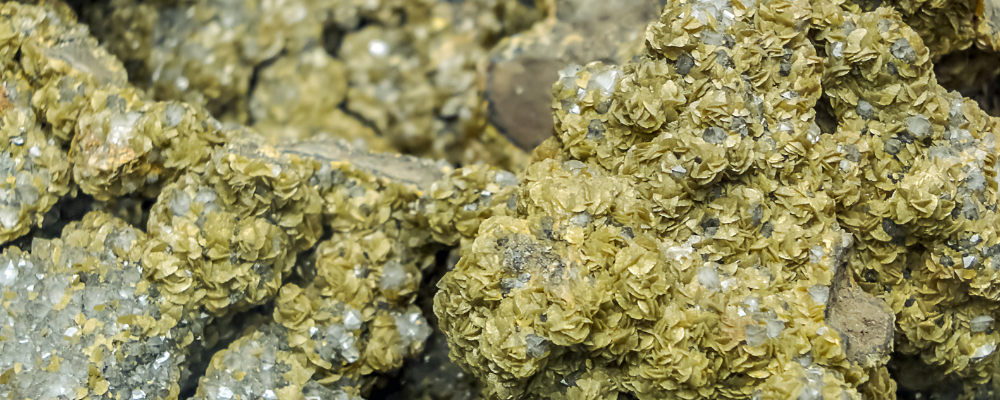
Siderite holds iron in a brown, dense, and still-silent form. It is neither blade nor tool: it represents the reserve before action, strength before its use, and the transformation necessary for a capacity to become a work.
Its name comes from the Greek sidēros, meaning “iron.” The stone does not possess a separate ancient talismanic tradition, but its composition connects it to the planetary tradition of iron. Mars provides impetus and courage; Earth contains this power, gives it form, and directs it toward a lasting result.
To place this stone among related minerals, compare it with Iron, Hematite, and Magnetite.
The iron retained in stone
Siderite is an iron carbonate, with the formula FeCO3. Its yellow, brown, or gray crystals take rhombohedral forms, with flat or curved faces. It occurs in iron-bearing layers, concretions, and veins where it accompanies Quartz, Baryte, Fluorite, or Pyrite.
The Handbook of Mineralogy links its name to the Greek sidēros, meaning iron. The material therefore contains the metal of Mars without yet possessing the form of a forged object.
From reserve to action
In contact with humid air, Siderite may take on ochre or brown hues as its surface transforms into oxidized iron compounds. In mining history, the ore also had to undergo several processes before yielding usable iron.
This material offers a clear ritual image: possessing strength is not enough. Knowledge, will, or a resource remains in reserve until an operation directs it toward action.
Contained power requires form. Siderite does not encourage action driven by anger. It helps us recognize the available strength, choose how to use it, and accept the steps that transform intention into results.
Iron under the power of Mars
In Book I of his Occult Philosophy, published in the 16th century, Heinrich Cornelius Agrippa places iron among the metals of Mars. The same chapter links this planet to fire, boldness, struggle, and materials capable of cutting or resisting.
Siderite receives this correspondence through its composition. However, its carbonate nature and earthy colors temper Mars. The Martian force remains contained within it, available for work, defense, and endurance rather than reckless confrontation.
The ore thus becomes a reserve of courage. It represents what already exists within us, but requires a decision, a schedule, and a series of actions before producing its effect.
Mars, Earth, and Controlled Fire
Mars governs iron, drive, courage, and the ability to break through an obstacle. Earth provides weight, patience, and form. Fire acts as an agent of transformation without becoming a method of caring for the stone.
Tuesday is suitable for workings of will, defense, and taking action. A red candle held at a distance, an iron nail placed beside the specimen, a drawn hammer, or a brown sheet can accompany the ritual.
Siderite helps distinguish anger, which expends strength, from resolve, which directs it. Its work begins with a simple question: what action truly deserves this energy?
Will, Courage, and Discipline
To awaken a neglected ability, write down what you already know how to do, then the precise use you want to make of it. Place the stone between the two statements and set the first step with a date.
When facing an obstacle, separate what requires courage, what requires a method, and what requires time. Siderite supports the Martian aspect of the work, but its Earth element reminds us that victory also comes through organization.
In a protection ritual, pair it with an unrusted iron nail. The nail represents direct action; the stone, reserve and mastery. Name the boundary, then take the step that makes it real.
The Rite of Freed Iron
On a Tuesday, place the Siderite on a brown sheet and put an iron nail to its right. Light a red candle at a distance. Write the available force beneath the stone and the action it must express beneath the nail.
Say: “The iron leaves reserve, my will takes shape, and my action follows my word.” Then move the nail onto the action statement. Keep it in your journal until the task is accomplished, then return the Siderite to its place.
Correspondences and References
| Reference | Correspondence |
|---|---|
| Nature | Brown, yellow, or gray iron carbonate |
| Planet | Mars, through the ancient correspondence of iron |
| Elements | Predominantly Earth, transformative Fire |
| Day | Tuesday |
| Colors | Brown, ochre, dark red, and metallic gray |
| Domains | Will, courage, defense, discipline, transformation, and taking action |
| Associated Objects | Iron nail, drawn hammer, brown sheet, and red candle |
| Gesture | Identify the available force, then give it a dated action |










