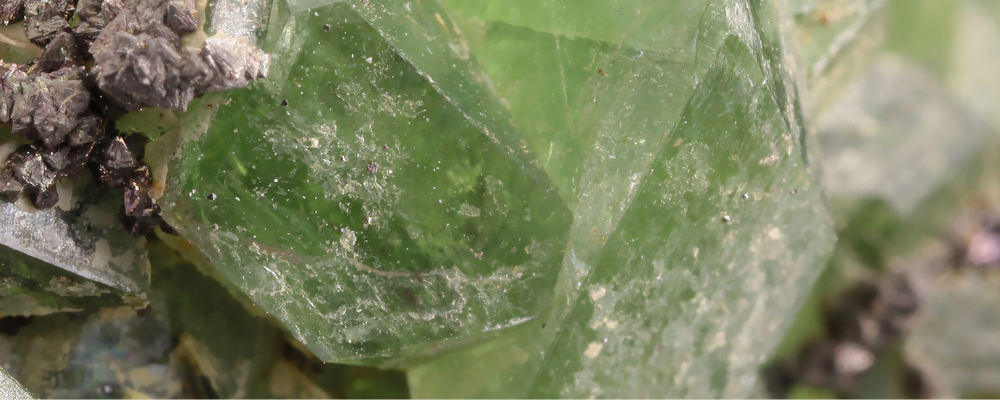
Ludlamite appears as unspoiled greenery at the heart of dark ores. Rare, soft, and luminous, it forms when older phosphates are transformed by fluids. Its symbolic language arises from this real history: new material can emerge from an already charged heritage.
Described in the 19th century, it has no known ancient magical tradition. Its correspondences are therefore proposed as a contemporary framework: Mars for iron, Venus for green, Earth for the matrix, and Water for transformation. It accompanies healing, the resumption of a project, and the return of an ability once thought lost.
To place this stone among related minerals, compare it with Purpurite, Phosphosiderite, and Brochantite.
The green born in iron
Ludlamite is a hydrated phosphate dominated by iron, with magnesium and manganese. Its tabular crystals range from apple green to vivid green; their luster becomes pearly on the planes where the stone separates.
The Handbook of Mineralogy indicates a hardness of 3.5 and perfect cleavage. This fragility does not diminish its presence: it reminds us that a rebirth remains something to protect.
A transformation through water
In pegmatites and certain veins, fluids transform phosphates formed earlier. Ludlamite thus emerges as a secondary mineral, accompanied in particular by Vivianite, Siderite, or Apatite.
Mindat describes it as an alteration product in an oxygen-poor environment. The image is fertile: it does not deny the ancient material; it takes it up and gives it another form.
Henry Ludlam and Cornwall
The first description dates to 1877 and refers to Wheal Jane, near Truro, in Cornwall. Its name honors Henry Ludlam, an English collector and mineralogist born in 1824.
The Webmineral entry retains this origin and the type locality. Nothing therefore supports attributing an ancient cult, priestly function, or power from a vanished civilization to Ludlamite.
A recent stone in the history of names. Its symbolism does not require a fabricated past: its green color, iron, and secondary formation already provide a coherent framework for working on repair and resumption.
Mars, Venus, Earth, and Water
Mars governs iron, effort, and the decision to begin again. Venus corresponds to green and to what is brought back into harmony. Earth represents the ancient support; Water, the fluids that made the transformation possible.
Tuesday is suited to resuming action, while Friday is suited to repairing a bond or creative project. A green cloth, a key, and an empty cup may accompany the stone without getting it wet.
Repair, Resume, Regreen
Ludlamite accompanies what deserves a second form: an abandoned manuscript, interrupted learning, a piece to restore, or a relationship that must regain fair rules. It does not promise a return to the past; it helps discern what can genuinely be resumed.
It is also suitable for periods when energy returns before confidence. The magical gesture then consists of choosing a modest, visible, repeatable resumption and protecting it from haste.
The Green Resumption Rite
Write on a piece of paper the name of what you wish to resume. Beneath that name, note an abandoned action you can complete in less than thirty minutes. Place the Ludlamite near the paper, on a green cloth.
Place a key between the stone and the phrase, then say: “I do not erase what was. I open the form that can live now.” Perform the action that same day and keep the key with the paper until the third repetition.
Correspondences and references
| Reference | Correspondence |
|---|---|
| Nature | Hydrated iron-rich phosphate |
| Color | Apple green to bright green |
| Suggested celestial bodies | Mars and Venus |
| Suggested elements | Earth and Water |
| Days | Tuesday and Friday |
| Areas | Repair, resumption, adaptation, renewed momentum |
| Associated objects | Key, green cloth, empty cup |
| Gesture | Opening a second viable form |