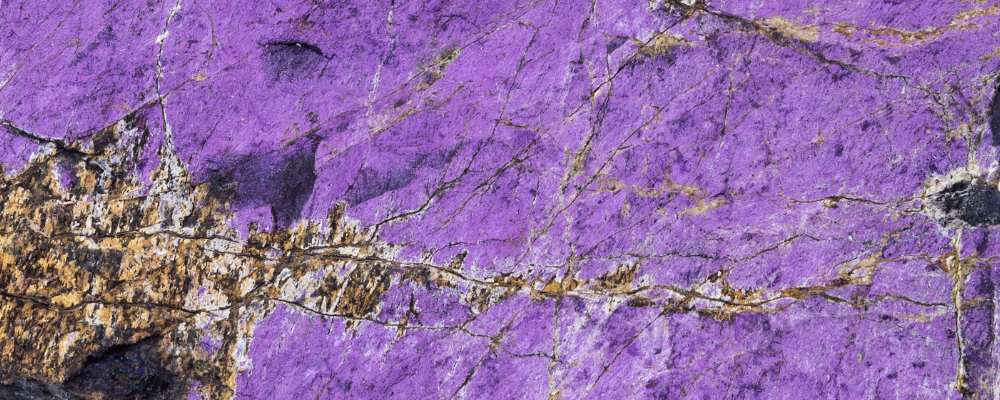
Violet on a brown matrix, Purpurite displays a royal color gained through transformation. This manganese phosphate appears when older minerals oxidize and reorganize. It accompanies the reclamation of authority, restored dignity, and the decision to give new form to what has already lived.
Its name comes from purple, the color of rank and sovereignty. Its magical reception is modern, but its language remains firmly rooted in matter: Jupiter governs violet, authority, and breadth; Mars provides the impetus of transformed manganese; Earth and Fire describe the stability gained after a mutation.
To place this stone among related minerals, compare it with Apatite, Turquoise, and Variscite.
The violet born from manganese
Purpurite is a manganese phosphate with a variable proportion of iron. The Handbook of Mineralogy describes a violet, purple-red, dark pink, or blackish-brown stone, with a hardness of 4 to 4.5.
The most sought-after color appears on material that retains brown areas. This contrast already forms a symbol of reclamation: new authority does not erase history; it becomes visible on its surface.
A color gained through oxidation
In Pegmatites, Purpurite results from the transformation of manganese-rich primary phosphates, such as Lithiophilite. Oxidation and the removal of mobile elements alter the material until trivalent manganese, associated with its color, appears.
The Mindat mineralogical entry places it in a series with Heterosite, its more iron-rich counterpart. The passage from one pole to the other nourishes a magic of transformation that does not deny the original material.
Purple, Jupiter, and sovereignty
The name Purpurite comes from the Latin purpura, purple. The Webmineral database preserves this etymology derived from violet-red. In Western planetary magic, this color belongs to Jupiter’s domain: rank, justice, expansion, authority, and generosity.
The stone is therefore less suited to dominating others than to taking back one’s own responsibility. Bearing responsibility requires making decisions, protecting a framework, and accepting the consequences of one’s words.
A contemporary sovereignty. No ancient lapidary gives Purpurite a complete ritual system. Jupiter, Mars, and purple form a current interpretation here, based on the name, color, and mineral transformation.
Mars, Earth, and the Fire of Transformation
Mars brings the courage to break with a position that has become too narrow. Jupiter provides meaning, legitimacy, and scope. Earth stabilizes the authority gained; Fire represents oxidation and the act that makes the change visible.
Thursday suits authority, business, and growth. Tuesday supports decision-making, defending a boundary, and returning to action. Purple, brown, a seal, and a decision sheet make up its altar.
Authority, Dignity, and Reclaiming One’s Position
Purpurite accompanies a promotion, speaking up, or returning to an abandoned responsibility. Place it near the title, contract, or decision, then write what this position obliges you to protect.
In the face of shame, it helps separate the fault that calls for reparation from the judgment that condemns the whole person. Transformation then becomes concrete: acknowledge, repair, and then reclaim a position that no longer depends on the former failure.
In a rite of expansion, give it a measurable territory: clientele, reach, income, or influence. Jupiter expands what already has direction.
The Seal of the Reclaimed Position
On a Thursday, write the role, position, or authority you agree to assume. Below it, note three duties that give it legitimacy. Place the Purpurite on the first duty and light a purple candle at a distance.
Say: “I claim my place and bear its measure.” Fulfill the first duty before moving the stone to the next one. Once all three acts are complete, draw a circle around the text and sign it.
Correspondences and references
| Reference | Correspondence |
|---|---|
| Nature | Manganese phosphate resulting from a transformation |
| Name | From the Latin purpura, purple |
| Suggested planets | Jupiter and Mars |
| Suggested elements | Earth and Fire |
| Days | Thursday and Tuesday |
| Areas | Authority, dignity, responsibility, expansion, and reparation |
| Ritual image | The violet that appears on an ancient material |
| Ritual act | Linking a claimed position to the duties that make it just |