















































































































































































































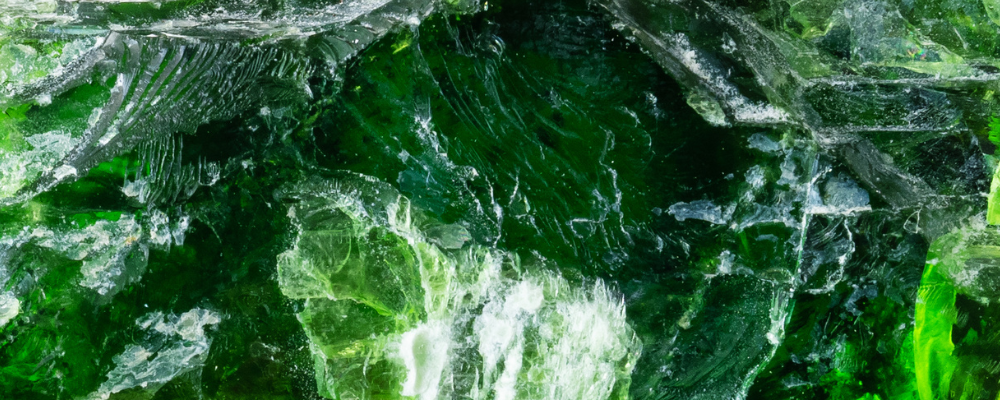
Diopside displays greens ranging from light leaf green to deep emerald. Its name means “two appearances” and refers to the orientation of its crystals. Too recent for ancient lapidaries, it is now associated with a magic of growth, repair, and fair exchange based on Venus, Mercury, and Earth.
Green attracts the Venusian sphere: fertility, harmony, value, and bonds. Mercury responds to the dual perspective contained in its name. The stone thus accompanies situations where one must understand a second perspective before returning something, making amends, or resuming a relationship.
To place this stone among related minerals, compare it with Enstatite, Fassaïte, and Babingtonite.
A Pyroxene with Many Shades of Green
Diopside is a calcium and magnesium silicate of the Pyroxene group. It can be white, gray, yellow, brown, black, or green. Chromium gives gem varieties a particularly vivid green color.
The Handbook of Mineralogy indicates a hardness of 5.5 to 6.5 and pronounced cleavage. Mindat describes it as a widespread member of the Pyroxene group, found in metamorphic marbles, skarns, and certain mantle rocks.
The crystal’s two appearances
The name comes from the Greek dis, “two,” and opsis, “appearance” or “view.” It was chosen for the two orientations that the prismatic faces seem to present.
The GIA also shows that chrome diopside can appear as a green inclusion in Diamond. The stone thus belongs to rocks formed through transformation and to the clues geologists read to uncover a hidden origin.
A modern magic of restitution
Diopside does not hold a stable place in the great ancient lapidaries. The correspondences of compassion, repair, and connection to nature belong to contemporary systems.
They gain coherence when given a planetary framework. Venus carries green, harmony, and exchanged value. Mercury brings the second perspective contained in the name. Earth transforms intention into actual restitution.
Restitution does not require returning to any relationship. It can take the form of an apology, a returned object, a settled debt, or a separation carried out fairly. The stone supports the right action, not reconciliation at any cost.
Repair requires a second perspective. The first sees the wound from its own position. The second seeks what the other person lacks, what can be returned, and the limit beyond which no agreement can hold.
Venus, Mercury, and Earth
Venus governs harmony, reciprocity, fair pricing, and growth. Mercury helps rephrase, negotiate, and understand another position. Earth supports slow recovery and the act that repairs.
Friday is suitable for relationships, prosperity, and reconciliation. Wednesday supports discussion and contracts. Green, copper, two leaves, a seed, and scales extend its correspondences.
Growth, repair, and reciprocity
To repair a bond, write what you regret, what you can give back, and what you will not promise. Place the Diopside on the second sentence: repair begins with an available action.
For material growth, place the stone near a seed and a coin. Determine the resource to cultivate, the necessary investment, and the date on which you will evaluate the result.
For a negotiation, formulate your proposal from your own position, then from that of the other party. Look for the point that protects the value of both sides.
The second perspective
On a Friday, place two leaves facing each other with the Diopside in the middle. On the first, write: “This is what I see.” On the second: “This is what the other person may see.”
Turn over the leaves, reread them, and say: “I understand without denying myself; I repair without losing myself.” Write an action shared by both perspectives underneath and carry it out within seven days.
Correspondences and references
| Reference | Correspondence |
|---|---|
| Nature | Calcium magnesium pyroxene |
| Name | “Two appearances” or “two views” |
| Modern planets | Venus and Mercury |
| Element | Earth |
| Days | Friday and Wednesday |
| Areas | Growth, repair, reciprocity, negotiation, and value |
| Symbols | Two leaves, a seed, a coin, and scales |
| Ritual gesture | Writing about a situation from two perspectives |










