





















































































































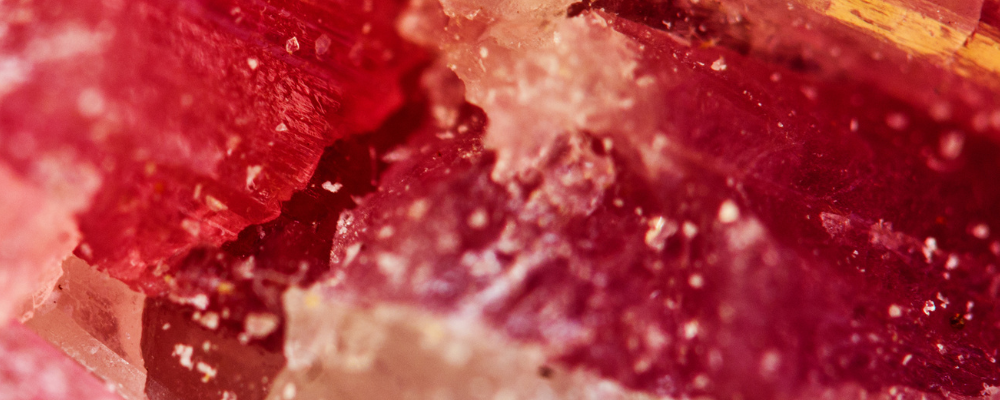
Rhodochrosite resembles a rose turned to stone: soft pink, raspberry red, or banded with white. Contemporary magic entrusts it with love, restored peace, and the heart’s impulse. Yet Scott Cunningham assigns it to Mars and Fire, reminding us that a pink stone can also carry courage and movement.
It therefore does not speak of passive gentleness. Its symbol is that of a pink fire that warms, reconciles, and sets joy back into motion without consuming what it touches.
To place this stone among related minerals, compare it with Calcite, Honey Calcite, and Chocolate Calcite.
The Pink Manganese Carbonate
Rhodochrosite is a manganese carbonate. The Handbook of Mineralogy assigns it a hardness of 3.5 to 4. It can form transparent crystals, as well as banded masses whose pink and white layers create waves.
The Argentine deposits of Capillitas made this banded form famous. The red crystals from the Sweet Home mine in Colorado are among the species’ most renowned expressions.
From the Greek Rose to the Rose of the Inca
Its name comes from the Greek words rhodon, rose, and chroma, color. It directly describes its hue. Rhodochrosite was studied as a manganese ore before entering collections and then the ornamental stone market.
“Rose of the Inca” or “Rosa del Inca” is the modern name given to the Argentine material. This commercial name has inspired appealing legends, but it does not constitute proof of Inca ritual use. Research by the GIA on gem-quality Rhodochrosite chiefly highlights the mineralogical and lapidary interest of its beautiful crystals.
Mars in a pink stone
In his encyclopedia published in 1988, Scott Cunningham places Rhodochrosite under Mars and Fire. He associates it with energy, peace, and love.
This attribution is surprising if pink is reduced to Venus. It becomes clear when Mars represents the courage to love, the impulse that breaks inertia, and the warmth needed for a reconciliation. The white bands temper this Fire and give the stone its rhythm of expansion followed by rest.
The courage of the heart. Rhodochrosite does not merely ask you to feel an emotion. It invites you to give it form: apologize, accept joy, defend your dignity, or reopen a dialogue when it is right to do so.
Mars, Venus, Fire, and Water
Mars and Fire come from Cunningham: action, energy, and courage. Venus and Water extend the color pink, love, beauty, and soothing. Their alliance makes Rhodochrosite a stone of emotional warmth set in motion.
Tuesday is suitable for courageous action or regaining momentum. Friday serves love, joy, and repairing a bond. Raspberry red, pink, copper, and cultivated rose accompany its rites.
Love, Joy, and Reconciliation
For reconciliation, place the stone between two names. Write what can be repaired and the boundary that will not be abandoned. Love grows stronger when it stops demanding self-abandonment.
To regain momentum, pair it with a red candle and choose a short action that brings movement back into the day. Its Martian correspondence supports initiative here more than confrontation.
In a self-love practice, use it in front of a mirror and name a quality you have already demonstrated through your actions. The stone supports self-esteem grounded in reality, not an empty formula.
The Pink Fire Rite
Place a pink candle on the left, a red candle on the right, and the Rhodochrosite between them. On a piece of paper, write a relationship, a desire, or a part of yourself that needs to recover warmth and movement.
Light the pink candle first, then the red one. Say: “May gentleness preserve its strength, and may strength preserve its heart.” Slide the paper beneath the stone and let the flames burn for a few minutes under supervision. Then carry out an act of repair or joy.
Correspondences and References
| Reference | Correspondence |
|---|---|
| Nature | Pink to red manganese carbonate |
| Hardness | 3.5 to 4 on the Mohs scale |
| Planets | Mars according to Scott Cunningham, Venus by modern affinity |
| Elements | Fire and Water |
| Days | Tuesday and Friday |
| Areas | Love, joy, emotional courage, energy, and reconciliation |
| Ritual Image | A pink fire that warms without consuming |
| Ritual Action | Unite gentleness with courageous action |