















































































































































































































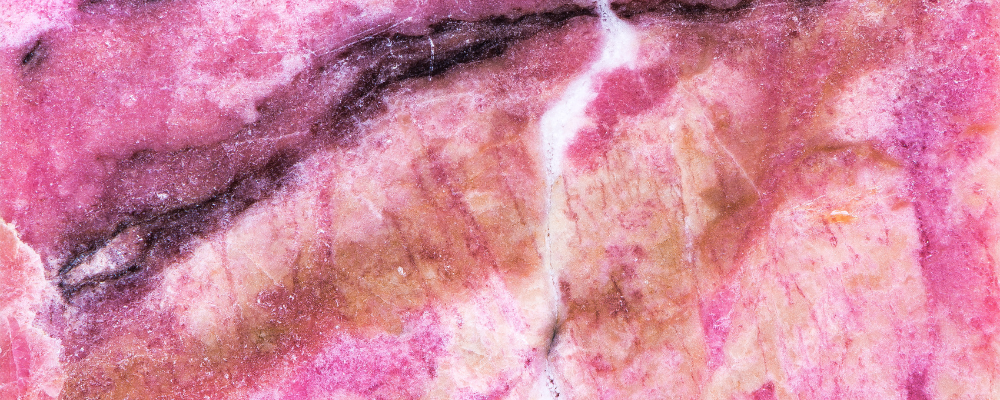
In Rhodonite, pink meets black veins. This combination makes it a stone of clear-sighted reconciliation: the heart remains present, but it neither denies the wound nor the boundary. Contemporary magic entrusts it with forgiveness, emotional balance, and conflict resolution.
Scott Cunningham places it under Mars and Fire, alongside peace, balance, and emerging from confusion. The contrast in its material aptly conveys this idea: uniting what seemed opposed without erasing the contours.
To place this stone among related minerals, compare it with Rhodochrosite, Rose Tourmaline, and Rose Quartz.
The Pink Silicate Veined with Black
Rhodonite is a manganese silicate whose name comes from the Greek rhodon, meaning pink. It occurs as crystals or pink masses crossed by black manganese oxides. The Handbook of Mineralogy gives it a hardness of 5.5 to 6.5.
The color and composition may vary from one deposit to another. A study by the GIA also shows that materials sold under this name may combine Rhodonite and Pyroxmangite, two closely related minerals.
The Monumental Stone of the Ural Mountains
In the 19th century, the large deposits in the Ural Mountains supplied Russian lapidary workshops. Rhodonite became an ornamental stone there: vases, columns, tables, and panels made use of its broad pink areas marked with black.
This monumental past adds an earthly dimension to its symbolism. Rhodonite is not limited to the intimacy of feelings; it can represent peace embedded in a home, a family, or an institution, like an architecture that must be maintained.
Mars in the Service of Peace
In 1988, Scott Cunningham attributed Rhodonite to Mars and Fire. He associated it with peace, balance, and the dissipation of confusion.
Mars here is not about war, but about the energy required to move beyond conflict: looking at the facts, acknowledging one’s part, setting a boundary, and deciding on the next step. Pink subsequently gained its modern associations with affection, forgiveness, and healing.
Peace has a framework. The black veins do not spoil the pink; they give it shape. Likewise, a peaceful relationship needs clear words, acknowledged responsibilities, and respected boundaries.
Mars, Venus, Fire, and Earth
Mars and Fire come from Cunningham: decision, courage, and clarification. Venus receives pink, affection, and agreement. Earth corresponds to the black oxides, stability, and the stone’s architectural character from Russia.
Tuesday helps cut through confusion and take action. Friday suits repair, forgiveness, or an agreement. Pink and black, iron, the rose, and a line drawn in charcoal extend its language.
Conflict, forgiveness, and a fair boundary
In a conflict, place the Rhodonite on a sheet divided into three sections: facts, emotions, and possible action. This separation prevents emotion from disguising itself as evidence and makes the decision clearer.
For forgiveness, first define what it means in the present situation. Forgiveness can free you from a burden without restoring closeness. The pink and black stone supports this distinction.
In the home, place it near a space for dialogue or a family photograph. Pair it with one simple rule that everyone can follow: take turns speaking, do not threaten, return to the subject, or suspend the exchange.
The Three Truths Ritual
On a Tuesday or Friday, light a pink candle. Write three sentences: “What happened,” “What it awakened in me,” and “What I choose now.” Place the Rhodonite on the first while you read all three.
Then move it to the last sentence and say: “I deny neither the heart nor the boundary. I give peace a fair form.” Keep the sheet until the chosen action has been taken, then store the stone where that peace needs to live.
Correspondences and references
| Reference | Correspondence |
|---|---|
| Nature | Pink manganese silicate, frequently veined with black |
| Hardness | 5.5 to 6.5 on the Mohs scale |
| Planets | Mars according to Scott Cunningham, Venus by modern affinity |
| Elements | Fire and Earth |
| Days | Tuesday and Friday |
| Areas | Peace, balance, forgiveness, decision-making, and conflict resolution |
| Ritual image | Pink supported by a black framework |
| Ritual gesture | Separating facts, emotions, and action |










