


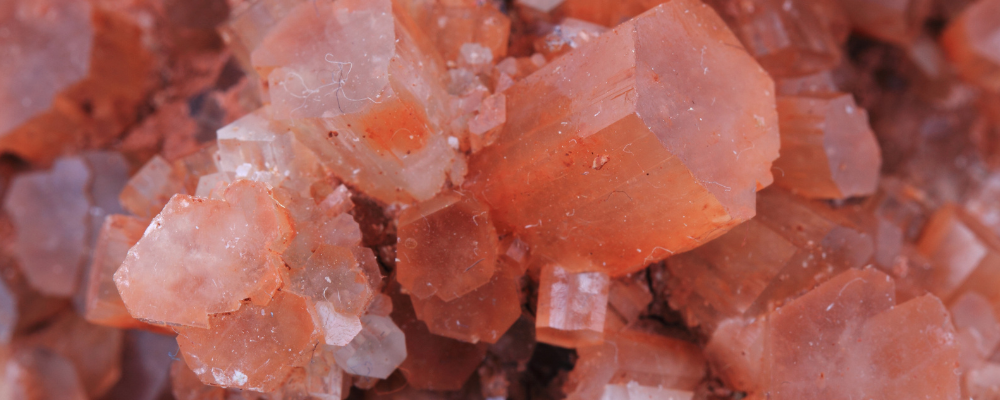
Aragonite builds mineral stars, columns, and part of many shells. It shares the same composition as Calcite but arranges its atoms differently. Its modern magic speaks of structure, home, patience, and the right form.
It unites Water, which enables its precipitation and nourishes marine organisms, with Earth, which preserves its crystals. The Moon governs the shell and the home; Saturn provides the framework, duration, and rule that prevent a structure from dispersing.
To place this stone among related minerals, compare it with Calcite, Honey Calcite, and Chocolate Calcite.
The carbonate that changes structure
Aragonite is a Calcium carbonate, with the formula CaCO₃, like Calcite. The difference comes from the crystal arrangement: Aragonite is orthorhombic. Mindat assigns it a hardness of 3.5 to 4 and a density close to 2.95.
Repeated twinning produces crystals that appear hexagonal, although their system is not. A crystallographic study published in 2024 examines this pseudo-hexagonal appearance and the organization of the twins. Aragonite also forms part of shells, nacre, and coral skeletons.
Molina de Aragón and the name of the mineral
Abraham Gottlob Werner named Aragonite at the end of the 18th century after crystals from Molina de Aragón, in the present-day Spanish province of Guadalajara. The Molina-Alto Tajo Geopark presents this type locality and links the crystals to the circulation of Calcium-rich waters.
The name caused confusion with the administrative region of Aragon. It does indeed come from the municipality of Molina de Aragón. The stone therefore entered mineralogical catalogs in the modern era, even though biological Aragonite had existed long before its scientific recognition.
Shell, home, and architecture
Ancient lapidaries did not distinguish Aragonite from Calcite under its current name. Its esoteric interpretation rests on its actual structure: the same compound can build several forms, and a living form can become stone.
This material is suited to the home, rebuilding, habits, and projects that require structure. The star-shaped aggregates add the image of several directions held together by a common center.
A structure is not a prison. The shell protects because it accommodates growth. Aragonite invites you to build a rule firm enough to support life and fair enough to evolve with it.
Moon, Saturn, Water, and Earth
The Moon governs the home, the shell, daily care, and cycles. Saturn carries the framework, boundaries, patience, and the long term. Water deposits the material; Earth fixes it and gives it permanence.
Monday suits the home and family cohesion. Saturday serves organization, work, boundaries, and the resumption of discipline. An empty shell, a house plan, a ruler, and a bowl of sand extend these associations.
Stability, order, and reconstruction
To restore a routine, place the Aragonite on a calendar and choose an action short enough to repeat. Saturn sets the rhythm; the Moon integrates it into domestic life.
For a home, write down what the space must protect, what it must let in, and what must remain outside. The stone marks the center of this agreement.
After a disruption to your routine, do not try to rebuild the entire structure in one day. Choose the supporting point: sleep, budget, meals, work, or upkeep of the space. Repairing one foundation makes the other actions possible.
The Home Hexagon
On a Monday or Saturday, draw a hexagon and place the Aragonite in the center. Write one function of the home on each side: rest, food, work, welcome, protection, and order.
Choose the side that needs immediate repair. Say: “I give form to what supports me.” Write a dated action under this phrase and complete it before moving the stone.
Correspondences and references
| Reference | Correspondence |
|---|---|
| Nature | Orthorhombic calcium carbonate |
| Name | Molina de Aragón, Spain, late 18th century |
| Modern planets | Moon and Saturn |
| Elements | Water and Earth |
| Days | Monday and Saturday |
| Areas | Home, structure, patience, stability, and reconstruction |
| Symbols | Shell, home, star, and framework |
| Ritual act | Repair the supporting point of a structure |