















































































































































































































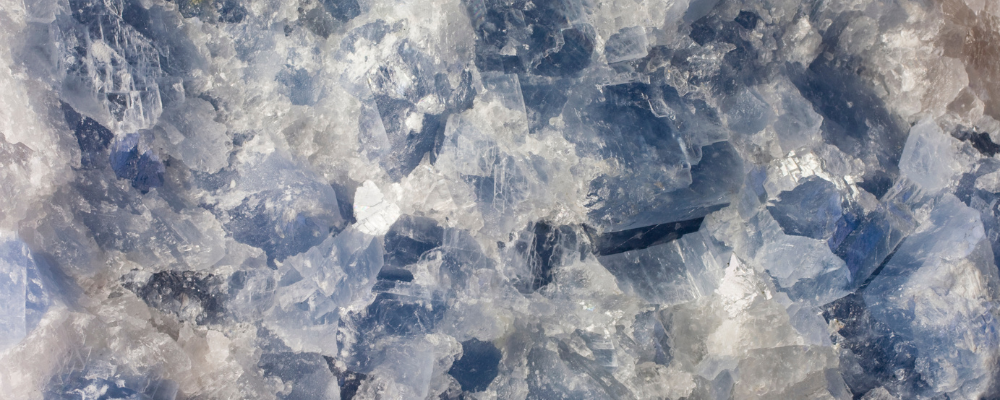
Calcite splits light and appears in a wide range of colors. This soft stone therefore does not carry a single magic: transparency opens vision, green calls forth prosperity, orange rekindles action, and pink soothes relationships. Its common thread remains clarification, as if a hidden form became visible from a second angle.
Twentieth-century systems organized its uses according to color, planets, and elements. Calcite thus becomes a stone of clarification, purification, and flow, to be chosen according to intention rather than under a general label.
To place this stone among related minerals, compare it with Honey Calcite, Chocolate Calcite, and Cobaltocalcite.
The carbonate that splits light
Calcite is a very widespread calcium carbonate. It forms part of limestones and marbles, forms crystals in cavities, and contributes to stalactites. Colorless when pure, it becomes white, yellow, orange, pink, green, blue, or brown depending on the elements and inclusions present.
Its hardness is 3 on the Mohs scale, and its cleavage produces rhombohedral fragments. The Handbook of Mineralogy describes its birefringence: through a clear crystal, a line or letter may appear doubled.
From Iceland spar to earthly colors
The transparent variety called Iceland spar played a major role in the study of light. In the 17th century, scholars sought to explain why it split a ray into two images. Calcite thus stands at the meeting point of matter and perception.
Its name comes from the Latin calx, lime. The Mindat entry presents its crystal forms and numerous localities. Behind its colors, the same structure remains: a mineral order capable of revealing two directions of light.
A modern magic organized by color
Calcite does not occupy a uniform talismanic place in ancient lapidaries. Its magical reception took shape in the 20th century through a language of colors. In 1988, Scott Cunningham distinguished transparent, pink, blue, green, and orange Calcite.
It connects the transparent variety with the Moon, Water, meditation, and intuition; the green with Venus, Earth, and prosperity; the orange with the Sun, Fire, energy, and protection; and the pink with Venus, Water, calm, and love. This mapping enables precise use without inventing an ancient tradition.
Seeing double can make you more lucid. Transparent Calcite does not blur the image: it reveals two paths of light. Its magical act consists in separating what seemed confused, then choosing the reading that leads to a right action.
Moon, Venus, Sun, and elements
Transparent Calcite corresponds to the Moon and Water; green Calcite to Venus and Earth; orange Calcite to the Sun and Fire. Blue Calcite corresponds to Venus and Water in Cunningham’s system. The color therefore determines the dominant planet.
Monday suits dreams and intuition, Friday agreement and prosperity, and Sunday action and confidence. A mirror, two parallel lines, and a transparent bowl extend its optical language.
Clarity, prosperity, and movement
To clarify a question, place a transparent Calcite over a written sentence and observe its doubling. Then formulate two possible readings: what you hope for and what the facts show. Decide based on their point of convergence.
For prosperity, place a green Calcite near the ledger, cash register, or plan for a project. Write the exchange you seek to make more fruitful: sale, collaboration, saving, or investment.
To set an action in motion again, pair an orange Calcite with a solar candle. Give it a short, visible task. The momentum of Fire thus remains linked to a concrete accomplishment.
The rite of the two readings
Write a question on a sheet of paper and draw two columns. In the first, write your initial reading; in the second, the opposite reading. Place the Calcite between them.
Light a candle matching its color and say: “The light separates so that my gaze may choose.” Circle the common element in both columns, then carry out the action it makes possible.
Correspondences and references
| Reference | Correspondence |
|---|---|
| Nature | Calcium carbonate |
| Hardness | 3 on the Mohs scale |
| Property | Strong birefringence in transparent crystals |
| Planets | Moon, Venus, or Sun depending on the color |
| Elements | Water, Earth, or Fire depending on the color |
| Days | Monday, Friday, or Sunday |
| Areas | Clarity, intuition, love, prosperity, energy, and protection |
| Ritual act | Comparing two readings before choosing |










