























































































































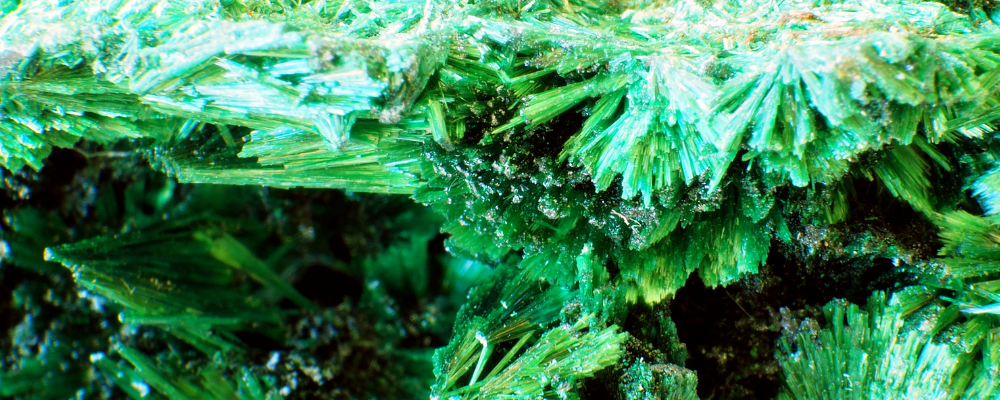
Brochantite is copper turned green through contact with water, air, and time. It appears in the oxidized zones of copper deposits, where an old material receives a new form. Its magical language unites the Venusian sphere of copper with a lesson in transformation: repairing an agreement requires recognizing the conditions that altered it.
Green supports soothing and the restoration of connection. Water carries exchange, Earth establishes boundaries, and Venus seeks the right proportion between the parties. Brochantite is suited to work involving reconciliation, cooperation, and restoration after a period of strain.
To place this stone among related minerals, compare it with Copper, Bronze, and Malachite.
Copper Turned Green
Brochantite is a basic copper sulfate. Its crystals range from light green to emerald green and may form needles, prisms, crusts, or aggregates. The Handbook of Mineralogy presents its forms, color, and formation environment.
Its color does not come from a pigment applied to the stone: it belongs to the mineral’s structure. This transformation of copper provides its first ritual image. What has been exposed does not return to its initial state; it can nevertheless acquire a new coherence.
The Slow Work of Oxidation
Brochantite forms in the oxidized part of copper deposits, particularly in arid climates and under slightly acidic conditions. It occurs alongside Malachite, Azurite, Cuprite, Chrysocolla, and other minerals resulting from the transformation of copper ores.
The stone therefore speaks of context. Water, oxygen, sulfate, and copper must meet in the right measure. Its symbolic use follows this logic: before seeking reconciliation, one must recognize the environment, the tensions present, and the part that each person can genuinely change.
Brochant de Villiers and the Mineral Name
Brochantite honors André-Jean-François-Marie Brochant de Villiers, a French geologist and mineralogist born in 1772. The name places the stone in the history of 19th-century science, at a time when the observation of deposits and the classification of mineral species were taking on a more rigorous form.
This patronage strengthens one aspect of its language: describing before interpreting. To work with Brochantite, we begin by naming the facts of a relationship or conflict. Harmony does not rest on erasing differences, but on an accurate reading of what connects and what separates.
Copper, Venus, Water and Earth
In the Western magic of the Renaissance, green materials, as well as copper and its alloys, belong to the domain of Venus. The chapter devoted to Venus in Agrippa's De occulta philosophia associates this planet with green colors, Air, Water, and the Venusian metals.
Brochantite does not appear in this text under its modern name. Its connection to Venus comes through its copper-bearing composition and color. Earth completes this correspondence through the deposit, boundary, and duration. Friday is suitable for work involving accord, peace, and the restoration of exchange.
Accord, Repair, and Fair Conditions
Brochantite supports a dialogue that must resume after a rupture. It also serves collective projects whose roles have become unclear. Placed between two sheets bearing the positions of those involved, it represents the point where a new accord can form without denying what happened.
In personal work, it helps examine the conditions of a relationship: what nourishes the bond, what harms it, and what needs a boundary. Its green does not herald a return to the past. It represents visible repair, built with the material available.
The Ritual of the Conditions for Accord
On a Friday, write the name of the bond to be restored in the center of a sheet of paper. Around it, draw three circles and write one condition in each: truth, boundary, reciprocity. Place the Brochantite in the middle and formulate an action that respects all three words.
Keep the sheet until the following Friday. Carry out the chosen action, then fold the paper toward the center. If any of the conditions is not met, do not force the accord: move the stone outside the circles and reformulate the boundary. The ritual places harmony under the sign of clarity.
Correspondences and reference points
| Domain | Correspondence | Reading |
|---|---|---|
| Planet | Venus | Copper, green color, accord, and proper proportion. |
| Elements | Water and Earth | Exchange, transformation, structure, and duration. |
| Day | Friday | Reconciliation, cooperation, and repairing the bond. |
| Colors | Emerald green and dark green | Renewal, appeasement, and renewed connection. |
| Figures | Circle, patina, network | Accord, memory of the exposure, and shared conditions. |
| Verbs | Name, harmonize, repair | The talismanic method of Brochantite. |
Brochantite gives the reconstructed accord a mineral form. It reminds us that peace requires clear conditions, genuine exchange, and a boundary capable of protecting what is being reborn.