Long before receiving the name Variscite, this green stone already circulated among the mines, workshops, and burial sites of Neolithic Europe. Shaped into beads, it connected the living, the dead, and distant communities. Its contemporary magic can therefore speak of memory, passage, and shared prosperity, without attributing to it a cult that the surviving remains do not describe.
Its color evokes new growth and hope; its presence in funerary contexts also invites Saturn, guardian of time and ancestors. Venus and Earth form its modern language: value placed on connection, continuity of a lineage, and growth that does not forget what it has received.
To place this stone among related minerals, compare it with Apatite, Turquoise, and Adamite.
A green phosphate veined with stone
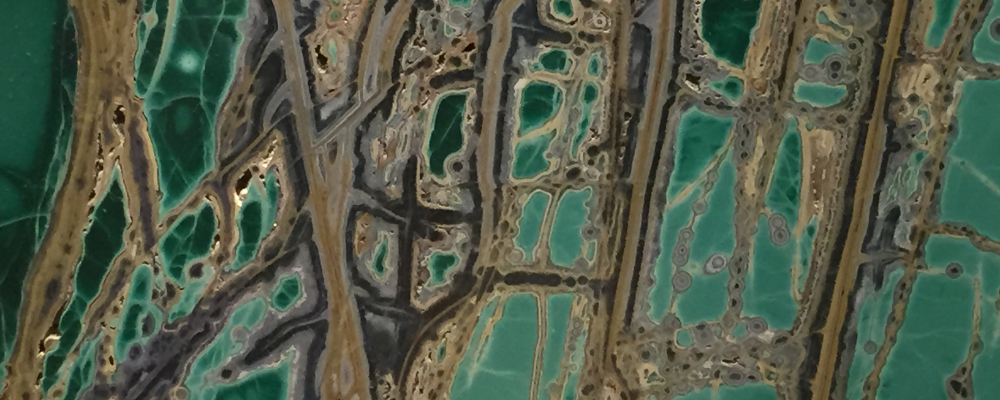
Variscite is a hydrated aluminum phosphate, with the formula AlPO4·2H2O. It forms near the surface when phosphate-rich waters react with aluminum-bearing rocks. Its palette ranges from yellowish green to blue-green.
The Handbook of Mineralogy reference sheet indicates a hardness of 3.5 to 4.5. Brown or black veins form a matrix in some stones that resembles Turquoise, but the mineral composition differs.
The green beads of the Neolithic
The prehistoric mines of Gavà, near Barcelona, yielded Variscite that had been extracted and then shaped into ornaments. The archaeometric study published in the Boletín de la Sociedad Geológica Mexicana shows the importance of these green materials in Neolithic exchange networks.
Beads discovered far from their place of extraction attest to the movement of the stone and the social value of its color. Their deposition in graves provides information about status, affiliation, or the care given to the deceased. On its own, however, it does not make it possible to reconstruct the words of a vanished ritual.
From Callaïna to modern interpretations
In The Magic and Science of Jewels and Stones, published in 1922, Isidore Kozminsky connects Variscite with the Callaïna described by ancient authors. He mentions ornaments found in prehistoric burials in Brittany and the Utah deposits known in his time.
This historical identification has been debated, because ancient names for green materials covered several minerals. The associations with peace, hope, and prosperity mainly belong to modern color-based systems. Memory and transmission, meanwhile, draw cautiously on the stone’s archaeological history.
Memory is not a closed dwelling. A pearl passes from hand to hand, crosses a distance, accompanies a dead person, and then reappears beneath the earth. Variscite teaches us to receive an inheritance without surrendering the entire future to it.
Venus, Saturn, and Earth
Venus corresponds to green, value, connections, and peace. Saturn watches over ancestors, graves, long stretches of time, and what must be passed on. Earth brings together the mine, the grave, the seed, and continuity.
Friday is suited to harmony, hope, and prosperity. Saturday serves family memory, mourning, and lasting commitments. Matte green, clay, a thread, a pearl, and a twig extend these correspondences.
Memory, transmission, and the future
To honor an ancestor, place the Variscite near their name and recount a concrete gesture you received from them. Avoid attributing a will or message to them. The ritual primarily carries your memory and gratitude.
To pass something on, write down what you want to preserve, what needs to be repaired, and what you refuse to bequeath. Saturn sorts the inheritance; Venus maintains the connection without demanding repetition.
For shared prosperity, tie a green thread around a shared commitment: paying fairly, returning a favor, supporting learning, or passing on knowledge. Here, wealth takes the form of a circulation that does not dry up its source.
The green thread between yesterday and tomorrow
On a Saturday, stretch a green thread between two sheets. On the first, write the name of an inheritance you received; on the second, how you want to transform it. Place the Variscite in the middle of the thread.
Say: “I receive without repeating; I transform without forgetting.” Tie one knot on the side of the past, then another on the side of the future. In the following days, carry out the act written on the second sheet.
Correspondences and references
| Reference | Correspondence |
|---|---|
| Nature | Green to blue-green hydrated aluminum phosphate |
| Material inheritance | Pearls, adornments, and funerary deposits from the Neolithic |
| Planets | Venus and Saturn in a modern interpretation |
| Element | Earth |
| Days | Friday and Saturday |
| Areas | Memory, transmission, peace, hope, and shared prosperity |
| Symbols | Pearl, green thread, twig, and burial |
| Ritual act | Connecting a received inheritance to its future transformation |