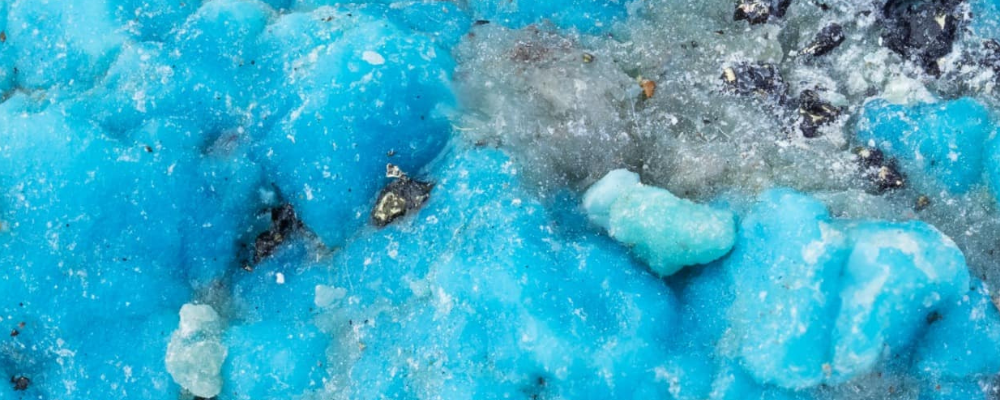
Callaïte is not the name of an isolated mineral species. In archaeological vocabulary, it refers to green or blue-green materials used for beads and ornaments, including Variscite and Turquoise. Its history leads toward exchanges in the European Neolithic.
Its symbolic power therefore comes not from a single chemical formula, but from the color’s journey, the bead’s craftsmanship, and the place of adornment among the living and the dead. Venus governs union; the Moon, memory; Earth and Water carry transitions and connections.
To place this stone among related minerals, compare it with Variscite, Turquoise, and Bergénite.
One name for several materials
The word “Callaïte” comes from a term transmitted by Pliny the Elder and later revived by archaeologists in the early 20th century. It encompasses green or blue-green adornment elements whose nature remained to be established.
This caution remains useful: two beads of the same color may consist of different minerals. The presentation of the C2RMF and University of Rennes project shows why analyzing objects is reshaping their history.
Variscite, Turquoise, and analyses
The old label includes, in particular, Variscite, a hydrated aluminum phosphate, and Turquoise, a hydrated phosphate containing copper and aluminum. Color alone is not enough to distinguish them.
The C2RMF explains the non-destructive study of Carnac ornaments. Researchers connect composition, sources, and circulation without reducing Callaïte to a simple formula.
Neolithic adornment
Callaïte ornaments mark the Neolithic period in Western Europe. The Carnac Museum of Prehistory presents the beads found in megalithic monuments and their current study.
Their presence far from certain sources reveals routes, encounters, and the social value attached to color. Funerary contexts also attest to transmission among the dead. They do not allow us to reconstruct, word for word, the rites that accompanied them.
A bead is matter, gesture, and relationship. It was extracted, shaped, pierced, worn, and then set down. Callaïte reminds us that an object's value also lies in the connections it crosses and the people who pass it on.
Venus, Moon, Earth, and Water
In a modern correspondence, Venus receives adornment, alliance, and the circulation of gifts. The Moon preserves lineage and the memory of passages. Earth represents extracted matter; Water, the routes and continuity of the thread.
Friday is suited to relationships, and Monday to family memory. A green thread, a simple bead, and a covered bowl of water serve as supports without claiming to reproduce a Neolithic ceremony.
Alliance, passage, and transmission
Callaïte accompanies a commitment, reconciliation, departure, or the transmission of an object charged with history. It invites you to name what is circulating: a word, a responsibility, a memory, or help.
It reminds us that receiving creates a duty of continuity. The bond is measured not only by what one possesses, but by how one keeps it and puts it back into circulation.
The thread of passages
Place three ordinary beads on a green thread without tying them. Give the first the name of what you received, the second the name of what you will make of it, and the third the name of the person or time to which you will transmit it. Then tie the thread.
Say: “I recognize the path of what has been entrusted to me. I carry it without stopping it.” Keep the thread near the Callaïte until the passage is complete.
Correspondences and reference points
| Reference point | Correspondence |
|---|---|
| Nature | Archaeological category of green or blue-green materials |
| Celestial bodies | Venus and Moon |
| Elements | Earth and Water |
| Days | Friday and Monday |
| Ritual colors | Green, blue-green, white |
| Domains | Alliance, passage, exchange, transmission |
| Associated objects | Green thread, simple bead, covered bowl |
| Gesture | Connecting what is received with what will be transmitted |