















































































































































































































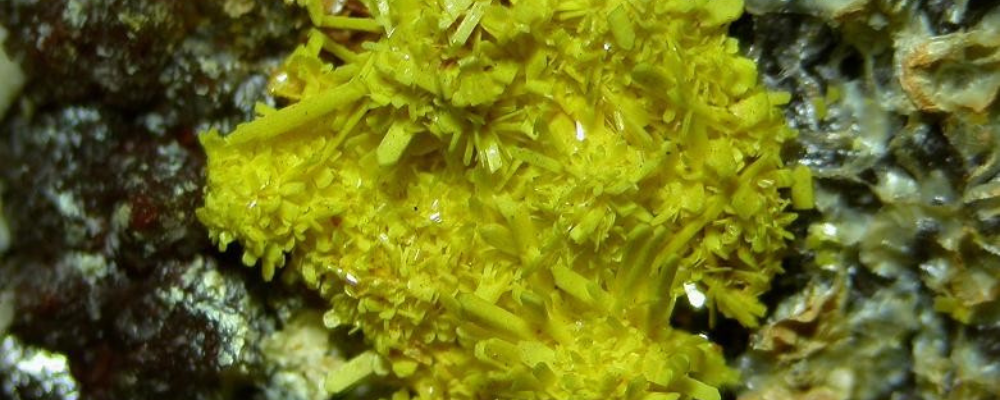
Bergenite displays a luminous yellow in a material that nevertheless calls for distance and restraint. It speaks less of possession than of safekeeping: receiving a charge, recognizing its significance, and organizing the proper conditions for its transfer.
Described in the 20th century, it has no ancient magical tradition under this name. A contemporary reading associates Jupiter with the entrusted charge, Saturn with the boundary, Fire with brilliance, and Earth with containment. Any practice proposed here is carried out using a photograph.
To place this stone among related minerals, compare it with Becquerelite, Betafite, and Ekanite.
A Yellow Uranium Phosphate
Bergenite is a hydrated uranyl phosphate containing calcium and barium. It occurs as yellow crystals, plates, or aggregates in the alteration zones of uranium deposits.
The Mindat entry notes its radioactivity and rarity. Its color attracts the eye, but its nature means it should be reserved for a collection managed with appropriate measures.
A Layered Architecture
The structure of Bergenite assembles uranyl and phosphate units into layers, connected by water, calcium, and barium. A study published in The Canadian Mineralogist clarified this architecture and its membership in the monoclinic system.
This organization suggests a clear image: what carries significant force is held not by isolated brilliance, but by connections, boundaries, and a framework for preservation.
Bergen and the Ore Mountains
Bergenite was described in 1959 and named after Bergen, in Saxony, near its type locality in the Ore Mountains. Its name therefore belongs to the modern history of European mineralogy.
No ancient or medieval text attributes ritual virtue to it. Its symbolism arises here from its history, its color, and the practical obligations associated with its preservation.
A luminous material can be entrusted without being made accessible. Safekeeping is not passive possession: it requires an inventory, a limit, a person responsible, and a rule for transfer.
Jupiter, Saturn, Fire, and Earth
Jupiter governs the charge, authority, and property placed under protection. Saturn establishes the boundaries, duration, and responsibility. Fire receives yellow and radiance; Earth represents the stable container.
Thursday is suitable for accepting a mission, and Saturday for establishing its limits. A yellow square surrounded by a black line, a register, and a key serve as supports, without the mineral being present.
Custody, inheritance, and responsibility
Bergenite accompanies situations in which something of value must be held on behalf of others: family archives, a trusted secret, a shared budget, a collection, or a position of responsibility. It invites you to clarify who keeps it, who may access it, and how the responsibility will be transferred.
It is also suitable for work involving inheritance. Receiving something does not mean exposing everything or keeping everything with oneself: some assets require an appropriate place, duration, and transfer of responsibility.
The custody register
Work with a photograph. On one page, write down what has been entrusted, its value, its risk, the name of the person responsible for it, and the transmission rule. Frame it with a black line, then draw a small key at the bottom of the page.
Say: “I acknowledge what has been entrusted to me, regulate its access, and prepare its proper transmission.” Then store the register in the designated place for responsibility documents.
Correspondences and markers
| Marker | Correspondence |
|---|---|
| Nature | Hydrated uranyl, calcium, and barium phosphate |
| Celestial bodies | Jupiter and Saturn |
| Elements | Fire and Earth |
| Days | Thursday and Saturday |
| Ritual colors | Yellow, black, brown |
| Areas | Custody, inheritance, access, transmission |
| Supports | Photograph, register, key |
| Action | Define the custodian and the transmission rule |










