
























































































































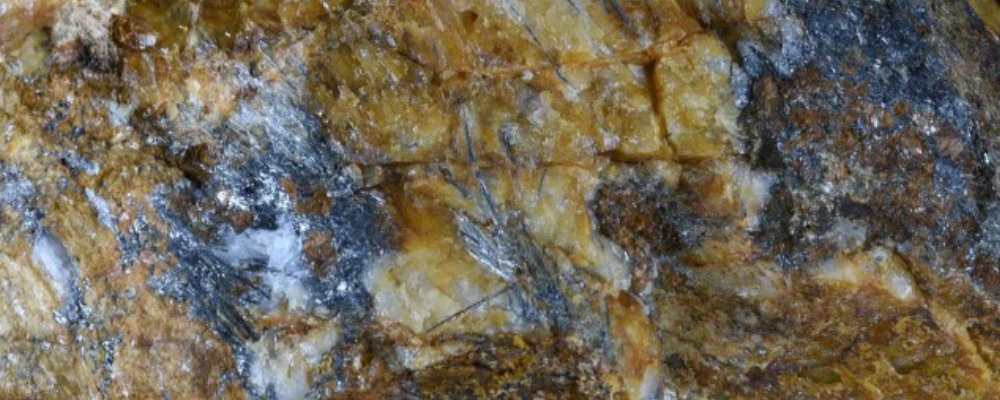
Boulangerite forms gray needles, metallic threads, and fibrous masses that seem to propagate a direction throughout the stone. Its beauty lies in this tight network; its lead and antimony composition requires that this image remain a contemplation, not an object for ritual contact.
Described in the 19th century, it has no ancient magical tradition under this name. A contemporary reading associates Saturn with lead and confinement, Mercury with antimony and connections, Earth with ore, and Air with the spreading of the fibers.
To place this stone among related minerals, compare it with Lead, Galena, and Cerussite.
A lead and antimony sulfosalt
Boulangerite is a sulfosalt with the formula Pb5Sb4S11. The Handbook of Mineralogy describes it as orthorhombic, with a lead-gray color, metallic luster, and low hardness.
It occurs in hydrothermal veins with Galena, Sphalerite, Pyrite, Stibnite, Quartz, or Carbonates. Its appearance may be massive, granular, or fibrous.
Needles and Feather Ore
The most remarkable aggregates unfold fine fibers that evoke hair or a feather. The historical term “plumosite” was applied to fibrous materials rich in sulfosalts; by itself, it does not guarantee an identification of Boulangerite.
The Mindat entry brings together its forms and localities. Here, the fibers transform a dense mass into a visible network, but they also make the specimen delicate to preserve.
Charles Boulanger and the Mines
Moritz Christian Julius Thaulow named the mineral in 1837 in honor of Charles Louis Boulanger, a French mining engineer. The stone belongs to the development of industrial mineralogy in the 19th century.
Its name therefore refers neither to bread nor to a ritual custom. It preserves the memory of a mining man and the work of classifying metallic ores.
An isolated thread seems light; a network carries, holds, or transmits. Boulangerite invites us to look at the connections before acting on a single point.
Saturn, Mercury, Earth, and Air
Saturn receives lead, weight, and confinement. Mercury governs antimony, lines, and circulation between points. Earth corresponds to the dense ore; Air, to the fibers that spread out.
Saturday is suitable for closing a harmful network, and Wednesday for examining a circulation. A photograph, gray thread, and three marked points on a sheet are sufficient.
Networks, propagation, and responsibility
Boulangerite accompanies the study of a rumor, an expense that spreads, a chain of dependence, or a task shared among several people. It asks you to identify the point of origin, the relays, and the place where the effect becomes visible.
It also helps to understand that shared responsibility does not become absent responsibility. Each thread must lead to a named role.
The map of active threads
Work with a photograph. Write the subject in the center of a sheet, then draw the threads connecting it to the people, habits, or places involved. Give each connection a verb: transmit, retain, nourish, divert, or protect.
Say: “I see the threads, I name their function, and I act at the right point.” Circle the connection where a real action can begin.
Correspondences and markers
| Marker | Correspondence |
|---|---|
| Nature | Lead and antimony sulfosalt |
| Celestial bodies | Saturn and Mercury |
| Elements | Earth and Air |
| Days | Saturday and Wednesday |
| Ritual colors | Lead gray, black, white |
| Domains | Networks, propagation, relays, responsibility |
| Supports | Photograph, gray thread, card |
| Action | Name the function of each connection |