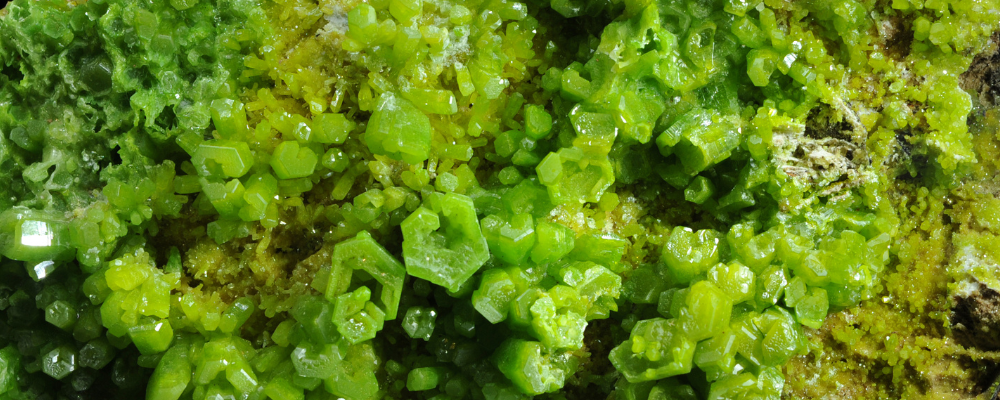
Green, yellow, or honey-colored, Pyromorphite bears a name forged in fire: when heated by early mineralogists, it melted and then regained a crystalline form. Yet its beauty arises in the alteration zones of lead. It becomes a stone of contained transformation, boundaries, and reconstruction after the ordeal.
Lead places it under Saturn; the name and historical experiment give it Fire; the re-formed crystals bring the theme of returning to structure. Its magic remains contemporary, but it rests on material characteristics and a precise etymology. The specimen is worked with its enclosure intact, without direct contact.
To place this stone among related minerals, compare it with Lead, Galena, and Cerussite.
The green crystal of former lead mines
Pyromorphite is a lead chlorophosphate, Pb5(PO4)3Cl. The Handbook of Mineralogy describes green, yellow, orange, or brown hexagonal prisms with a resinous luster and high density.
It forms in the oxidized zone of lead deposits, after the transformation of older minerals. The stone thus marks a second state of the ore: what was buried, extracted, and then altered finds a new appearance.
A second life in mining ground
The National Museum of Wales describes Pyromorphite as a secondary mineral in the oxidized zones of lead deposits. It documents crystals formed in several former Welsh mines.
This birth in disturbed ground gives it a language of renewal. It does not make the history innocent, but shows that matter exposed to new conditions can acquire an unexpected and remarkable form.
The fire that destroys and restores form
Johann Friedrich Ludwig Hausmann named it Pyromorphite in 1813, from the Greek pyr, “fire,” and morphê, “form.” The Mindat entry recalls the experiment: the molten mineral recrystallized as it cooled.
This account must never be reenacted with a specimen, because applying heat to a lead-bearing mineral is dangerous. In the rite, Fire remains an image: undergoing the ordeal, losing an old configuration, and recovering a viable structure.
Fire belongs to the symbol, never to the practice. The correspondence rests on the name and its mineralogical history. The specimen remains enclosed, away from candles, smoke, and any source of heat.
Saturn, Fire, and Earth
Lead is Saturn’s metal in Western planetary magic. The planet governs boundaries, ruins, time, and forms that endure after the ordeal. Fire describes metamorphosis; Earth receives the reformed crystal and the restored stability.
Saturday is suited to closing a cycle, protecting a place, and slow reconstruction. Black, mineral green, a closed box, and a foundation stone make up its altar.
Reconstruction, limitation, and return to form
Pyromorphite accompanies a period following a loss of structure: cessation of activity, breakup, interrupted construction, or a framework that has become uninhabitable. Place its box near a new plan and write down the first boundary that will make reconstruction possible.
For protection, it marks a place where one no longer wants to let former disorder enter. The function concerns a real rule: access, schedule, spending, or contact. Saturn protects better when the boundary has a concrete form.
It is also suited to long-term commitments. The stone reminds us that taking shape again does not mean returning exactly to the previous state.
The plan after the ordeal
On a Saturday, place the closed box of Pyromorphite beside a fresh sheet of paper, under a cool light. Write down what has lost its shape, then trace the outline of what should exist in its place.
Write a single reconstruction rule and the date of its implementation within this outline. Say: “What remains receives a habitable form.” Store the sheet under the box until the rule is implemented, without using a flame.
Correspondences and references
| Reference | Correspondence |
|---|---|
| Nature | Lead chlorophosphate from oxidized zones |
| Name | From the Greek words for “fire” and “form” |
| Suggested planet | Saturn through lead and limitation |
| Suggested elements | Symbolic Fire and Earth |
| Day | Saturday |
| Areas | Reconstruction, closure, endurance, protection, and commitment |
| Ritual image | The matter that takes shape again after the ordeal |
| Ritual gesture | Write a reconstruction rule in front of the closed box |